Introduction
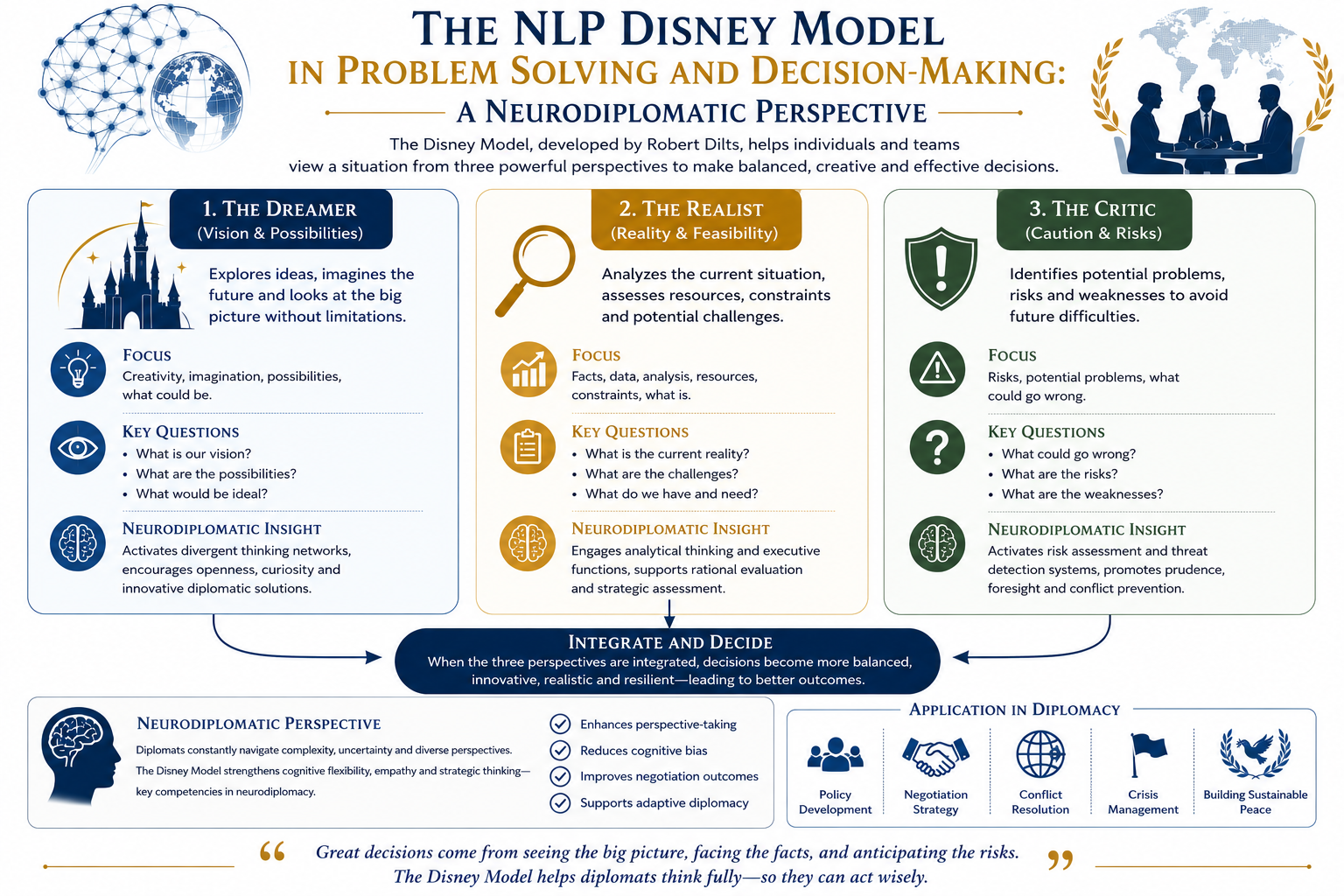
The Disney Strategy, often called the Disney Model, is one of the most practical thinking models developed within Neuro-Linguistic Programming (NLP). It was formulated by Robert Dilts based on the creative process of Walt Disney. The model proposes that effective problem solving and decision-making require three distinct thinking positions:
-
The Dreamer
-
The Realist
-
The Critic
Rather than mixing creativity, planning, and evaluation simultaneously, the Disney Model separates them into different cognitive processes. This allows decision-makers to generate innovative ideas, develop practical implementation plans, and identify potential risks without becoming trapped by premature criticism or unrealistic optimism.
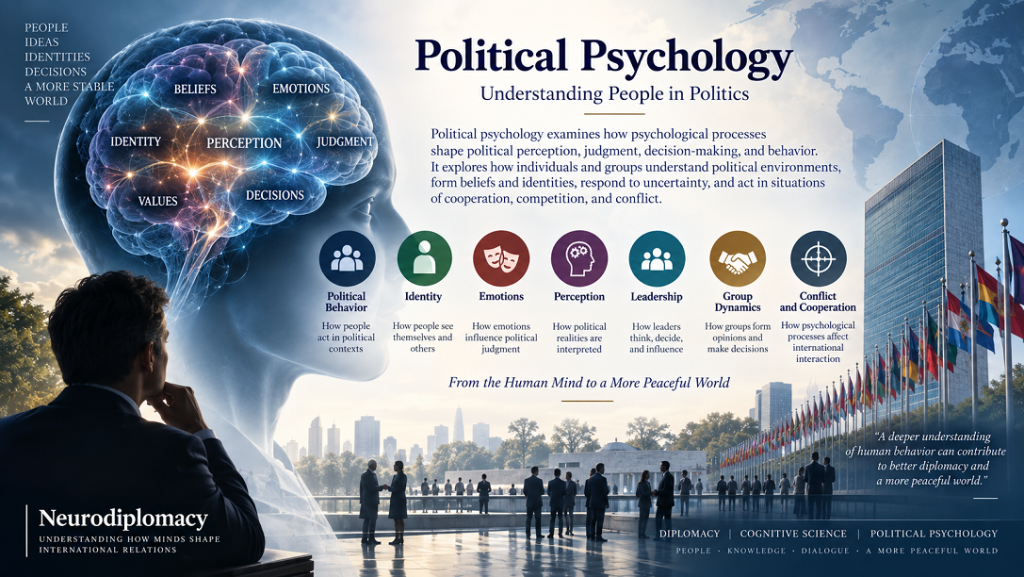
From a Neurodiplomatic perspective, the Disney Model offers a valuable framework for diplomatic problem solving, negotiation, conflict resolution, and foreign policy decision-making because it integrates imagination, strategy, and critical analysis into a structured decision-making process.
The Neurodiplomatic Foundation
Neurodiplomacy argues that foreign policy decisions are influenced by:
Perceptions.
Emotions.
Beliefs.
Values.
Cognitive processes.
Communication patterns.
Traditional decision-making models often emphasize rational analysis alone. The Disney Model recognizes that effective decisions require multiple modes of thinking.
In diplomatic practice, leaders frequently fail because they become trapped in only one position:
Excessive dreaming without planning.
Excessive realism without innovation.
Excessive criticism without solutions.
The Disney Model seeks to balance these tendencies.
The Dreamer Position
Creating Possibilities
The Dreamer generates ideas without limitations.
Questions include:
What do we want to achieve?
What would be the ideal outcome?
What opportunities exist?
What if anything were possible?
The Dreamer focuses on vision rather than constraints.
Diplomatic Example
Suppose two rival states have experienced decades of conflict.
The Dreamer asks:
What would lasting peace look like?
What kind of relationship could exist twenty years from now?
How could both societies benefit from cooperation?
At this stage, criticism is suspended.
Neurodiplomatic Value
The Dreamer expands cognitive flexibility and encourages innovative thinking.
The Realist Position
Transforming Vision into Action
The Realist asks:
How can this be achieved?
What resources are required?
What steps must be taken?
Who needs to be involved?
The Realist transforms dreams into practical strategies.
Diplomatic Example
Following the vision of regional peace, the Realist may propose:
Confidence-building measures.
Economic cooperation projects.
Cultural exchanges.
Security guarantees.
The focus shifts from possibility to implementation.
Neurodiplomatic Value
The Realist connects vision with practical diplomatic action.
The Critic Position
Identifying Risks and Weaknesses
The Critic evaluates the plan.
Questions include:
What could go wrong?
What obstacles exist?
What assumptions are questionable?
What risks have been overlooked?
The Critic does not destroy ideas but strengthens them.
Diplomatic Example
The Critic may identify:
Domestic political opposition.
Security concerns.
Historical mistrust.
Economic costs.
These concerns allow planners to improve the strategy.
Neurodiplomatic Value
The Critic reduces cognitive biases and prevents unrealistic expectations.
The Dynamic Interaction of the Three Positions
The power of the Disney Model lies in the interaction among all three positions.
Dreamer
Creates possibilities.
Realist
Creates strategies.
Critic
Improves the strategies.
This process continues until a robust solution emerges.
The model encourages movement among perspectives rather than attachment to a single viewpoint.
Application to Foreign Policy Decision-Making
Foreign policy decisions often involve uncertainty and complexity.
Example: Climate Diplomacy
Dreamer
What would a sustainable global climate agreement look like?
Realist
What specific commitments can states realistically make?
Critic
What political, economic, or technological barriers exist?
The resulting policy is often stronger than one produced through a single mode of thinking.
Application to International Negotiation
Negotiations frequently become stuck because participants focus only on immediate positions.
The Disney Model introduces broader thinking.
Dreamer
What would a mutually beneficial agreement look like?
Realist
How can the agreement be implemented?
Critic
What could cause the agreement to fail?
This process improves the quality of negotiated outcomes.
Application to Conflict Resolution
In conflict situations, parties often become trapped in criticism.
The Disney Model restores balance.
Dreamer
Imagine a future without conflict.
Realist
Identify concrete steps toward that future.
Critic
Address potential obstacles.
This sequence encourages constructive problem solving.
Disney Model and Perceptual Positions
The Disney Model complements NLP perceptual positions.
Disney Position Main Focus
Dreamer Possibilities
Realist Implementation
Critic Evaluation
Combined with perceptual positions, diplomats can evaluate solutions from multiple perspectives.
For example:
Their own perspective.
The opponent’s perspective.
The neutral observer’s perspective.
The international community’s perspective.
Disney Model and Robert Dilts’ Logical Levels
The Disney Model can be integrated with Robert Dilts’ Logical Levels, which often serve as a foundation for Neurodiplomatic analysis.
Dreamer focuses on: identity, vision and mission.
Realist focuses on: capabilities, behavior and resources.
Critic focuses on: environmental constraints, risks and challenges.
Together, they create a comprehensive decision-making framework.
Neurodiplomatic Advantages of the Disney Model
Encourages Creativity
Generates innovative diplomatic solutions.
Improves Strategic Planning
Connects vision with implementation.
Enhances Risk Assessment
Identifies weaknesses before action.
Reduces Cognitive Rigidity
Promotes flexibility and adaptability.
Supports Complex Decision-Making
Useful in environments characterized by uncertainty and ambiguity.
Example: A Neurodiplomatic Approach to a Regional Crisis
Imagine escalating tensions between neighboring states.
Dreamer
“What would a stable and cooperative region look like in ten years?”
Possible answers:
Open trade.
Security cooperation.
Cultural exchanges.
Realist
“How can we move toward that vision?”
Possible measures:
Diplomatic talks.
Joint commissions.
Economic incentives.
Critic
“What obstacles might prevent success?”
Potential challenges:
Nationalist opposition.
Security concerns.
Historical grievances.
The final strategy incorporates all three perspectives.
Limitations of the Disney Model
Despite its usefulness, the model has limitations.
It requires time and reflection.
Political leaders may favor one position excessively.
Crisis situations sometimes demand immediate action.
Cultural differences may influence how the positions are expressed.
Nevertheless, the model remains a valuable framework for structured thinking.
Conclusion
The Disney Model offers Neurodiplomacy a practical and flexible framework for problem solving and decision-making. By separating creative thinking, strategic planning, and critical evaluation into distinct cognitive positions, the model enables diplomats and policymakers to generate more innovative, realistic, and resilient solutions.
In an increasingly complex international environment, successful diplomacy requires more than rational analysis alone. It requires imagination to envision new possibilities, realism to implement them, and critical thinking to anticipate challenges. The Disney Model integrates these dimensions into a coherent process, making it a valuable tool for diplomatic negotiation, conflict resolution, foreign policy formulation, and Neurodiplomatic decision-making in the twenty-first century.