
Abstract
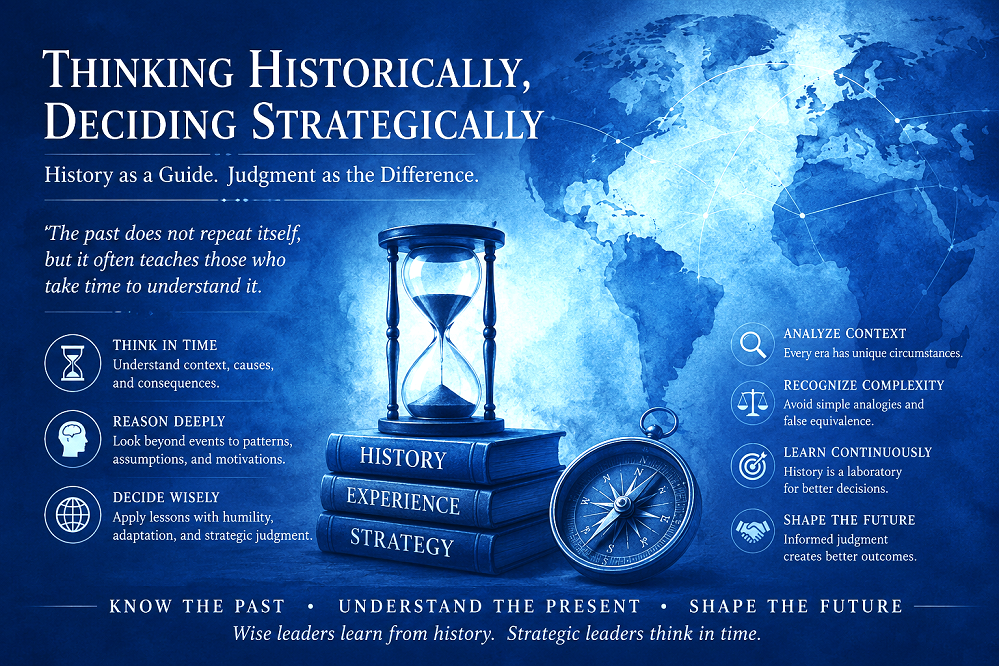
History has long served as one of the principal resources through which statesmen, diplomats, and political leaders interpret international events and formulate foreign policy. Yet history does not provide ready-made solutions to contemporary problems. Instead, it offers a framework for understanding patterns, identifying causal relationships, recognizing institutional continuity, and evaluating strategic alternatives. Richard E. Neustadt and Ernest R. May’s Thinking in Time: The Uses of History for Decision-Makers (1986) fundamentally transformed the study of public policy by arguing that historical reasoning should become an analytical discipline rather than a collection of simplistic lessons. Their work demonstrated that policymakers frequently misuse historical analogies by ignoring contextual differences and applying superficial comparisons to contemporary crises.
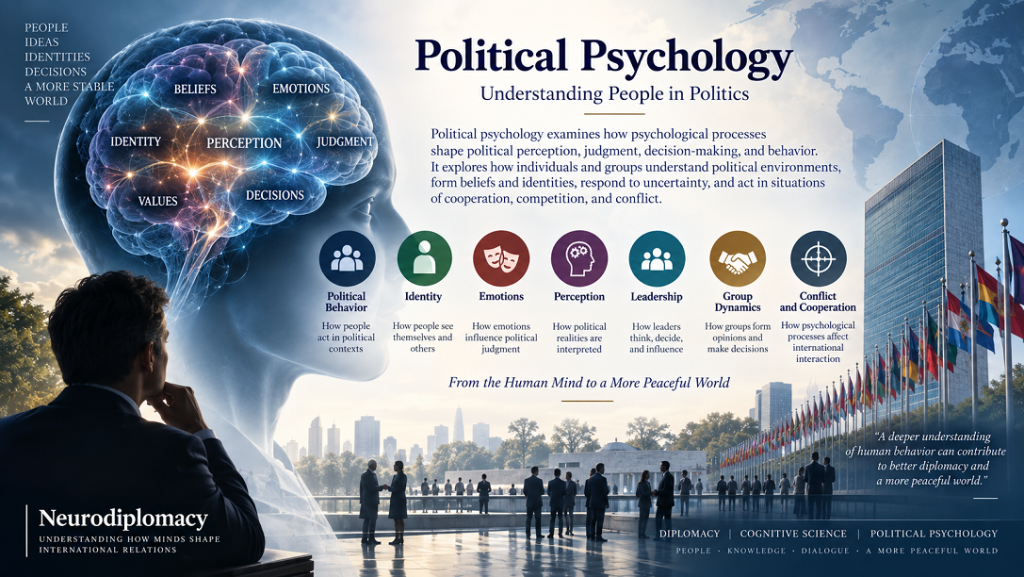
This article expands Neustadt and May’s insights by integrating them with contemporary developments in cognitive science, political psychology, and Neurodiplomacy. It argues that historical reasoning is fundamentally a neurocognitive process involving memory, perception, emotion, language, and institutional learning. Historical analogies influence how policymakers define problems, evaluate risks, communicate strategically, and select policy options. Consequently, effective diplomacy requires not merely historical knowledge but disciplined cognitive processes capable of distinguishing genuine strategic lessons from misleading analogies. Neurodiplomacy provides such a framework by combining historical analysis with cognitive science to improve institutional decision-making in international affairs.
Introduction
Foreign policy is inherently forward-looking, yet it is deeply influenced by interpretations of the past. Governments rarely confront international crises without reference to historical experience. Whether addressing military conflicts, diplomatic negotiations, economic sanctions, alliance politics, or emerging security challenges, policymakers instinctively compare contemporary situations with previous historical events.
History provides orientation in uncertain environments. It reduces complexity, facilitates communication, and offers expectations regarding possible outcomes. However, historical reasoning also presents significant dangers. Policymakers may rely upon inappropriate analogies, selective memories, or politically convenient narratives that distort strategic judgment.
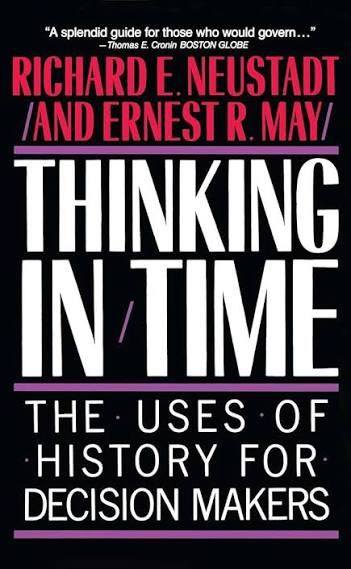
Richard Neustadt and Ernest May recognized this dilemma in Thinking in Time. Their central argument is that history should function neither as political rhetoric nor as a source of predetermined policy prescriptions. Instead, historical thinking constitutes a disciplined analytical method requiring contextual understanding, causal analysis, and intellectual humility.
The present article argues that Neurodiplomacy extends this perspective by explaining the neurocognitive mechanisms through which historical reasoning influences foreign policy decision-making.
Historical Thinking Beyond Historical Memory
Historical thinking differs fundamentally from historical memory.
Historical memory refers to accumulated knowledge of past events.
Historical thinking involves analytical reasoning about historical processes.
Neustadt and May emphasize that policymakers should ask not only what happened, but also:
- Why did it happen?
- Which conditions produced the outcome?
- Which assumptions guided decision-makers?
- What has changed?
- What remains similar?
This distinction transforms history from passive knowledge into active strategic analysis.
For diplomats, historical thinking encourages continuous questioning rather than unquestioned acceptance of historical precedents.
History as a Strategic Resource
States continuously rely upon history in foreign policy.
Historical experience influences:
- national identity;
- diplomatic traditions;
- alliance formation;
- strategic culture;
- perceptions of security;
- institutional learning.
The Marshall Plan continues to influence reconstruction policies.
The Cuban Missile Crisis shapes nuclear diplomacy.
The Cold War influences alliance strategy.
The Munich Agreement affects deterrence debates.
The Vietnam War shapes military intervention.
These examples demonstrate that history functions as a strategic resource rather than merely a chronological record.
The Cognitive Foundations of Historical Reasoning
Modern cognitive science provides deeper insight into why history plays such a central role in foreign policy.
Human cognition naturally seeks patterns.
When confronted with unfamiliar situations, policymakers search memory for comparable experiences.
This process reduces uncertainty while facilitating rapid judgment.
However, pattern recognition is not identical to objective analysis.
The brain often emphasizes similarities while overlooking important differences.
Consequently, historical reasoning is simultaneously indispensable and vulnerable to cognitive bias.
Historical Analogies in Foreign Policy
Historical analogies represent one of the principal mechanisms through which policymakers think historically.
Yuen Foong Khong demonstrated that American policymakers repeatedly interpreted the Vietnam War through analogies involving Munich, Korea, and Dien Bien Phu.
Similarly, contemporary diplomacy frequently invokes:
- another Cold War;
- another Munich;
- another Vietnam;
- another Cuban Missile Crisis.
These analogies simplify strategic complexity.
Yet every analogy possesses limitations because historical circumstances never repeat themselves exactly.
Neustadt and May therefore encourage disciplined comparison rather than automatic historical transfer.
Historical Thinking and Strategic Decision-Making
Strategic decision-making requires balancing continuity and change.
History offers continuity.
Contemporary politics introduces change.
Successful policymakers recognize both.
Neustadt and May propose several principles.
Historical inquiry should begin with questions rather than conclusions.
Context matters more than superficial similarity.
Institutional conditions deserve careful examination.
Multiple historical comparisons should be evaluated.
Assumptions require continuous reassessment.
These principles improve strategic judgment by encouraging analytical flexibility.
Neurodiplomacy and Historical Cognition
Neurodiplomacy expands historical reasoning by examining its cognitive foundations.
Historical analogies emerge through interactions among:
- memory;
- perception;
- emotion;
- language;
- attention;
- institutional learning.
Foreign ministries develop institutional memories.
Diplomatic academies transmit historical narratives.
Political leaders interpret international events through accumulated experiences.
These processes shape strategic expectations before formal analysis begins.
Consequently, history becomes part of institutional cognition.
Strategic Empathy and Historical Narratives
Different societies remember history differently.
Historical narratives influence diplomatic communication.
For one government, a particular event may represent national liberation.
For another, the same event may symbolize geopolitical loss.
Effective diplomacy therefore requires understanding how other states interpret history.
Neurodiplomacy describes this capability as strategic empathy.
Strategic empathy involves recognizing another actor’s cognitive framework without necessarily accepting its political conclusions.
Such understanding reduces misperception while improving negotiations.
Historical Thinking within the Neurodiplomatic Institutional Decision-Making Model
Within the Neurodiplomatic Institutional Decision-Making Model (NIDM), historical reasoning becomes a structured institutional process rather than an intuitive individual judgment.
Before historical analogies influence foreign policy, institutions should evaluate several questions.
Is the analogy factually appropriate?
Which contextual differences exist?
What emotional factors influence interpretation?
Which cognitive biases may distort judgment?
Are alternative historical comparisons available?
Does contemporary evidence support the analogy?
Such procedures transform historical reasoning into systematic institutional analysis.
Contemporary Challenges
The international environment confronting twenty-first-century diplomats differs significantly from that examined by Neustadt and May.
Today’s policymakers confront:
- artificial intelligence;
- cyber conflict;
- digital diplomacy;
- information overload;
- social media;
- hybrid warfare;
- rapidly changing geopolitical environments.
These developments increase both the importance and difficulty of historical reasoning.
Information abundance often encourages superficial historical comparisons.
Neurodiplomacy therefore emphasizes cognitive resilience, critical thinking, and institutional information filtering.
Implications for Diplomatic Practice
Historical thinking should become a core component of diplomatic education.
Foreign ministries should encourage:
- interdisciplinary historical analysis;
- cognitive bias awareness;
- strategic empathy;
- institutional learning;
- evidence-based decision-making;
- comparative historical assessment.
Such reforms improve both policy quality and diplomatic communication.
Conclusion
Richard Neustadt and Ernest May fundamentally changed the study of foreign policy by demonstrating that history should function as a disciplined analytical method rather than a repository of simplistic lessons. Their work remains highly relevant because international politics continues to be shaped by historical narratives, institutional memory, and strategic analogies.
Nevertheless, developments in cognitive science permit a broader understanding of why historical reasoning influences foreign policy. Neurodiplomacy extends Neustadt and May’s insights by explaining how memory, perception, emotion, language, and institutional cognition shape strategic judgment. Historical thinking thus becomes not merely an intellectual exercise but a neurocognitive process embedded within diplomatic institutions.
In an era characterized by unprecedented information complexity, geopolitical uncertainty, and rapid technological change, successful foreign policy depends increasingly upon disciplined historical reasoning integrated with cognitive awareness. Thinking historically and deciding strategically are therefore inseparable components of effective diplomacy. Neurodiplomacy offers a comprehensive interdisciplinary framework that unites these dimensions and contributes to a more sophisticated understanding of decision-making in twenty-first-century international relations.
References
- Allison, G. T., & Zelikow, P. D. (1999). Essence of decision: Explaining the Cuban Missile Crisis (2nd ed.). Longman.
- Aron, R. (1966). Peace and war: A theory of international relations. Doubleday.
- Janis, I. L. (1972). Victims of groupthink: A psychological study of foreign-policy decisions and fiascoes. Houghton Mifflin.
- Jervis, R. (1976). Perception and misperception in international politics. Princeton University Press.
- Khong, Y. F. (1992). Analogies at war: Korea, Munich, Dien Bien Phu, and the Vietnam decisions of 1965. Princeton University Press.
- May, E. R., & Neustadt, R. E. (1986). Thinking in time: The uses of history for decision-makers. Free Press.
- Tetlock, P. E. (2005). Expert political judgment: How good is it? How can we know? Princeton University Press.

2 Responses
Hi
Thank you