Introduction
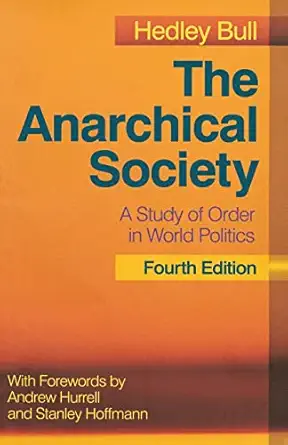
Hedley Bull’s The Anarchical Society: A Study of Order in World Politics is widely regarded as one of the most influential and enduring works in the discipline of International Relations (IR). First published in 1977, the book remains a cornerstone of the English School of International Relations and continues to shape scholarly debates concerning international order, state sovereignty, diplomacy, international law, and the institutions of global society. At a time when realist and idealist perspectives dominated the field, Bull offered a sophisticated middle ground by arguing that, despite the absence of a central world government, states form an international society governed by shared norms, rules, and institutions that promote order and stability.
Hedley Bull (1932–1985), an Australian political scientist and one of the leading figures of the English School, sought to answer a fundamental question: How is order possible in an international system characterized by anarchy? Contrary to the realist assumption that international politics is merely a struggle for power among self-interested states, Bull contended that states recognize common interests and common values that encourage cooperation, restraint, and the maintenance of international order. His work combines historical analysis, political philosophy, diplomatic history, and international legal theory to construct one of the most comprehensive examinations of world politics ever written.
The central thesis of The Anarchical Society is that anarchy should not be equated with disorder. Although no supreme authority governs relations among sovereign states, international politics is not chaotic. Instead, order emerges through institutions such as diplomacy, international law, the balance of power, war, and great-power management. These institutions constitute the foundation of what Bull calls international society, enabling states to coexist despite persistent competition, conflict, and differences in political values.
Summary of the Book
Bull begins by distinguishing three fundamental concepts: the international system, international society, and world society. An international system exists whenever states interact sufficiently to influence one another’s decisions. An international society develops when states not only interact but also recognize common rules, shared interests, and common institutions that regulate their behavior. World society, by contrast, extends beyond states to encompass humanity as a whole and emphasizes individuals, transnational actors, and universal moral values.
The book argues that the defining characteristic of international politics is anarchy, understood as the absence of a central governing authority rather than the absence of order. While domestic societies rely upon governments to enforce laws, international society depends upon voluntary compliance, diplomacy, mutual recognition, and shared expectations.
Bull identifies order as the preservation of the elementary goals of social life. In international society, these goals include maintaining the independence of states, preserving agreements, limiting violence, protecting sovereignty, and ensuring stable coexistence among political communities. Order, therefore, is not synonymous with justice or peace but represents the minimum conditions necessary for predictable international relations.
A major contribution of the book is Bull’s discussion of the institutions of international society. He identifies five principal institutions that sustain international order.
The balance of power prevents the domination of the international system by any single state and encourages equilibrium among competing powers. Although imperfect, it contributes to stability by discouraging excessive concentration of power.
International law establishes shared legal principles that regulate state behavior. While lacking centralized enforcement mechanisms, international law influences state conduct through legitimacy, reciprocity, and diplomatic expectations.
Diplomacy serves as the principal mechanism for communication, negotiation, conflict management, and peaceful adjustment among states. Bull views diplomacy as one of the oldest and most essential institutions supporting international order.
War, paradoxically, is also considered an institution because it performs political functions within international society. Although destructive, war has historically influenced balances of power, enforced international norms, and reshaped political orders.
Finally, great powers possess special responsibilities for maintaining international stability. Bull argues that major powers contribute disproportionately to managing conflicts, preserving equilibrium, and preventing systemic collapse.
Throughout the book, Bull examines the historical evolution of international society, emphasizing the development of the European state system before expanding his analysis to global politics following decolonization. He also explores tensions between order and justice, arguing that while these objectives often reinforce one another, they may also conflict when humanitarian concerns challenge principles of sovereignty and non-intervention.
Major Themes and Contributions
One of the book’s greatest contributions is its reconceptualization of anarchy. Prior to Bull, anarchy was frequently interpreted as synonymous with insecurity and perpetual conflict, particularly within realist scholarship. Bull challenges this interpretation by demonstrating that political order can emerge even without centralized authority. This insight has profoundly influenced subsequent scholarship in the English School and beyond.
A second major contribution is the development of the concept of international society. Bull argues that states are not isolated actors existing solely in competition but members of a society governed by shared rules, institutions, and expectations. This perspective offers an important alternative to both classical realism, which emphasizes power politics, and idealism, which often overestimates the prospects for global governance.
Bull’s treatment of diplomacy represents another enduring contribution. Rather than viewing diplomacy merely as a technical instrument of foreign policy, he conceptualizes it as a fundamental institution of international society. Diplomacy facilitates communication, reduces uncertainty, builds trust, manages crises, and enables peaceful coexistence among sovereign states. This broader understanding has significantly influenced diplomatic studies and foreign policy analysis.
The book also contributes to debates concerning sovereignty and international law. Bull demonstrates that international law functions effectively despite the absence of compulsory enforcement because states recognize the long-term benefits of rule-governed interaction. His analysis illustrates that legitimacy, reciprocity, and reputation often shape state behavior alongside material power.
Another important theme concerns the relationship between order and justice. Bull acknowledges that maintaining international order sometimes requires tolerating political arrangements that appear unjust. Conversely, efforts to promote justice through intervention or revolutionary change may undermine stability. This tension remains highly relevant in contemporary debates concerning humanitarian intervention, human rights, and the Responsibility to Protect (R2P).
Critical Evaluation
One of the principal strengths of The Anarchical Society is its intellectual balance. Bull avoids the extremes of both realism and idealism by recognizing that international politics involves both conflict and cooperation. States pursue national interests, yet they also recognize shared interests in maintaining an orderly international environment.
Another significant strength is the book’s interdisciplinary character. Bull draws upon history, political philosophy, international law, diplomatic practice, and strategic studies to construct a comprehensive theory of international order. This broad intellectual foundation explains why the book continues to influence scholars across multiple disciplines.
Bull’s writing is notable for its conceptual precision. Rather than relying on abstract theoretical models alone, he carefully defines key concepts such as order, society, institutions, sovereignty, and legitimacy. These definitions have become standard references within International Relations scholarship.
The historical depth of the analysis further strengthens the book. Rather than focusing exclusively on contemporary politics, Bull traces the evolution of international society over several centuries, demonstrating how diplomatic practices and legal norms gradually developed into enduring institutions.
Nevertheless, the book is not without limitations. One criticism concerns its strong emphasis on the state as the primary actor in world politics. Since the book’s publication, globalization has increased the importance of multinational corporations, international organizations, non-governmental organizations, terrorist networks, and digital platforms. Although Bull anticipated aspects of world society, his analysis remains largely state-centric.
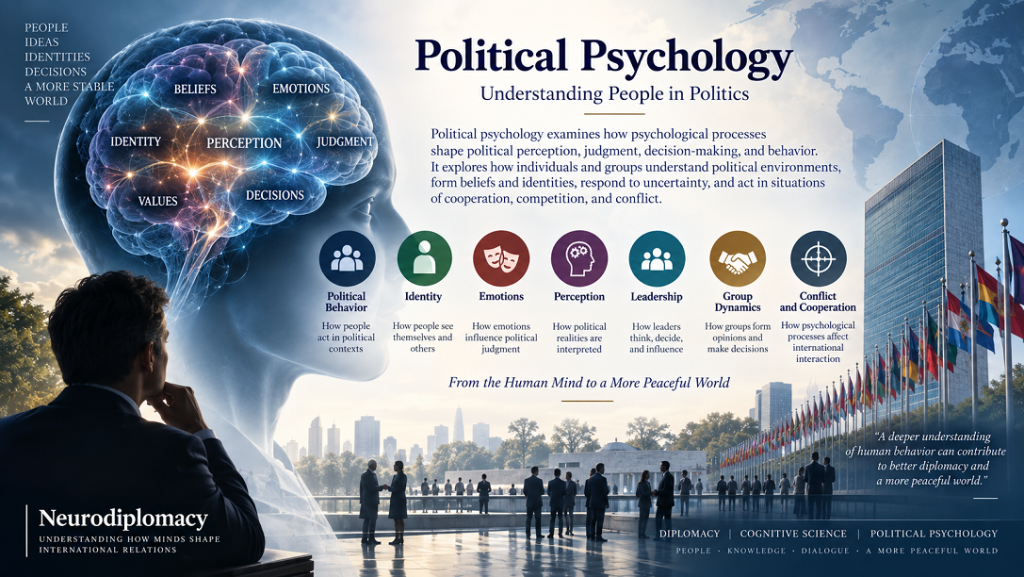
A second limitation involves limited engagement with domestic political processes and cognitive dimensions of decision-making. Bull explains how international institutions influence state behavior but pays relatively little attention to how leaders perceive threats, process information, and make foreign policy decisions. Contemporary research in political psychology and behavioral international relations suggests that cognitive biases, emotions, identity, and perception significantly influence international outcomes.
The book also predates many major transformations in world politics, including the end of the Cold War, globalization, cyber diplomacy, artificial intelligence, climate governance, and the rise of digital information networks. Consequently, some empirical illustrations reflect the geopolitical realities of the mid-twentieth century rather than today’s increasingly interconnected world.
Relevance to International Relations and Neurodiplomacy
The Anarchical Society remains exceptionally relevant for understanding contemporary international relations. Bull’s emphasis on diplomacy, norms, legitimacy, and institutional cooperation continues to inform research on global governance, regional organizations, conflict management, and international law.
For the emerging field of Neurodiplomacy, Bull’s work provides an important structural foundation while simultaneously highlighting areas requiring further development. Bull successfully explains the institutional environment within which diplomacy operates but devotes relatively little attention to the cognitive processes occurring inside decision-makers themselves.
Neurodiplomacy complements Bull’s framework by examining how diplomats, political leaders, and foreign policy institutions perceive threats, interpret information, construct trust, and make strategic decisions. While Bull focuses on the external architecture of international society, Neurodiplomacy investigates the internal cognitive mechanisms that shape behavior within that society.
For example, Bull identifies diplomacy as a key institution preserving international order. Neurodiplomacy extends this insight by examining how communication influences perception, emotion, framing, identity, cognitive biases, and negotiation outcomes. Diplomatic success depends not only upon institutional rules but also upon how the human brain processes uncertainty, credibility, reciprocity, and strategic interaction.
Similarly, Bull’s discussion of order can be enriched through contemporary behavioral research. International order ultimately depends upon decisions made by individuals operating under conditions of incomplete information and cognitive limitations. Psychological heuristics, confirmation bias, prospect theory, group dynamics, and identity all influence whether states cooperate, escalate conflicts, or maintain stability. Integrating Bull’s institutional perspective with cognitive science provides a more comprehensive understanding of international politics.
Moreover, Bull’s concept of international society aligns well with contemporary studies of social identity and collective cognition. Shared norms and common values become effective only when political leaders and societies internalize them psychologically. Neurodiplomacy therefore offers valuable insights into the cognitive foundations of legitimacy, trust, cooperation, and norm diffusion that Bull recognized but did not explore extensively.
Conclusion
Hedley Bull’s The Anarchical Society remains one of the most important and intellectually sophisticated works in the history of International Relations. Nearly five decades after its publication, its central argument—that order is possible despite international anarchy—continues to shape theoretical debates and policy discussions worldwide.
Bull’s concept of international society provides a compelling alternative to purely realist interpretations of world politics by demonstrating that shared norms, institutions, and diplomatic practices significantly influence state behavior. His analysis of diplomacy, international law, sovereignty, balance of power, and great-power management has become indispensable for understanding both the historical evolution and contemporary practice of international relations.
Although the book reflects the geopolitical realities of its time and gives limited attention to cognitive and behavioral dimensions of foreign policy, its theoretical framework remains remarkably resilient. Contemporary approaches such as Behavioral International Relations and Neurodiplomacy do not replace Bull’s insights but rather extend them by incorporating advances in psychology, neuroscience, and decision science.
Overall, The Anarchical Society deserves its status as a classic of International Relations scholarship. It is essential reading for students, researchers, diplomats, policymakers, and anyone seeking to understand how order emerges in an international system lacking central authority. Its enduring relevance demonstrates that understanding international politics requires not only the study of power but also the institutions, norms, and increasingly the cognitive processes that sustain cooperation among states.
References
Bull, H. (1977). The anarchical society: A study of order in world politics. Macmillan.