Neurodiplomacy
A New Concept in International Relations
Integrating Diplomacy, Cognitive Science, and Political Psychology in International Relations
The twenty-first century has witnessed unprecedented levels of global interconnectedness, political complexity, technological innovation, and strategic competition among nations. Traditional diplomacy remains the primary mechanism through which states manage international relations, negotiate agreements, resolve disputes, and pursue national interests. Yet contemporary diplomatic challenges increasingly involve factors that extend beyond conventional political and economic considerations.
International negotiations, peace processes, strategic decision-making, crisis management, and global governance are ultimately human activities shaped by cognition, perception, emotion, communication, and behavior.
Advances in cognitive science, neuroscience, psychology, political psychology, and decision science have provided important insights into how individuals and groups perceive information, form judgments, experience emotions, construct identities, evaluate risks, and make decisions. These developments create new possibilities for understanding the human dimensions of diplomacy and international relations and constitute an important foundation for Neurodiplomacy.
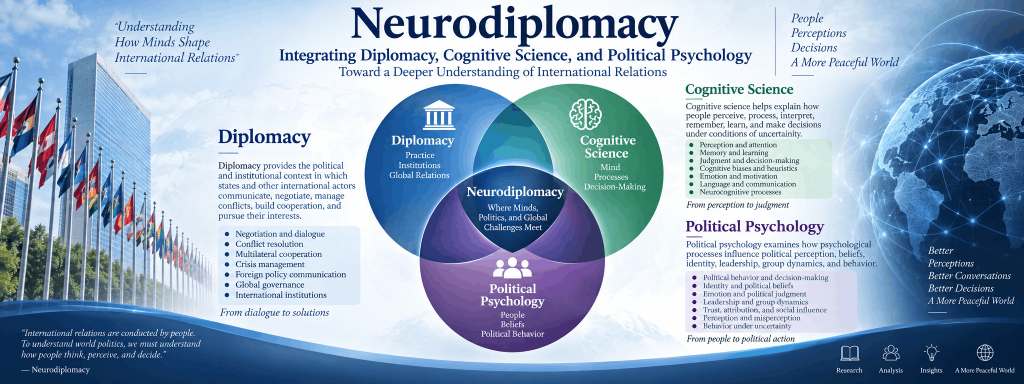
Neurodiplomacy is an interdisciplinary approach to the study of how cognitive and neurocognitive processes influence diplomacy, international negotiation, foreign policy decision-making, and international behavior. It brings International Relations and diplomatic studies into dialogue with cognitive science, neuroscience, and political psychology to examine how perception, cognition, emotion, language, communication, and decision-making shape diplomatic behavior and international outcomes.
Within this framework, diplomacy is not viewed solely as interaction among states and institutions, but also as interaction among the people who represent them. Political leaders, diplomats, negotiators, and policymakers do not make decisions as perfectly rational actors. They operate through cognitive processes influenced by perception, memory, emotion, experience, identity, culture, expectations, and cognitive biases. Understanding these processes can deepen our understanding of diplomatic behavior and contribute to more informed diplomatic practice.
The Emergence of Neurodiplomacy
Traditional theories of International Relations have emphasized such factors as power, national interests, institutions, norms, identities, and strategic interaction. These dimensions remain indispensable to understanding international politics. At the same time, research in Foreign Policy Analysis, political psychology, cognitive science, and related fields has demonstrated that human cognition plays an important role in how international conditions are perceived and translated into political decisions.
Diplomatic negotiations are conducted by individuals who interpret information through cognitive frameworks shaped by experience, culture, identity, expectations, and emotion. Foreign policy decisions are therefore influenced not only by external conditions but also by how those conditions are perceived, interpreted, and evaluated.
Neurodiplomacy emerged from the recognition that understanding diplomacy requires greater attention to the cognitive and neurocognitive foundations of human judgment and behavior. It seeks to build stronger connections between International Relations and the sciences concerned with cognition, decision-making, emotion, and political behavior.
Its central premise is that international actors do not respond to events independently of their interpretations of those events. Understanding international relations therefore requires attention both to the environment in which political actors operate and to the cognitive processes through which that environment becomes meaningful.
Cognitive Science as a Foundation of Neurodiplomacy
Cognitive science provides an important interdisciplinary foundation for Neurodiplomacy because it investigates how human beings acquire, process, interpret, store, and use information.
Understanding Diplomatic Decision-Making
One of the most important contributions of cognitive science to diplomacy concerns the processes involved in judgment and decision-making.
Diplomatic negotiations frequently occur under conditions of uncertainty, incomplete information, time pressure, competing objectives, and political risk. Cognitive science helps explain how negotiators and decision-makers:
- Assess risks and opportunities.
- Interpret complex information.
- Form judgments.
- Evaluate alternatives.
- Make strategic choices.
Understanding these processes can help diplomats and policymakers recognize both the capabilities and limitations of human decision-making.
Cognitive Biases in International Relations
Human judgment is frequently influenced by cognitive biases and heuristics. These processes can simplify complex decisions, but they can also contribute to systematic errors in judgment.
Biases and cognitive tendencies relevant to diplomacy include:
- Confirmation bias.
- Overconfidence.
- Availability bias.
- Anchoring effects.
- Attribution errors.
- Groupthink.
Such processes can affect diplomatic assessments, reinforce existing beliefs, contribute to misperceptions, and, under some circumstances, increase the risk of international misunderstanding or escalation.
Neurodiplomacy therefore examines how cognitive biases operate within diplomatic and foreign policy environments and how greater awareness of them may contribute to more reflective decision-making.
Perception and International Conflict
International actors can interpret the same event in very different ways. Historical experience, existing beliefs, political narratives, identities, expectations, and perceptions of other actors can all influence how an international development is understood.
Cognitive science helps explain:
- How perceptions are formed.
- Why misperceptions occur.
- How threat perceptions develop.
- How prior beliefs influence the interpretation of new information.
Understanding these processes can help identify cognitive sources of misunderstanding and illuminate why international actors sometimes reach different conclusions when confronting similar information or circumstances.
Emotions in Diplomacy
Traditional models of decision-making often distinguished sharply between reason and emotion. Contemporary research instead demonstrates that cognition and emotion are closely interconnected in judgment and decision-making.
Fear, anger, trust, empathy, pride, humiliation, and hope can influence diplomatic interaction and political behavior.
Neurodiplomacy therefore recognizes that diplomatic judgment cannot be understood adequately without considering both the cognitive and emotional dimensions of international decision-making.
The Role of Neuroscience in Neurodiplomacy
Neuroscience complements cognitive science by examining biological processes associated with cognition, emotion, learning, and behavior.
Trust and Cooperation
Trust is central to many forms of international cooperation. Diplomatic actors continually evaluate whether counterparts are credible, reliable, and likely to honor commitments.
Research in neuroscience and psychology contributes to understanding the cognitive and affective processes associated with trust, while diplomacy provides the political and institutional context in which judgments of trustworthiness acquire strategic significance.
Trust can influence:
- Diplomatic engagement.
- International cooperation.
- Negotiation.
- Conflict resolution.
Neurodiplomacy examines trust as a dynamic process shaped by perception, communication, experience, expectations, and continuing evaluation of another actor’s behavior.
Empathy and Perspective-Taking
Research in psychology and neuroscience has highlighted the importance of empathy and perspective-taking in social interaction.
Perspective-taking can help individuals:
- Understand how others perceive a situation.
- Anticipate possible reactions.
- Recognize different interests and concerns.
- Improve mutual understanding.
In diplomacy, perspective-taking does not require agreement with another actor. Rather, it can improve the ability to understand how a counterpart interprets a situation and why that actor may respond in a particular way.
Stress and Crisis Decision-Making
International crises frequently expose leaders and decision-makers to substantial psychological and cognitive pressure.
Stress can affect:
- Attention.
- Memory.
- Judgment.
- Risk assessment.
Understanding these effects is particularly important in crisis diplomacy, where decisions may need to be made rapidly and with incomplete information. Neurodiplomacy therefore examines how stress and cognitive pressure can influence judgment and how decision-making processes can be structured to reduce avoidable errors.
Political Psychology and Neurodiplomacy
Political psychology provides a crucial bridge between psychological processes and political behavior. It examines how cognition, emotion, beliefs, identity, motivation, personality, group processes, and social context influence political judgment and action.
Within Neurodiplomacy, political psychology helps connect the study of human cognition with the realities of diplomacy, foreign policy, leadership, negotiation, and international conflict.
Political Perception and Judgment
Political actors do not encounter international events as neutral observers. They interpret them through existing beliefs, expectations, identities, historical experiences, and assumptions about other actors.
Political psychology helps explain how leaders, diplomats, and policymakers:
- Interpret international events.
- Form beliefs about other actors.
- Assess intentions and credibility.
- Perceive threats and opportunities.
- Revise—or maintain—existing judgments.
These processes are particularly important in international relations because political decisions are often made under uncertainty. Decision-makers rarely possess complete information about another actor’s intentions and must therefore interpret signals and make judgments based on limited evidence.
Leadership and Foreign Policy Decision-Making
Political leaders occupy an important position between international conditions and foreign policy behavior.
Their decisions are shaped not only by strategic and institutional constraints but also by beliefs, experiences, perceptions, cognitive styles, emotional responses, and interpretations of political circumstances.
Political psychology contributes to Neurodiplomacy by examining how these individual-level processes interact with advisory systems, bureaucratic structures, institutional procedures, and the wider international environment.
This perspective does not reduce foreign policy to the psychology of individual leaders. Rather, it recognizes that individual judgment operates within institutional and political contexts and that both levels must be considered when explaining international decision-making.
Identity and International Relations
Identity influences how individuals and political communities understand themselves and others.
National, political, cultural, and social identities can shape perceptions of interests, allies, adversaries, threats, obligations, and acceptable political behavior. They can strengthen cooperation within groups while also contributing to distinctions between in-groups and out-groups.
Political psychology helps Neurodiplomacy examine how identity influences diplomatic perceptions and how narratives about self and other can affect international interaction.
Understanding these processes is particularly relevant in conflicts involving historical memory, nationalism, competing narratives, and deeply rooted perceptions of political identity.
Group Dynamics and Institutional Decision-Making
Foreign policy is rarely produced by individuals acting alone. Decisions emerge through advisory groups, bureaucracies, diplomatic institutions, intelligence organizations, cabinets, and other collective decision-making structures.
Group processes can influence:
- How information is shared.
- Which alternatives receive attention.
- How disagreement is expressed.
- How consensus develops.
- How risks are evaluated.
Political psychology therefore contributes to understanding how individual cognition interacts with group and institutional processes.
For Neurodiplomacy, this relationship is especially important because international behavior emerges not simply from individual minds but from individuals operating through organizations and institutions.
Neurodiplomacy and International Negotiation
Negotiation lies at the heart of diplomacy.
Neurodiplomacy contributes to the understanding of negotiation by integrating insights from cognitive science, neuroscience, political psychology, and diplomatic studies.
Improving Strategic Thinking
Understanding cognitive and political-psychological processes can help negotiators:
- Anticipate possible reactions.
- Evaluate alternatives.
- Manage uncertainty.
- Recognize cognitive biases.
- Understand different perceptions of the same issue.
These capabilities are particularly important when negotiators operate under conditions of incomplete information and must continually revise their assessments as negotiations develop.
Communication and Persuasion
Successful diplomacy frequently depends on persuasion rather than coercion.
Neurodiplomacy examines how language, framing, narratives, credibility, perception, and audience characteristics influence how diplomatic messages are interpreted.
This perspective can help negotiators:
- Frame proposals more clearly.
- Understand the perspectives of different audiences.
- Build and evaluate trust.
- Communicate intentions more effectively.
- Identify potential sources of misunderstanding.
Communication in Neurodiplomacy is therefore not simply the transmission of information. It is also a process through which political meaning is constructed, interpreted, and negotiated.
Managing Emotions
Negotiations can generate frustration, fear, anger, distrust, hope, and other emotional responses.
Because cognition and emotion interact in decision-making, effective diplomatic practice requires awareness of how emotional states can influence judgment, communication, and behavior.
Neurodiplomacy examines these interactions to better understand how diplomats and negotiators can maintain productive communication during difficult negotiations and periods of political tension.
Neurodiplomacy and Conflict Resolution
Conflict resolution represents an important area for the application of Neurodiplomacy.
International conflicts involve material interests and strategic disagreements, but they may also involve misperceptions, competing identities, historical memories, distrust, emotional responses, and conflicting interpretations of intentions.
By examining these cognitive and political-psychological dimensions, Neurodiplomacy can contribute to:
- Peace negotiations.
- Post-conflict reconciliation.
- Mediation.
- Intercultural dialogue.
- Confidence-building initiatives.
This perspective is particularly relevant when conflicts involve deeply established narratives, historical grievances, identity-based divisions, or persistent mutual distrust.
Neurodiplomacy and Global Governance
Global governance increasingly requires cooperation among actors with different political systems, cultures, interests, identities, and interpretations of international problems.
Neurodiplomacy contributes to understanding:
- Multilateral negotiations.
- International cooperation.
- Consensus-building.
- Strategic communication.
- Leadership and collective decision-making.
As global challenges become more complex, understanding how political actors perceive problems, evaluate information, communicate across differences, and make collective decisions becomes increasingly important.
The Future of Neurodiplomacy
The future of diplomacy will increasingly be shaped by developments in cognitive science, neuroscience, political psychology, artificial intelligence, behavioral science, and digital communication.
Future diplomats and policymakers may therefore benefit from knowledge extending beyond traditional diplomatic training in international law, history, economics, and foreign policy to include:
- Cognitive psychology.
- Political psychology.
- Decision science.
- Emotional intelligence.
- Behavioral analysis.
- Intercultural communication.
- Strategic communication.
Such knowledge can provide diplomats with a deeper understanding of the human processes involved in negotiation, crisis management, communication, and international decision-making.
As an interdisciplinary research program, Neurodiplomacy seeks to develop stronger connections among International Relations, diplomacy, cognitive science, neuroscience, and political psychology. Its development can contribute both to theoretical understanding of international behavior and to the practice of diplomacy.
Conclusion
Neurodiplomacy represents an interdisciplinary approach to understanding international relations through the interaction of diplomacy, cognitive science, neuroscience, and political psychology. It recognizes that diplomacy is fundamentally a human and institutional endeavor shaped by cognition, perception, emotion, communication, identity, judgment, and behavior.
Cognitive science contributes to understanding how information is perceived, processed, remembered, and evaluated. Neuroscience provides insight into biological processes associated with cognition and emotion. Political psychology connects these processes to political beliefs, identities, leadership, groups, and decision-making. Diplomacy provides the arena in which these processes acquire international significance.
Together, these perspectives provide the intellectual foundations for examining how international conditions become perceptions, how perceptions contribute to judgments, and how judgments are translated through institutions into diplomatic communication, foreign policy decisions, cooperation, and conflict.
In an era characterized by geopolitical uncertainty, technological transformation, information competition, and complex global challenges, Neurodiplomacy offers a human-centered perspective on international relations – one that recognizes that relations among states and institutions are ultimately interpreted, negotiated, and acted upon by people.
Neurodiplomacy at a glance