Introduction
Conflict is an enduring feature of international relations. Throughout history, states, nations, ethnic groups, and political actors have engaged in conflicts arising from competing interests, territorial disputes, ideological differences, security concerns, and historical grievances. Traditional approaches to conflict resolution have often focused on power, military capabilities, institutional arrangements, and strategic bargaining. While these factors remain important, contemporary research increasingly demonstrates that conflicts are also shaped by psychological, cognitive, and emotional processes.
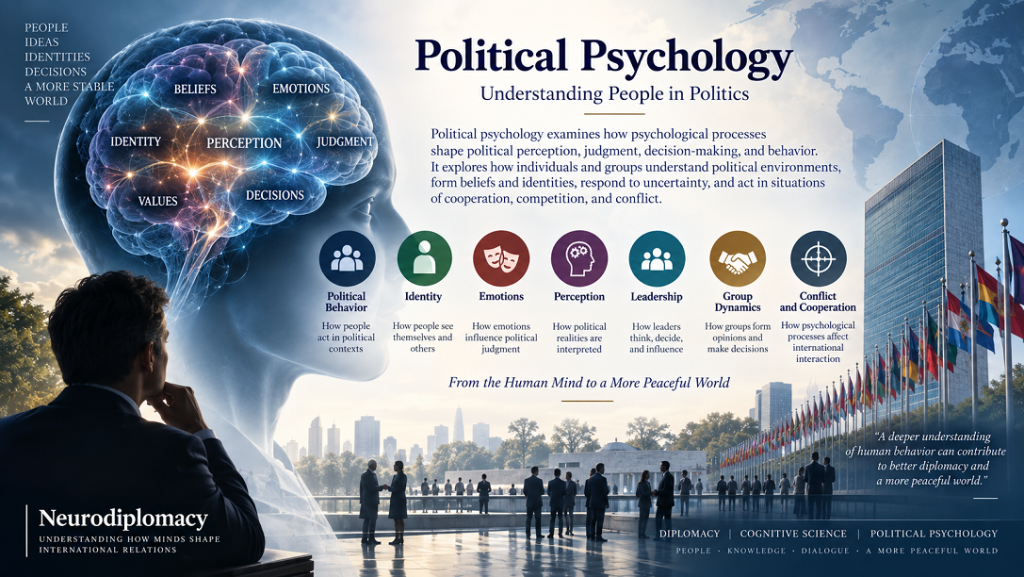
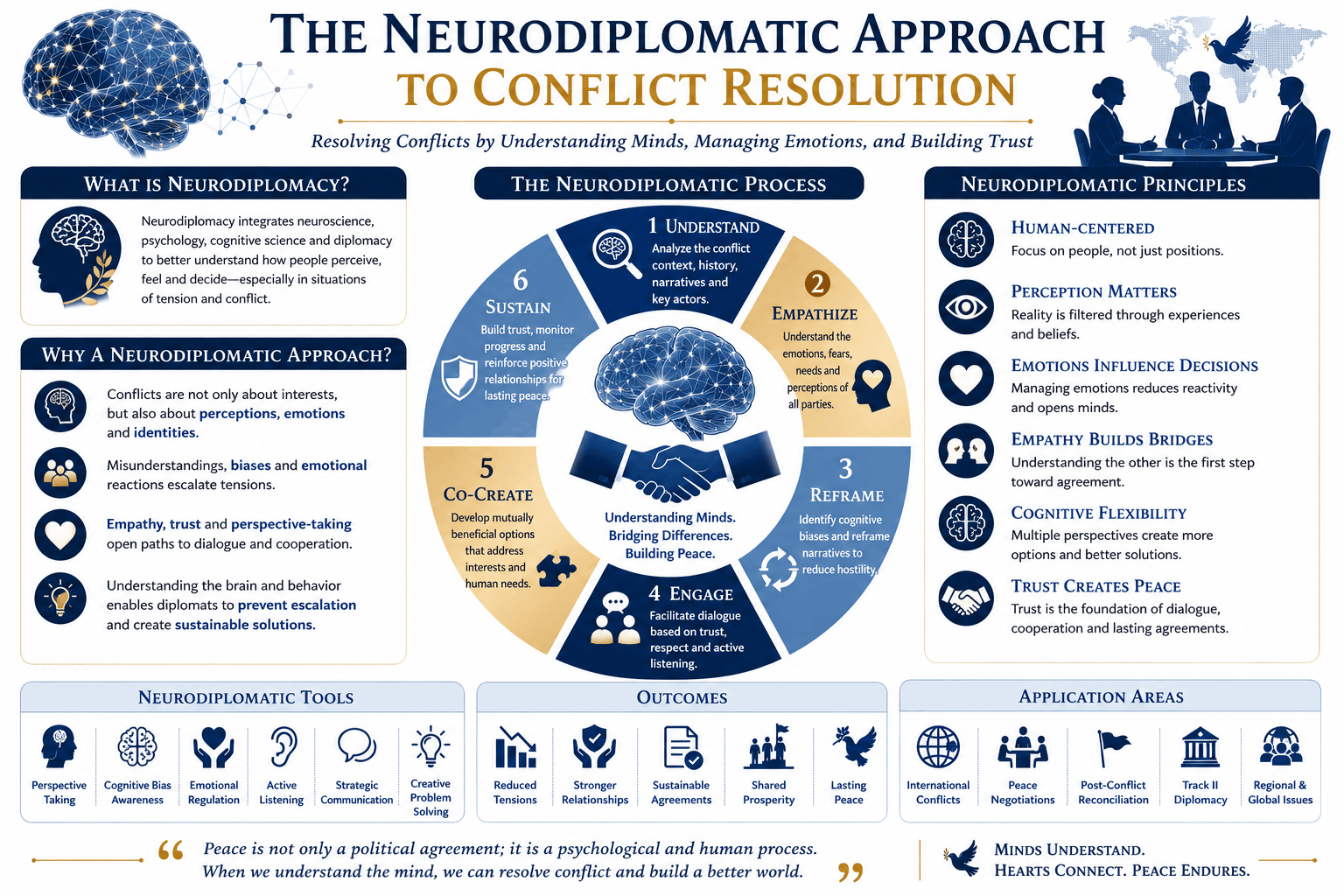
This recognition has contributed to the emergence of Neurodiplomacy, an interdisciplinary framework that integrates diplomacy, cognitive science, neuroscience, political psychology, and communication studies. Neurodiplomacy seeks to understand how human cognition, perception, emotion, and communication influence diplomatic interactions and international conflict.
From a neurodiplomatic perspective, many conflicts persist not merely because of objective disagreements but because of how parties perceive, interpret, and emotionally respond to those disagreements. Consequently, conflict resolution requires more than political settlements; it requires transforming perceptions, reducing misperceptions, building trust, and fostering mutual understanding.
Neurodiplomacy and the Nature of Conflict
Neurodiplomacy begins with a fundamental assumption:
Conflicts are not only clashes of interests; they are also clashes of perceptions.
Parties involved in conflict often possess different interpretations of:
Historical events
Political realities
Security threats
National identities
Diplomatic intentions
These differing perceptions shape behavior and influence decision-making.
As a result, conflict resolution must address both objective issues and subjective perceptions.
Perception as the Core of Conflict Resolution
Perception is the central concept of Neurodiplomacy.
Individuals and states do not react directly to objective reality. Instead, they react to their perceptions of reality.
For example:
A military deployment may be perceived as:
Defensive by one side.
Aggressive by the other.
A peace proposal may be perceived as:
A genuine effort at reconciliation.
A strategic attempt to gain advantage.
Because perceptions differ, misunderstandings frequently arise.
Neurodiplomacy contributes to conflict resolution by helping parties understand how perceptions influence behavior.
Reducing Misperceptions
One of Neurodiplomacy’s most important contributions is the identification and reduction of misperceptions.
Misperceptions occur when actors incorrectly interpret:
Intentions
Motivations
Capabilities
Diplomatic signals
Many conflicts escalate because parties assume hostile intentions where none exist.
Drawing upon the work of Robert Jervis, Neurodiplomacy emphasizes that decision-makers often act upon perceived realities rather than objective realities.
Conflict resolution therefore requires mechanisms that:
Clarify intentions.
Improve communication.
Correct false assumptions.
Reduce uncertainty.
Understanding Cognitive Biases
Human beings rely on cognitive shortcuts to process complex information.
While useful, these shortcuts can produce biases that contribute to conflict.
Examples include:
Confirmation Bias
The tendency to seek information that supports existing beliefs.
Attribution Bias
The tendency to attribute hostile motives to opponents.
Availability Bias
The tendency to overemphasize recent or emotionally powerful events.
Stereotyping
The tendency to simplify perceptions of other groups.
Neurodiplomacy helps negotiators and policymakers recognize these biases and avoid decisions based upon distorted perceptions.
The Importance of Emotional Intelligence
Emotions and Conflict
Conflicts are rarely driven by rational calculations alone. They are often fueled by emotions. The emotions influence:
Decision-making
Communication
Negotiation behavior
Risk perception
Neurodiplomacy highlights the importance of understanding emotional dynamics in conflict situations.
Emotional Regulation
Effective conflict resolution requires the ability to regulate emotions. Leaders and negotiators who can manage emotional reactions are better able to:
Remain open to dialogue.
Avoid escalation.
Explore compromise.
Maintain strategic clarity.
Neurodiplomacy therefore emphasizes emotional intelligence as a critical diplomatic skill.
Empathy and Perspective-Taking
One of the most valuable contributions of Neurodiplomacy to conflict resolution is the promotion of empathy.
Empathy does not mean agreement or approval.
Rather, it means understanding how others perceive the situation.
Empathy enables negotiators to ask:
How does the other side view the conflict?
What fears shape their behavior?
What historical experiences influence their perceptions?
Perspective-taking reduces misunderstandings and facilitates communication.
It creates opportunities for finding common ground even when disagreements remain.
Trust Building and Reconciliation
Trust is essential for sustainable conflict resolution.
Without trust:
Agreements remain fragile.
Cooperation becomes difficult.
Suspicion persists.
Neurodiplomacy examines trust as a psychological process.
Trust develops through:
Consistent communication.
Predictable behavior.
Transparency.
Positive interactions.
Conflict resolution efforts that incorporate trust-building measures are more likely to produce durable outcomes.
Communication as a Tool of Conflict Resolution
The principle:
“You cannot not communicate”
has significant implications for Neurodiplomacy.
Every action communicates something.
Examples include:
Official statements.
Diplomatic visits.
Military deployments.
Humanitarian initiatives.
Silence.
Parties continuously interpret these signals.
Neurodiplomacy helps negotiators understand how messages are perceived and how communication can reduce tensions rather than intensify them.
Cognitive Flexibility and Peacebuilding
Another important neurodiplomatic contribution is promoting cognitive flexibility.
Conflicts often become entrenched because parties adopt rigid narratives and fixed positions.
Cognitive flexibility enables actors to:
Reconsider assumptions.
Explore alternative interpretations.
Generate creative solutions.
Imagine different futures.
This flexibility is essential for transforming adversarial relationships into cooperative ones.
Transforming Narratives
Many conflicts are sustained by powerful narratives. Groups often develop narratives concerning:
Victimhood
Historical injustice
National identity
Security threats
While these narratives provide meaning, they may also reinforce hostility.
Neurodiplomacy seeks to understand how narratives influence cognition and behavior. Conflict resolution often requires the development of new narratives that emphasize:
Shared interests
Mutual recognition
Common humanity
Future cooperation
Neurodiplomacy and Mediation
Mediators play a crucial role in many peace processes. Neurodiplomacy can strengthen mediation by helping mediators:
Identify perceptual barriers.
Recognize emotional dynamics.
Facilitate empathy.
Build trust.
Improve communication.
By understanding the cognitive and emotional dimensions of conflict, mediators can create more effective dialogue processes.
From Conflict Management to Conflict Transformation
Traditional diplomacy often seeks to manage conflicts.
Neurodiplomacy aims to transform them. Conflict management focuses on:
Containing violence.
Preventing escalation.
Maintaining stability.
Conflict transformation goes further by addressing:
Perceptions
Emotions
Relationships
Identities
Narratives
This deeper approach increases the likelihood of achieving sustainable peace.
Applications in Contemporary International Conflicts
Neurodiplomatic approaches can contribute to:
Interstate Conflicts
Reducing security dilemmas and strategic misperceptions.
Ethnic and Religious Conflicts
Promoting empathy and mutual understanding.
Peace Negotiations
Improving communication and trust-building.
Post-Conflict Reconciliation
Transforming narratives and collective memories.
Humanitarian Diplomacy
Addressing emotional and psychological dimensions of suffering.
A Neurodiplomatic Framework for Conflict Resolution
Neurodiplomacy contributes to conflict resolution through five interconnected mechanisms:
-
Perception Management
Reducing misperceptions and improving understanding.
-
Emotional Intelligence
Managing fear, anger, and hostility.
-
Empathy and Perspective-Taking
Understanding how others perceive reality.
-
Trust Building
Creating psychological foundations for cooperation.
-
Cognitive Flexibility
Encouraging adaptive thinking and creative solutions.
Together, these mechanisms support more effective and sustainable conflict resolution.
Conclusion
Neurodiplomacy offers a valuable and innovative approach to conflict resolution by emphasizing the human dimensions of international conflict. It recognizes that wars, disputes, and diplomatic crises are shaped not only by material interests and political structures but also by perceptions, emotions, cognitive biases, identities, and communication processes.
By reducing misperceptions, enhancing emotional intelligence, fostering empathy, strengthening trust, and promoting cognitive flexibility, Neurodiplomacy provides powerful tools for resolving conflicts and building lasting peace. In an increasingly interconnected world, where misunderstandings and psychological barriers often fuel tensions, Neurodiplomacy offers a comprehensive framework for transforming conflict through a deeper understanding of the human mind.
Neurodiplomatic Principle of Conflict Resolution
Lasting peace emerges not only when interests are negotiated, but when perceptions are clarified, emotions are managed, trust is cultivated, and former adversaries develop a shared understanding of reality.