Abstract
The publication of Exponential Organizations: Why New Organizations Are Ten Times Better, Faster, and Cheaper Than Yours (and What to Do About It) by Salim Ismail, Michael S. Malone, and Yuri van Geest (2014) introduced a new framework for understanding organizational transformation in an era of accelerating technological change. Although originally developed to explain the success of technology-driven companies, the principles of Exponential Organizations (ExOs) have profound implications for government institutions, particularly Ministries of Foreign Affairs (MFAs). Traditional diplomatic institutions were largely designed for a hierarchical, state-centered, and relatively slow international environment. However, contemporary diplomacy increasingly operates within a world characterized by artificial intelligence, digital networks, global platforms, information acceleration, and complex transnational challenges. This article examines how the Exponential Organization model can transform foreign ministries by enhancing organizational agility, digital diplomacy, innovation capacity, strategic foresight, and adaptive decision-making. Through a Neurodiplomatic perspective, the article further argues that the transformation of MFAs requires not only technological modernization but also cognitive transformation among diplomats and policymakers. The future foreign ministry must become an adaptive, networked, intelligence-driven organization capable of responding to exponential change.
Keywords: Exponential Organizations, Foreign Ministries, Digital Diplomacy, Innovation, Artificial Intelligence, Neurodiplomacy, Organizational Transformation, Future Diplomacy.
Introduction
For centuries, Ministries of Foreign Affairs (MFAs) have been among the most important institutions responsible for representing states, managing diplomatic relations, negotiating agreements, and protecting national interests abroad. Their organizational structures developed during an era when international relations were relatively centralized, information moved slowly, and diplomatic communication depended primarily on official channels.
However, the twenty-first century has transformed the environment in which diplomacy operates.
Today, foreign ministries face challenges that are:
- faster,
- more complex,
- more interconnected,
- more technological,
- more unpredictable.
Artificial intelligence, social media, cyber diplomacy, climate change, biotechnology, misinformation, and global networks have changed both the substance and the speed of international affairs.
In this context, Salim Ismail, Michael S. Malone, and Yuri van Geest’s concept of Exponential Organizations provides an important framework for understanding how diplomatic institutions can adapt.
The central argument of this article is that Ministries of Foreign Affairs must evolve from traditional bureaucratic organizations into exponential diplomatic organizations—institutions capable of learning, adapting, innovating, and operating at the speed of global transformation.
Understanding the Concept of Exponential Organizations
In Exponential Organizations (2014), Ismail and his colleagues argue that technological acceleration has created a new organizational model.
Unlike traditional organizations that grow linearly, exponential organizations achieve extraordinary performance by leveraging:
- information technologies,
- networks,
- external resources,
- artificial intelligence,
- digital platforms,
- scalable systems.
The authors define an Exponential Organization as an institution whose impact is disproportionately larger than its size because it uses accelerating technologies and innovative organizational structures.
Their model is based on two major categories:
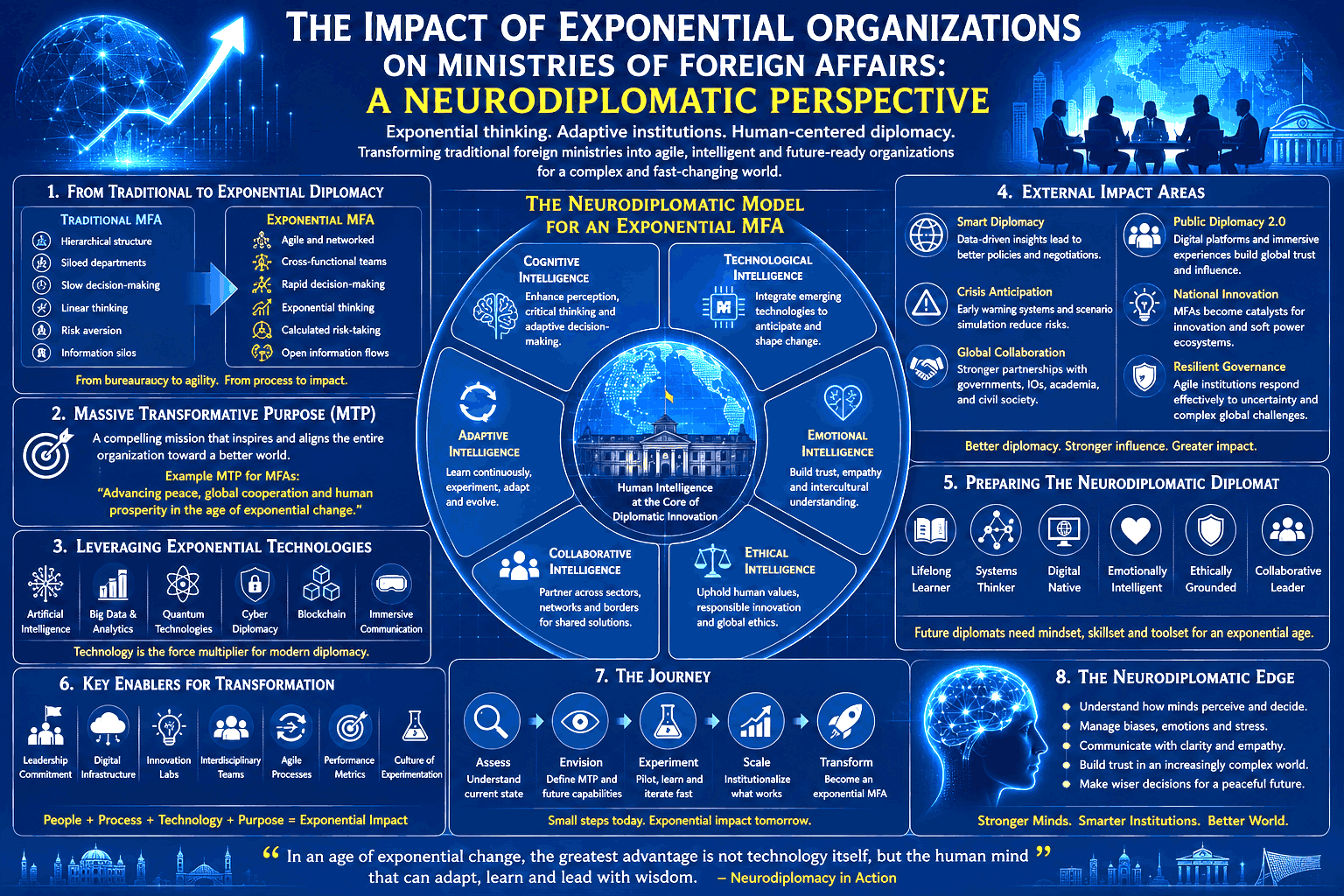
Massive Transformative Purpose (MTP)
An Exponential Organization begins with a powerful mission that inspires internal and external communities.
Examples include missions focused on:
- global sustainability,
- improving human welfare,
- technological innovation,
- solving international challenges.
For Ministries of Foreign Affairs, an MTP could redefine diplomacy as not merely protecting national interests but also contributing to global problem-solving.
The Traditional Foreign Ministry Model
Most foreign ministries historically follow a bureaucratic model characterized by:
- hierarchical decision-making,
- centralized authority,
- formal procedures,
- slow information flows,
- institutional continuity.
This model has advantages:
- stability,
- professionalism,
- diplomatic experience,
- institutional memory.
However, it also creates limitations in an environment of exponential change.
Traditional bureaucracies may struggle with:
- technological disruption,
- rapid crises,
- misinformation,
- emerging global issues,
- innovation.
The question therefore becomes:
How can foreign ministries preserve diplomatic expertise while becoming more adaptive organizations?
The Exponential Transformation of Foreign Ministries
Applying the Exponential Organization framework to MFAs suggests several areas of transformation.
1. From Hierarchical Diplomacy to Network Diplomacy
Traditional diplomacy operates through formal chains of command.
Exponential Organizations operate through networks.
Modern diplomacy increasingly requires cooperation among:
- governments,
- international organizations,
- technology companies,
- universities,
- civil society,
- global communities.
Future foreign ministries must become network coordinators rather than only state representatives.
Digital platforms allow diplomats to build broader diplomatic ecosystems.
2. Artificial Intelligence and Data-Driven Diplomacy
One of the strongest implications of Exponential Organizations is the strategic use of information technologies.
For foreign ministries, artificial intelligence can support:
- geopolitical analysis,
- diplomatic forecasting,
- translation,
- crisis monitoring,
- misinformation detection,
- policy simulation.
Instead of relying only on traditional reports, diplomats can use real-time data systems to understand global trends.
However, AI should enhance human diplomatic judgment rather than replace it.
3. Digital Diplomacy as an Exponential Capability
Digital diplomacy represents one of the clearest examples of exponential transformation.
Social media platforms allow foreign ministries to communicate instantly with global audiences.
Traditional diplomacy:
- government-to-government communication.
Digital diplomacy:
- government-to-government,
- government-to-public,
- public-to-public,
- network-to-network communication.
This transformation aligns strongly with the Exponential Organization principle of using scalable platforms.
4. The Role of External Networks
A key argument of Ismail’s model is that successful organizations do not attempt to control every resource internally.
Instead, they utilize external communities.
Foreign ministries can apply this principle through:
- diplomatic innovation labs,
- partnerships with universities,
- technology collaborations,
- think tanks,
- expert networks.
The future MFA may operate as a global knowledge platform.
5. From Information Management to Intelligence Management
Traditional diplomacy has emphasized collecting information.
Exponential diplomacy emphasizes transforming information into intelligence.
The challenge is no longer information scarcity.
The challenge is:
- information overload,
- misinformation,
- cognitive complexity.
Foreign ministries need systems capable of:
- filtering information,
- identifying patterns,
- forecasting developments,
- supporting strategic decisions.
6. Organizational Agility and Crisis Response
Modern crises develop rapidly.
Examples include:
- pandemics,
- cyberattacks,
- financial disruptions,
- climate emergencies.
Exponential Organizations succeed because they adapt quickly.
Foreign ministries must develop:
- flexible structures,
- rapid response teams,
- interdisciplinary units,
- scenario planning systems.
Agility becomes a diplomatic capability.
7. Innovation Culture Within Diplomacy
Exponential Organizations depend upon experimentation.
Traditional diplomatic institutions often prioritize caution and continuity.
While caution remains important, excessive institutional conservatism can reduce innovation.
Foreign ministries should encourage:
- experimentation,
- pilot projects,
- digital innovation,
- new diplomatic methods.
Diplomatic failure should become a source of institutional learning.
8. The Neurodiplomatic Dimension: Transforming Diplomatic Minds
Organizational transformation requires more than technology.
It requires cognitive transformation.
From a Neurodiplomatic perspective, diplomats must develop:
- cognitive flexibility,
- adaptive thinking,
- emotional intelligence,
- strategic perception,
- creativity.
The challenge of exponential change is not only technological.
It is psychological.
Diplomats must update their mental models to operate in uncertain environments.
Exponential Organizations and the Future Diplomat
The future diplomat will require different competencies.
Traditional diplomat:
- negotiation skills,
- language ability,
- political knowledge.
Future exponential diplomat:
- digital literacy,
- AI understanding,
- cognitive flexibility,
- systems thinking,
- strategic communication,
- technological awareness.
Diplomatic education must therefore evolve.
9. Massive Transformative Purpose and Global Diplomacy
The concept of MTP has important implications for foreign policy.
Many global challenges cannot be solved by individual states.
Examples include:
- climate change,
- pandemics,
- artificial intelligence governance,
- cybersecurity.
Foreign ministries increasingly need missions that connect national interests with global responsibilities.
10. Exponential Diplomacy and Soft Power
Joseph Nye’s concept of soft power emphasizes attraction and influence.
Exponential organizations strengthen soft power by enabling:
- faster communication,
- broader engagement,
- innovation leadership,
- global collaboration.
A technologically advanced and adaptive foreign ministry can enhance national reputation.
Challenges of Applying the Exponential Model to Foreign Ministries
Despite its advantages, applying the Exponential Organization model presents challenges.
Institutional Resistance
Large bureaucracies often resist rapid transformation.
Security Concerns
Greater openness and digital connectivity create cybersecurity risks.
Ethical Challenges
AI and digital technologies raise questions concerning:
- privacy,
- manipulation,
- surveillance,
- accountability.
Human Limitations
Technology cannot replace:
- empathy,
- ethical judgment,
- cultural understanding.
Therefore, transformation must remain human-centered.
Toward the Exponential Foreign Ministry
An exponential foreign ministry would include:
Digital Intelligence Units
Using AI and data analysis for strategic foresight.
Diplomatic Innovation Labs
Testing new approaches to international engagement.
Global Knowledge Networks
Connecting diplomats with external expertise.
Cognitive Training Programs
Developing adaptive diplomatic thinking.
AI-Assisted Decision Systems
Supporting but not replacing human judgment.
Neurodiplomacy and Exponential Transformation
The relationship between Exponential Organizations and Neurodiplomacy is particularly important.
Exponential Organizations focus on organizational adaptation.
Neurodiplomacy focuses on cognitive adaptation.
Together they suggest that the future foreign ministry requires transformation at two levels:
Organizational Level
- structures,
- technologies,
- networks,
- processes.
Cognitive Level
- perception,
- decision-making,
- emotional regulation,
- learning.
The future of diplomacy depends on both.
Conclusion
Salim Ismail, Michael S. Malone, and Yuri van Geest’s concept of Exponential Organizations provides a powerful framework for rethinking the future of Ministries of Foreign Affairs. Although originally developed for technology-driven companies, its principles offer valuable insights for diplomatic institutions operating in an era of accelerating global change.
Foreign ministries must move beyond traditional bureaucratic models and become adaptive, networked, digitally intelligent organizations. They must embrace artificial intelligence, strategic networks, innovation cultures, and real-time information systems while preserving essential diplomatic values such as trust, empathy, negotiation, and ethical responsibility.
From a Neurodiplomatic perspective, organizational transformation cannot occur without cognitive transformation. Diplomats must develop new ways of thinking capable of navigating uncertainty, complexity, and technological disruption.
The future foreign ministry will not simply be a larger or faster bureaucracy. It will become an exponential diplomatic organization—one that learns continuously, connects globally, thinks adaptively, and acts intelligently in a rapidly changing world.
Sources:
- Ismail, S., Malone, M. S., & van Geest, Y. (2014). Exponential organizations: Why new organizations are ten times better, faster, and cheaper than yours (and what to do about it). Diversion Books.
- Kurzweil, R. (2005). The singularity is near: When humans transcend biology. Viking.
- Schwab, K. (2016). The fourth industrial revolution. Crown Business.