Abstract
In Exponential Organizations (2014)*, Salim Ismail, Michael S. Malone, and Yuri van Geest argue that organizations capable of leveraging accelerating technologies, digital platforms, and decentralized innovation can achieve performance at least ten times greater than that of traditional institutions. While the book primarily addresses business organizations, its principles have profound implications for governments and, in particular, Ministries of Foreign Affairs (MFAs). Diplomatic institutions, traditionally characterized by hierarchical structures, lengthy decision-making processes, and bureaucratic cultures, increasingly operate in an international environment shaped by artificial intelligence, digital diplomacy, cyber threats, and real-time geopolitical crises. This article explores how the principles of exponential organizations can transform foreign ministries and argues that Neurodiplomacy provides the cognitive framework necessary for diplomats to adapt effectively to this new paradigm.
Introduction
Diplomacy has historically evolved slowly. Ministries of Foreign Affairs were designed for an era in which diplomatic correspondence traveled over weeks, negotiations unfolded over months, and policy changes occurred over years. Today’s geopolitical landscape is radically different. Information moves instantly, crises develop within hours, and technological innovation reshapes international relations at an exponential pace.
Salim Ismail’s central argument is that organizations must evolve from linear thinking to exponential thinking. This insight is particularly relevant for diplomacy. Future ministries cannot merely digitize existing bureaucratic processes; they must rethink how diplomacy is organized, how decisions are made, and how diplomats learn and collaborate.
From a Neurodiplomatic perspective, this transformation requires not only institutional reform but also a shift in the cognitive capacities of diplomats.
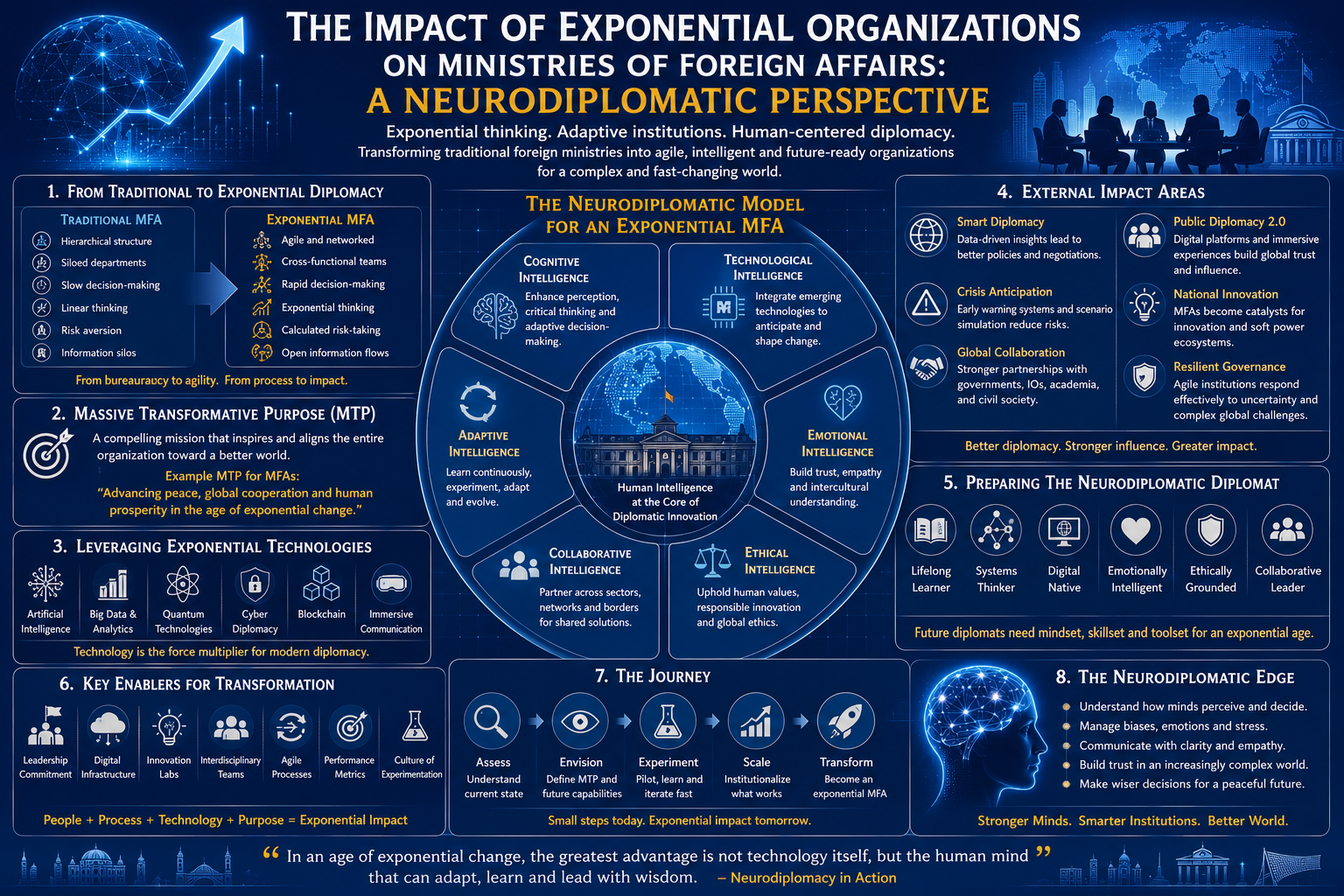
1. From Bureaucratic Diplomacy to Exponential Diplomacy
Traditional foreign ministries are typically characterized by:
- hierarchical decision-making
- centralized authority
- compartmentalized departments
- lengthy approval procedures
- information silos
These structures were effective in relatively stable international environments but are increasingly challenged by rapid technological and geopolitical change.
An exponential foreign ministry would instead emphasize:
- agility
- decentralized expertise
- rapid knowledge sharing
- digital collaboration
- continuous innovation
Neurodiplomacy complements this shift by preparing diplomats to think adaptively, embrace uncertainty, and make sound decisions under conditions of complexity.
2. Massive Transformative Purpose (MTP)
One of the book’s core concepts is the Massive Transformative Purpose (MTP)—a compelling mission that aligns organizational efforts toward a larger societal goal.
For Ministries of Foreign Affairs, the MTP could evolve from simply managing bilateral relations to:
Advancing peace, global cooperation, and human-centered governance in an era of technological transformation.
From a Neurodiplomatic perspective, a clear purpose enhances motivation, collective identity, resilience, and strategic coherence within diplomatic institutions.
3. Artificial Intelligence as a Diplomatic Partner
Exponential organizations leverage AI to improve decision-making and operational efficiency.
Future foreign ministries could use AI for:
- geopolitical forecasting
- crisis monitoring
- multilingual communication
- policy simulation
- treaty analysis
- public diplomacy analytics
However, Neurodiplomacy emphasizes that AI should support—not replace—human judgment. Diplomatic decisions involve ethical reasoning, empathy, cultural understanding, and trust, capacities that remain uniquely human.
4. Data-Driven Diplomacy
Exponential organizations rely on continuous data flows rather than periodic reporting.
Similarly, future ministries could integrate:
- satellite imagery
- social media analysis
- economic indicators
- cyber intelligence
- public sentiment analysis
- environmental monitoring
Neurodiplomacy highlights that more data does not automatically produce better decisions. Diplomats must develop the cognitive skills to filter information, recognize biases, and distinguish meaningful signals from noise.
5. Continuous Learning and Adaptive Diplomats
One of Ismail’s key arguments is that organizations must become learning systems.
For diplomats, this implies lifelong education in:
- artificial intelligence
- neuroscience
- behavioral science
- cyber diplomacy
- climate governance
- quantum technologies
- digital ethics
Neurodiplomacy reinforces this principle by identifying continuous learning as a core diplomatic competency. As technologies evolve, so too must the cognitive capabilities of those who govern them.
6. Networked Rather Than Hierarchical Diplomacy
Exponential organizations rely on networks rather than rigid hierarchies.
Future diplomacy will increasingly involve collaboration with:
- technology companies
- universities
- think tanks
- civil society organizations
- international organizations
- innovation hubs
Diplomats become facilitators of global networks rather than solely representatives of state bureaucracies.
7. Cognitive Flexibility as Institutional Capital
The book argues that exponential organizations embrace experimentation and rapid adaptation.
Neurodiplomacy extends this idea by identifying cognitive flexibility as one of the most valuable diplomatic assets.
Future diplomats should be capable of:
- questioning assumptions
- adapting strategies
- learning from failure
- integrating diverse perspectives
- navigating uncertainty
Institutional flexibility begins with flexible minds.
8. Innovation Culture in Foreign Ministries
Traditional bureaucracies often prioritize stability over innovation.
Exponential diplomacy requires:
- experimentation
- interdisciplinary teams
- rapid policy prototyping
- digital laboratories
- innovation incubators
Neurodiplomacy suggests that psychological safety, curiosity, and openness to new ideas are essential for fostering an innovative diplomatic culture.
9. Decision-Making in an Exponential World
Accelerating technological change shortens the time available for decision-making.
Diplomats increasingly confront crises involving:
- cyberattacks
- AI-enabled misinformation
- autonomous weapons
- pandemics
- financial disruptions
Neurodiplomacy proposes improving decision-making through:
- metacognition
- emotional regulation
- bias awareness
- scenario planning
- systems thinking
These capabilities enable diplomats to make high-quality decisions despite uncertainty and time pressure.
10. Human-Centered Digital Transformation
Perhaps the most important contribution of Neurodiplomacy is ensuring that technological modernization remains human-centered.
An exponential ministry should pursue technological innovation while safeguarding:
- trust
- empathy
- ethical responsibility
- intercultural dialogue
- legitimacy
- human dignity
Technology becomes a tool for diplomacy rather than its defining purpose.
A Neurodiplomatic Model for the Exponential Ministry of Foreign Affairs
The principles of Exponential Organizations can be integrated into a Neurodiplomatic framework comprising six mutually reinforcing pillars:
| Pillar | Contribution to Diplomacy |
|---|---|
| Exponential Thinking | Anticipating technological change and long-term geopolitical shifts. |
| Cognitive Intelligence | Improving perception, critical thinking, adaptive learning, and decision-making. |
| Technological Intelligence | Integrating AI, big data, quantum technologies, and digital diplomacy into foreign policy. |
| Collaborative Intelligence | Building networks with governments, academia, industry, and civil society. |
| Emotional Intelligence | Enhancing trust, negotiation, leadership, and intercultural communication. |
| Ethical Intelligence | Ensuring responsible governance, transparency, and human-centered technological development. |
Together, these pillars redefine the Ministry of Foreign Affairs as a learning organization capable of responding to exponential technological change while preserving the human foundations of diplomacy.
Conclusion
The ideas presented in Exponential Organizations challenge Ministries of Foreign Affairs to rethink their structures, processes, and cultures for an era of accelerating technological change. Digital tools, artificial intelligence, decentralized collaboration, and continuous innovation offer unprecedented opportunities to enhance diplomatic effectiveness.
Yet institutional transformation alone is insufficient. Diplomatic success ultimately depends on the cognitive abilities of diplomats to perceive emerging trends, adapt to uncertainty, regulate emotions, build trust, and make ethical decisions under pressure. Here, Neurodiplomacy provides a complementary framework by focusing on the human dimension of exponential change.
The Ministry of Foreign Affairs of the future will therefore be more than a digitally enabled bureaucracy. It will be an adaptive, networked, learning organization, where technological intelligence is balanced by cognitive, emotional, and ethical intelligence. In this vision, Neurodiplomacy serves as the bridge between exponential technological innovation and the enduring human purpose of diplomacy: fostering cooperation, peace, and responsible global governance.
*Ismail, S., Malone, M. S., & van Geest, Y. (2014). Exponential organizations: Why new organizations are ten times better, faster, and cheaper than yours (and what to do about it). Diversion Books.