Abstract
The growing complexity of international politics has challenged traditional theories of diplomacy and foreign policy by revealing the limitations of purely rational, structural, or institutional explanations of state behavior. Contemporary diplomacy requires decision-makers to process vast amounts of information, adapt to rapidly changing environments, negotiate under uncertainty, and respond to dynamic geopolitical conditions. This article argues that the TOTE (Test–Operate–Test–Exit) model, developed by George A. Miller, Eugene Galanter, and Karl H. Pribram (1960), provides an important cognitive foundation for the emerging field of Neurodiplomacy. Rather than viewing diplomacy as a linear sequence of decisions, Neurodiplomacy conceptualizes diplomatic behavior as a continuous process of perception, evaluation, action, feedback, and adaptation. Integrating the TOTE model with neuroscience, cognitive science, and International Relations offers a dynamic framework for understanding diplomatic negotiations, foreign policy decision-making, crisis management, and strategic communication in the twenty-first century.
Introduction
International Relations has traditionally explained diplomatic behavior through theories emphasizing power, institutions, national interests, or identities. Classical realism focuses on power and survival; liberalism highlights institutions and cooperation; constructivism emphasizes norms and identities. While these approaches provide valuable insights, they often devote limited attention to the cognitive mechanisms through which diplomatic decisions are actually made.
Every diplomatic decision begins with perception. Political leaders interpret information, compare current realities with desired objectives, evaluate alternatives, revise strategies, and continuously adapt to changing circumstances. These processes are fundamentally cognitive.
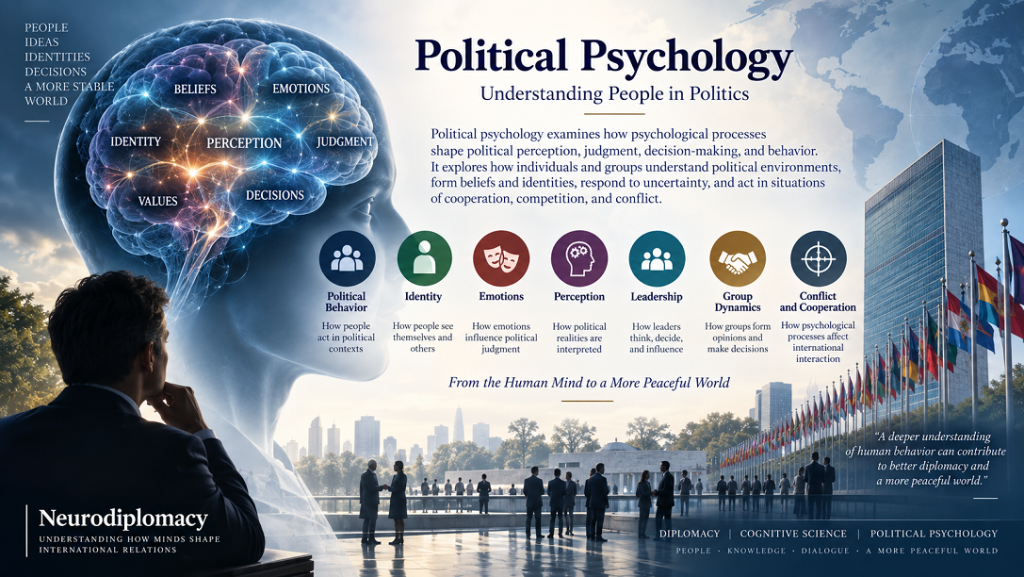
The TOTE model offers one of the earliest scientific explanations of adaptive human behavior. Combined with advances in neuroscience and cognitive science, it provides an ideal conceptual foundation for Neurodiplomacy, an interdisciplinary approach that examines how cognition, emotion, communication, and neural processes shape diplomacy and international relations.
The TOTE Model
In Plans and the Structure of Behavior (1960), George A. Miller, Eugene Galanter, and Karl H. Pribram proposed the TOTE model as an alternative to simple stimulus-response explanations of behavior.
The model consists of four stages:
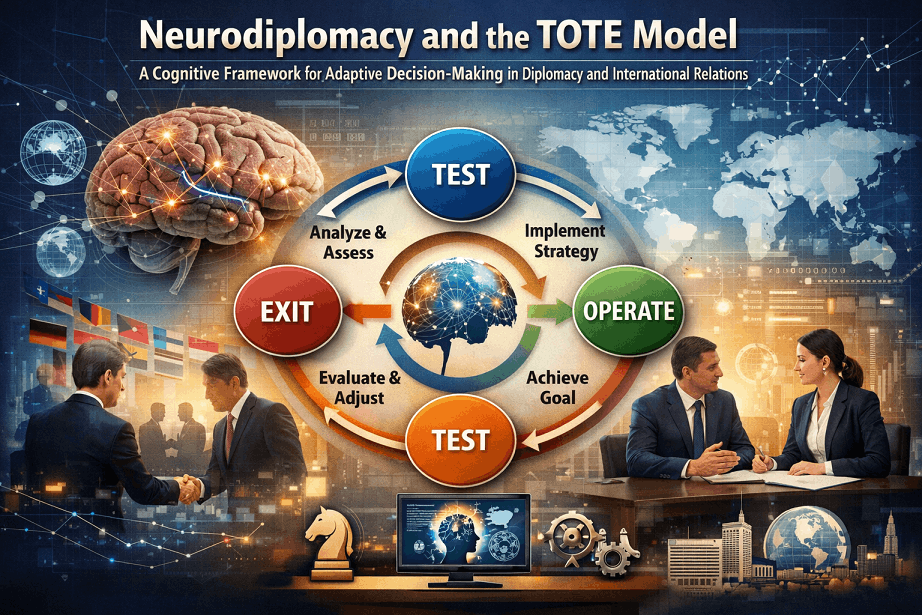
Test → Operate → Test → Exit
The first Test compares the current situation with a desired goal.
If differences exist, the system enters the Operate phase by performing actions designed to reduce the discrepancy.
Following each action, another Test evaluates whether the objective has been achieved.
If the goal remains unmet, additional operations are performed.
Once the desired condition is reached, the system Exits.
This feedback loop represents adaptive, goal-directed behavior rather than automatic reactions.
Diplomacy as a Cognitive Process
Diplomacy is inherently adaptive.
Negotiators rarely possess complete information.
Political environments constantly change.
New intelligence emerges.
Counterparts modify their positions.
Public opinion evolves.
Unexpected crises arise.
Consequently, diplomacy operates through continuous feedback rather than fixed plans.
Every diplomatic negotiation involves repeated cycles of observation, interpretation, communication, evaluation, and strategic adjustment.
The logic of the TOTE model closely resembles this process.
Neurodiplomacy and Adaptive Decision-Making
Neurodiplomacy expands the TOTE framework by incorporating findings from neuroscience regarding perception, attention, emotion, memory, executive function, and social cognition.
Diplomatic decision-making becomes a continuous interaction between external political realities and internal cognitive processes.
Rather than assuming perfectly rational actors, Neurodiplomacy recognizes that decisions are influenced by:
- perception,
- emotional regulation,
- cognitive biases,
- strategic learning,
- empathy,
- communication,
- prediction,
- memory.
These cognitive mechanisms continuously influence each stage of the TOTE cycle.
The Neurodiplomatic TOTE Cycle
Within Neurodiplomacy, the TOTE model can be reconceptualized as follows:
Test
- Assess the international environment.
- Interpret intelligence.
- Evaluate threats and opportunities.
- Compare reality with national objectives.
↓
Operate
- Conduct diplomatic negotiations.
- Communicate with allies.
- Adjust foreign policy.
- Build coalitions.
- Apply economic or political instruments.
↓
Test
- Measure diplomatic responses.
- Evaluate negotiations.
- Monitor public opinion.
- Assess strategic consequences.
↓
Exit
- Achieve agreement.
- Resolve conflict.
- Reach policy objectives.
- Begin monitoring for future changes.
Unlike traditional models, Neurodiplomacy recognizes that successful exits often initiate new cycles of diplomatic adaptation.
Cognitive Mechanisms within the TOTE Process
Each stage depends upon specific cognitive functions.
Perception
Diplomats interpret signals from the international environment.
Misperception may produce strategic errors.
Attention
Political leaders prioritize certain information while ignoring others.
Attention determines which threats become politically significant.
Memory
Historical experiences shape present diplomatic judgments.
National memory influences negotiations.
Emotion
Fear, trust, confidence, and empathy affect diplomatic communication.
Emotional regulation improves strategic judgment.
Executive Function
Planning, flexibility, inhibition, and problem-solving guide diplomatic adaptation.
These executive processes correspond directly to the Operate phase of the TOTE cycle.
Diplomatic Negotiation through the TOTE Model
Negotiation illustrates the practical value of the model.
Negotiators begin by comparing current conditions with desired agreements.
If disagreement exists, communication strategies are employed.
Responses from counterparts are continuously evaluated.
Negotiation tactics are revised.
Compromises are explored.
Feedback determines whether additional operations are required.
Agreement represents a temporary Exit.
However, international agreements require ongoing monitoring, often initiating new TOTE cycles.
Thus diplomacy becomes an adaptive learning system rather than a single decision.
Applications in Foreign Policy
The Neurodiplomatic TOTE framework can be applied to:
- foreign policy formulation,
- crisis management,
- conflict resolution,
- peace negotiations,
- alliance management,
- mediation,
- public diplomacy,
- strategic communication,
- sanctions policy,
- international organizations.
Each application involves continuous cycles of evaluation, action, feedback, and adjustment.
Advantages over Linear Decision Models
Traditional decision models often assume:
Problem → Decision → Outcome.
The TOTE framework proposes:
Problem → Evaluation → Action → Feedback → Adaptation → Learning.
This approach better reflects contemporary diplomacy, where uncertainty, complexity, and rapidly changing environments require continuous strategic adjustment.
Implications for Neurodiplomacy
Integrating the TOTE model into Neurodiplomacy offers several theoretical advantages.
First, it provides a scientifically grounded explanation of adaptive diplomatic behavior.
Second, it connects neuroscience with International Relations through observable cognitive processes.
Third, it explains why successful diplomacy depends upon flexibility rather than rigid strategic planning.
Fourth, it demonstrates that effective foreign policy is a process of continuous learning rather than one-time decision-making.
Finally, it establishes a bridge between cognitive science and diplomatic practice, allowing empirical research on negotiation, communication, and leadership to inform theories of international relations.
Conclusion
The TOTE model represents one of the earliest and most influential scientific frameworks for understanding adaptive human behavior. Developed during the cognitive revolution, it replaced linear stimulus-response explanations with a dynamic model of feedback, planning, evaluation, and goal-directed action.
Neurodiplomacy extends this framework into the field of International Relations by recognizing that diplomacy is fundamentally a cognitive process. Political leaders continuously perceive changing environments, evaluate information, regulate emotions, revise strategies, and adapt their behavior through repeated cycles of feedback. The integration of the TOTE model with neuroscience, cognitive science, and diplomatic theory therefore provides a powerful conceptual foundation for understanding contemporary diplomacy.
In an increasingly complex international environment characterized by uncertainty, rapid technological change, information overload, and multidimensional security challenges, diplomatic success depends not only on power or institutions but also on the cognitive capacity to learn, adapt, communicate, and make informed decisions. The Neurodiplomatic TOTE framework offers a promising interdisciplinary model that advances both the theory and practice of diplomacy in the twenty-first century.
References
Miller, G. A., Galanter, E., & Pribram, K. H. (1960). Plans and the structure of behavior. Holt, Rinehart and Winston.
Kahneman, D. (2011). Thinking, fast and slow. Farrar, Straus and Giroux.
McDermott, R. (2004). Political psychology in international relations. University of Michigan Press.
Pribram, K. H. (1991). Brain and perception: Holonomy and structure in figural processing. Lawrence Erlbaum Associates.