Introduction
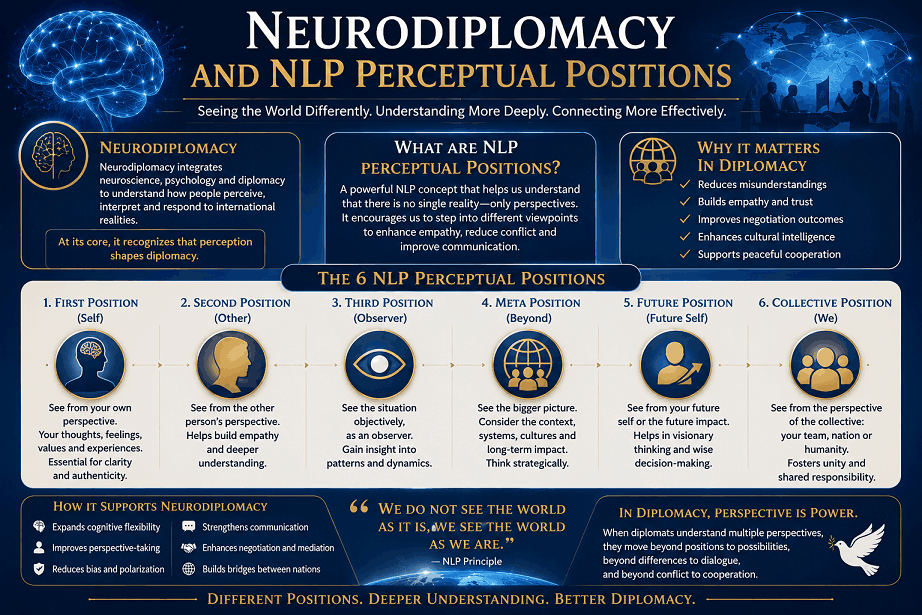
One of the most valuable concepts that Neuro-Linguistic Programming (NLP) can contribute to Neurodiplomacy is the concept of Perceptual Positions. Developed within NLP as a framework for understanding different viewpoints in communication, perceptual positions help individuals examine situations from multiple perspectives rather than becoming trapped in a single interpretation of reality.
From a Neurodiplomatic perspective, international conflicts, diplomatic failures, and foreign policy miscalculations often emerge because actors become locked into their own perceptions and fail to understand how others interpret events. Perceptual positions offer a practical model for improving diplomatic communication, negotiation, conflict resolution, and strategic decision-making.
Neurodiplomacy seeks to understand how perceptions shape international behavior, and perceptual positions provide a structured method for exploring those perceptions.
The Foundation: Perception and International Relations
A central assumption of Neurodiplomacy is:
States and leaders respond to perceived realities rather than objective realities.
This principle is consistent with:
Political psychology.
Constructivism.
Cognitive science.
Foreign policy analysis.
The same international event may generate completely different interpretations among different actors.
For example:
One state’s defensive action may be perceived as offensive by another state.
One country’s security policy may be viewed as a threat by its neighbors.
One diplomatic statement may be interpreted differently by different audiences.
Perceptual positions help diplomats understand these competing realities.
The First Perceptual Position
Seeing Through Your Own Eyes
The first position involves viewing the situation from one’s own perspective.
Questions include:
What do I think?
What do I feel?
What do I want?
How do I perceive the situation?
In diplomacy, this corresponds to:
National interests.
Strategic objectives.
Domestic political considerations.
National identity.
Example
A government may perceive military expansion as necessary for national security.
From the first position, this interpretation appears entirely logical and justified.
Neurodiplomatic Significance
The first position provides clarity regarding one’s own goals and concerns.
However, exclusive reliance on this perspective often contributes to diplomatic deadlock.
The Second Perceptual Position
Seeing Through the Eyes of Others
The second position involves adopting the perspective of another actor.
Questions include:
How do they see the situation?
What are their concerns?
What are their fears?
What do they hope to achieve?
This is one of the most important skills in diplomacy.
Example
A state deploying defensive weapons may perceive itself as increasing security.
Through the second position, diplomats may recognize that neighboring countries perceive the deployment as a potential threat.
Neurodiplomatic Benefits
The second position promotes:
Empathy.
Perspective-taking.
Trust building.
Conflict prevention.
It reduces the risk of misperception.
The Third Perceptual Position
The Neutral Observer
The third position involves stepping outside both parties and observing the interaction objectively.
Questions include:
What is actually happening?
What patterns are visible?
How are both sides influencing each other?
What is being overlooked?
Example
A neutral observer may notice that both parties:
Feel threatened.
Misinterpret intentions.
Respond defensively.
Escalate tensions unintentionally.
Neurodiplomatic Value
The third position encourages:
Strategic thinking.
Objectivity.
Systems analysis.
Conflict diagnosis.
Many effective mediators operate primarily from this position.
The Fourth Perceptual Position
The System Perspective
Some NLP practitioners describe a fourth position that focuses on the larger system.
Questions include:
What serves the broader community?
What benefits the international system?
What supports long-term stability?
How will future generations be affected?
Diplomatic Examples
Considering:
Regional stability.
Global security.
International law.
Collective interests.
This perspective aligns closely with multilateral diplomacy and global governance.
Perceptual Positions and Conflict Resolution
Many international conflicts persist because parties remain trapped in first-position thinking.
First Position
“Our actions are defensive.”
Opponent’s First Position
“Their actions are aggressive.”
Without perspective-taking, both sides reinforce their existing narratives.
Neurodiplomacy encourages movement among perceptual positions to reveal hidden assumptions and alternative interpretations.
Perceptual Positions and Negotiation
Successful negotiators routinely shift among positions.
First Position
Understanding one’s own interests.
Second Position
Understanding the counterpart’s interests.
Third Position
Evaluating the negotiation objectively.
Fourth Position
Considering long-term regional and international consequences.
The more positions negotiators can access, the greater their flexibility.
Perceptual Positions and Robert Jervis
The work of Robert Jervis strongly supports the relevance of perceptual positions.
Jervis demonstrated that leaders often:
Misread intentions.
Project their own assumptions onto others.
Interpret ambiguous signals as hostile.
These problems arise when decision-makers remain trapped in their own perceptual position.
Neurodiplomacy uses perceptual positions as a practical method for reducing such errors.
Perceptual Positions and Constructivism
Constructivist theory argues that international reality is socially constructed through shared meanings and interactions.
Perceptual positions help explain how different actors construct different realities.
For example:
State A
Views an alliance as protection.
State B
Views the same alliance as containment.
Both interpretations may be psychologically valid.
Neurodiplomacy seeks to understand these competing constructions.
Perceptual Positions and Diplomatic Training
Future diplomats could be trained to systematically practice:
Perspective Shifting
Moving between viewpoints.
Cognitive Flexibility
Generating alternative interpretations.
Empathic Understanding
Recognizing the concerns of others.
Systems Thinking
Understanding broader consequences.
Such skills may become increasingly important in a complex international environment.
Practical Neurodiplomatic Application
Consider a territorial dispute.
First Position
“What do we want?”
Second Position
“What does the other side need?”
Third Position
“What patterns sustain the conflict?”
Fourth Position
“What outcome best serves regional stability?”
This sequence often reveals options that remain invisible when only one perspective is considered.
Conclusion
Perceptual positions provide Neurodiplomacy with a powerful framework for understanding how perceptions shape international relations. By encouraging diplomats and policymakers to move beyond their own viewpoints and explore alternative perspectives, perceptual positions help reduce misperceptions, improve negotiations, strengthen conflict resolution, and enhance foreign policy decision-making.
In an era where international politics is increasingly influenced by identity, perception, communication, and cognition, the ability to shift perceptual positions may become one of the most important competencies of the Neurodiplomatic diplomat. Ultimately, successful diplomacy depends not only on understanding one’s own reality but also on understanding the realities constructed by others and the larger system in which all actors operate.