Abstract
The emergence of the metaverse represents one of the most transformative developments in the evolution of digital society. Combining virtual reality (VR), augmented reality (AR), artificial intelligence (AI), blockchain technologies, digital identities, and immersive social environments, the metaverse is redefining how individuals, organizations, and governments communicate and interact. As diplomatic engagement increasingly extends into digital environments, new opportunities and challenges arise for international relations. This article examines diplomacy in the world of the metaverse through the lens of Neurodiplomacy, arguing that future diplomacy will increasingly involve interactions mediated by immersive technologies that influence perception, cognition, emotion, trust, and decision-making. Integrating insights from neuroscience, cognitive science, communication studies, digital diplomacy, and international relations, the article proposes that Neurodiplomacy offers a comprehensive framework for understanding how human cognition will shape diplomatic practice within virtual environments. Rather than viewing the metaverse merely as a technological innovation, this article conceptualizes it as a new diplomatic ecosystem where cognitive processes become central to negotiation, cooperation, and global governance.
Keywords: Neurodiplomacy, Metaverse, Digital Diplomacy, Virtual Reality, Artificial Intelligence, Cognitive Science, International Relations, Diplomatic Communication
Introduction
Diplomacy has continuously evolved alongside transformations in human civilization. From face-to-face negotiations in ancient kingdoms to resident embassies during the Renaissance, from telegraphic diplomacy to digital diplomacy, each technological revolution has reshaped diplomatic communication. The emergence of the Internet and social media fundamentally altered public diplomacy, strategic communication, and global political engagement. Today, the rapid development of immersive technologies introduces another profound transformation: the metaverse.
The metaverse refers to interconnected virtual environments where individuals interact through digital avatars using immersive technologies such as virtual reality, augmented reality, artificial intelligence, blockchain, and spatial computing (Lee et al., 2021). Governments, multinational corporations, universities, and international organizations are increasingly exploring metaverse platforms for education, commerce, governance, and international cooperation.
Yet diplomacy is fundamentally a human activity. Regardless of technological sophistication, negotiations, trust-building, conflict resolution, and strategic communication ultimately depend upon human cognition. Consequently, understanding diplomacy within virtual environments requires more than technological expertise; it requires understanding how immersive digital environments influence the human brain.
Neurodiplomacy provides precisely this perspective.
This article argues that diplomacy in the metaverse is best understood as the interaction between technologically mediated human minds rather than simply between digital avatars or political institutions.
The Evolution of Diplomacy into Virtual Space
Diplomacy has historically expanded whenever communication technologies evolved.
The printing press facilitated international information exchange.
Telegraphy accelerated diplomatic correspondence.
Telephones transformed crisis communication.
The Internet enabled digital diplomacy.
Social media democratized public diplomacy.
The metaverse represents the next stage in this historical progression.
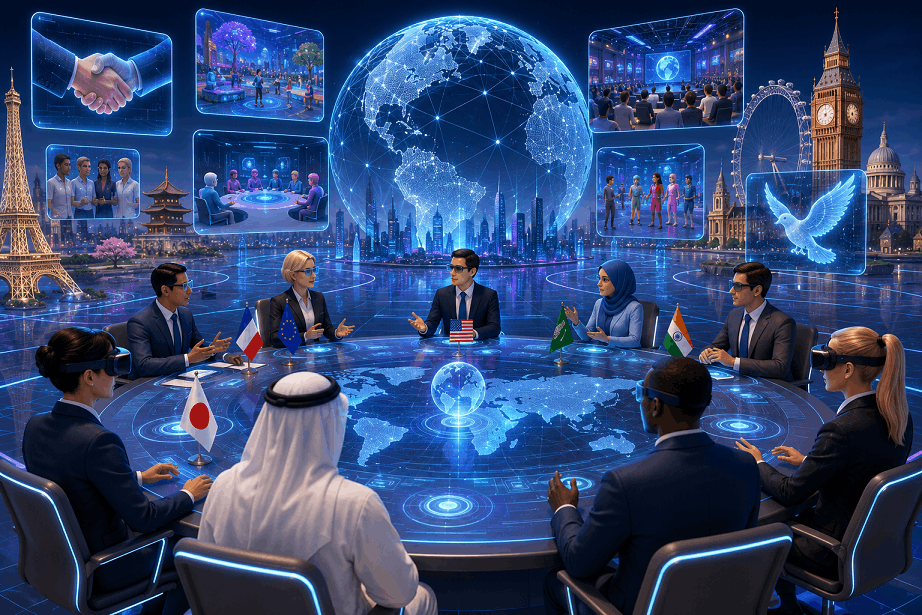
Unlike conventional online communication, immersive virtual environments simulate physical presence, allowing diplomats to interact through embodied digital identities within shared three-dimensional spaces.
Virtual embassies, immersive negotiations, digital conferences, cultural exhibitions, educational exchanges, and citizen engagement may increasingly occur inside persistent virtual worlds.
Consequently, diplomacy is no longer constrained by geography.
Understanding the Metaverse
The metaverse combines several technological innovations:
-
Virtual Reality (VR)
-
Augmented Reality (AR)
-
Artificial Intelligence (AI)
-
Blockchain technologies
-
Digital twins
-
Digital identity systems
-
Spatial computing
-
Extended Reality (XR)
Together these technologies create persistent virtual environments in which social interaction resembles physical reality.
Unlike traditional videoconferencing, the metaverse enables participants to experience spatial presence, shared environments, and embodied interaction.
These characteristics significantly alter diplomatic communication because they influence attention, perception, emotional engagement, and interpersonal trust.
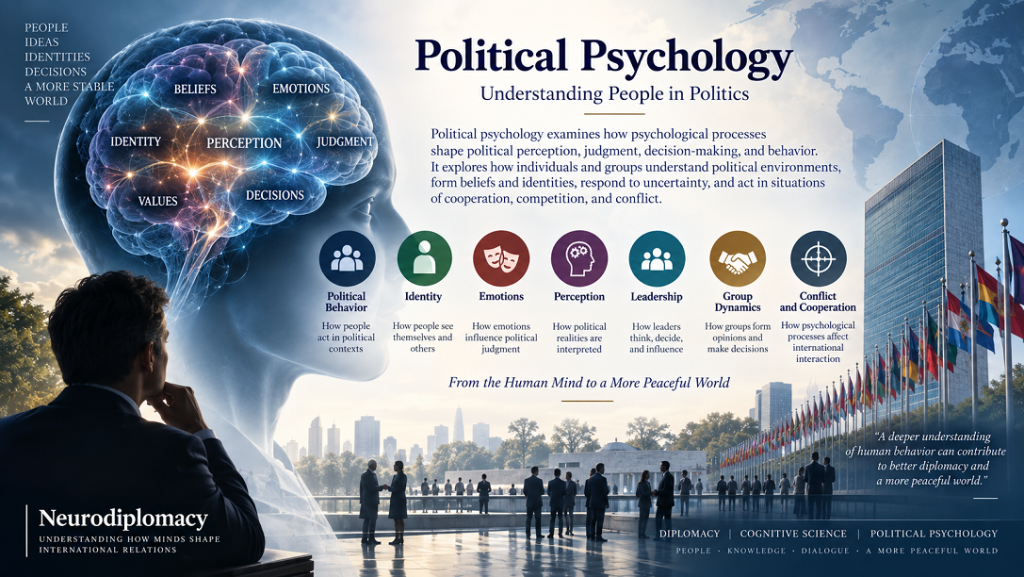
Neurodiplomacy: A Human-Centered Framework
Neurodiplomacy views diplomacy as a cognitive process before it becomes a political process.
Rather than focusing exclusively on governments or institutions, Neurodiplomacy examines:
-
perception
-
attention
-
emotion
-
memory
-
trust
-
empathy
-
cognitive flexibility
-
decision-making
Every diplomatic interaction begins inside the human brain.
Virtual environments do not eliminate these processes.
Instead, they transform them.
The metaverse therefore becomes not merely a technological space but a neurocognitive environment.
Presence and Cognitive Immersion
One of the defining characteristics of the metaverse is presence—the subjective feeling of “being there.”
Research in virtual reality demonstrates that immersive environments activate neural processes similar to those engaged during real-world experiences.
For diplomats, cognitive presence has important implications.
Negotiations conducted within immersive environments may generate stronger emotional engagement than conventional video meetings.
Participants may experience:
-
increased empathy
-
stronger interpersonal connection
-
greater attentional focus
-
enhanced memory formation
These cognitive effects may improve diplomatic dialogue while simultaneously introducing new ethical and psychological considerations.
Trust in Virtual Diplomacy
Trust remains one of diplomacy’s most valuable resources.
Traditional diplomacy often relies on face-to-face interaction because physical presence allows diplomats to interpret subtle social cues.
In virtual environments, trust depends upon additional factors, including:
-
avatar authenticity
-
digital identity verification
-
behavioral consistency
-
platform security
-
technological transparency
Neurodiplomacy suggests that trust formation within the metaverse will involve interactions between cognitive evaluation and emotional experience.
Designing virtual diplomatic platforms should therefore prioritize psychological safety alongside cybersecurity.
Communication Beyond Words
Diplomatic communication has always relied upon more than language.
Facial expressions, gestures, posture, eye contact, tone of voice, and interpersonal distance influence negotiation outcomes.
The metaverse introduces new forms of communication.
Avatars can reproduce:
-
facial expressions
-
hand gestures
-
body movements
-
eye tracking
-
spatial orientation
These technologies enhance non-verbal communication while simultaneously raising questions concerning authenticity and emotional representation.
Neurodiplomacy investigates how these virtual signals influence perception and diplomatic decision-making.
Artificial Intelligence and Diplomatic Cognition
Artificial intelligence will likely become an integral component of metaverse diplomacy.
AI systems may assist diplomats through:
-
real-time language translation
-
negotiation support
-
geopolitical forecasting
-
sentiment analysis
-
information synthesis
-
policy simulation
However, Neurodiplomacy emphasizes that AI should augment rather than replace human judgment.
Diplomatic decisions involve ethical reasoning, cultural sensitivity, emotional intelligence, and perspective-taking—capacities that remain uniquely human.
The future diplomat must therefore collaborate with intelligent systems while preserving human agency.
Cognitive Biases in Virtual Environments
Immersive technologies may reduce certain communication barriers while introducing new cognitive biases.
Virtual environments may influence:
-
attention allocation
-
emotional intensity
-
social identity
-
confirmation bias
-
group polarization
-
digital disinhibition
Neurodiplomacy highlights the importance of metacognition—the awareness of one’s own thinking processes—in preventing these biases from undermining diplomatic judgment.
Training diplomats to recognize cognitive distortions becomes increasingly important within immersive environments.
Digital Identity and Diplomatic Representation
Traditional diplomacy clearly distinguishes between the diplomat and the institution represented.
The metaverse complicates this relationship.
Diplomats increasingly interact through digital avatars.
Questions emerge regarding:
-
identity authenticity
-
representation legitimacy
-
avatar behavior
-
digital ethics
-
anonymity
-
accountability
These issues require new diplomatic norms and international governance frameworks.
Neurodiplomacy contributes by examining how identity representation influences trust, credibility, and cooperation.
Public Diplomacy in the Metaverse
The metaverse significantly expands opportunities for public diplomacy.
Countries may establish:
-
virtual embassies
-
cultural museums
-
historical exhibitions
-
educational campuses
-
international forums
-
digital heritage sites
Unlike conventional public diplomacy, immersive environments enable foreign publics to experience another country’s culture interactively.
Neurodiplomacy explains why such experiences may produce stronger emotional engagement than traditional communication because immersive learning enhances attention, memory, and emotional processing.
Conflict Resolution in Virtual Space
Virtual diplomacy may also contribute to peacebuilding.
Immersive simulations can facilitate:
-
perspective-taking
-
conflict visualization
-
negotiation training
-
intercultural dialogue
-
crisis simulations
Virtual environments enable participants to experience alternative viewpoints more vividly than traditional discussion formats.
Neurodiplomacy suggests that such experiences may strengthen empathy and reduce cognitive rigidity, both essential elements of successful conflict resolution.
Ethical Challenges
Despite its promise, metaverse diplomacy raises significant ethical concerns.
These include:
-
digital surveillance
-
privacy protection
-
psychological manipulation
-
misinformation
-
algorithmic bias
-
unequal technological access
-
cognitive influence operations
Because immersive technologies directly affect perception and emotion, ethical governance becomes essential.
Neurodiplomacy advocates a human-centered approach in which technological innovation remains aligned with human dignity, transparency, autonomy, and international law.
Toward a Neurodiplomatic Model of the Metaverse
A Neurodiplomatic framework for metaverse diplomacy may be organized around six interconnected dimensions:
-
Cognitive Intelligence – Understanding perception, attention, memory, and decision-making in virtual environments.
-
Emotional Intelligence – Managing emotions, empathy, and trust during immersive diplomatic interaction.
-
Technological Intelligence – Integrating AI, VR, blockchain, and digital identity systems responsibly.
-
Communication Intelligence – Optimizing verbal, non-verbal, and avatar-mediated communication.
-
Ethical Intelligence – Protecting privacy, transparency, fairness, and human autonomy.
-
Adaptive Intelligence – Developing cognitive flexibility to navigate rapidly evolving technological environments.
Together these dimensions provide a comprehensive framework for diplomatic practice in immersive digital worlds.
Conclusion
The metaverse represents more than the next generation of digital technology; it represents the emergence of a new environment for international interaction. As diplomacy increasingly extends into immersive virtual spaces, understanding human cognition becomes more important than ever. Negotiations conducted through avatars, AI-assisted communication, virtual embassies, and immersive public diplomacy all depend upon perception, attention, trust, emotional regulation, and decision-making.
Neurodiplomacy provides a uniquely human-centered framework for understanding these transformations. Rather than viewing diplomacy solely as an exchange between states or digital systems, it conceptualizes diplomacy as an interaction between human minds operating within technologically mediated environments. In this sense, the future of diplomacy will not be determined exclusively by advances in virtual reality or artificial intelligence, but by our ability to understand how these technologies influence the cognitive and emotional foundations of international cooperation.
As the metaverse continues to evolve, Neurodiplomacy offers an interdisciplinary roadmap for ensuring that diplomacy remains fundamentally human while embracing the unprecedented opportunities of immersive digital civilization.
Suggested Sources for Further Reading:
- Diamandis, P. H., & Kotler, S. (2020). The future is faster than you think. Simon & Schuster.
- Ismail, S., Malone, M. S., & van Geest, Y. (2014). Exponential organizations: Why new organizations are ten times better, faster, and cheaper than yours (and what to do about it). Diversion Books.
- Lee, L.-H., Braud, T., Zhou, P., Wang, L., Xu, D., Lin, Z., Kumar, A., Bermejo, C., & Hui, P. (2021). All one needs to know about metaverse: A complete survey on technological singularity, virtual ecosystem, and research agenda. Journal of Latex Class Files. https://arxiv.org/abs/2110.05352
- Slater, M., & Sanchez-Vives, M. V. (2016). Enhancing our lives with immersive virtual reality. Frontiers in Robotics and AI, 3, 74. https://doi.org/10.3389/frobt.2016.00074
-
Frontiers in Robotics and AI – https://www.frontiersin.org/journals/robotics-and-ai
-
arXiv Metaverse Survey – https://arxiv.org/abs/2110.05352
-
World Economic Forum – https://www.weforum.org/topics/metaverse
-
OECD Digital Economy Papers – https://www.oecd.org/digital/