Introduction
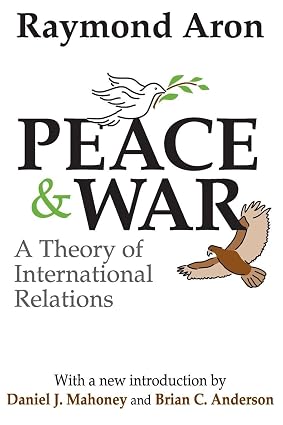
Raymond Aron’s Peace and War: A Theory of International Relations (originally published in French in 1962 and translated into English in 1966) is one of the foundational works of twentieth-century International Relations (IR). Written during the Cold War, the book presents a comprehensive theory of international politics that combines history, political philosophy, sociology, diplomacy, and strategic studies. Unlike many contemporary theorists who sought to explain international politics through a single analytical framework, Aron developed a multidimensional approach that recognized the complexity of relations among states.
Peace and War is often regarded as a European counterpart to the realist tradition represented by Hans J. Morgenthau and, later, Kenneth Waltz. However, Aron cannot be classified simply as a realist. While he accepts the importance of power, national interest, and military capability, he also emphasizes the significance of historical context, ideology, domestic political systems, diplomacy, and human judgment. His work rejects both utopian idealism and rigid determinism, proposing instead that international politics is shaped by the interaction of material forces, political choices, and historical circumstances.
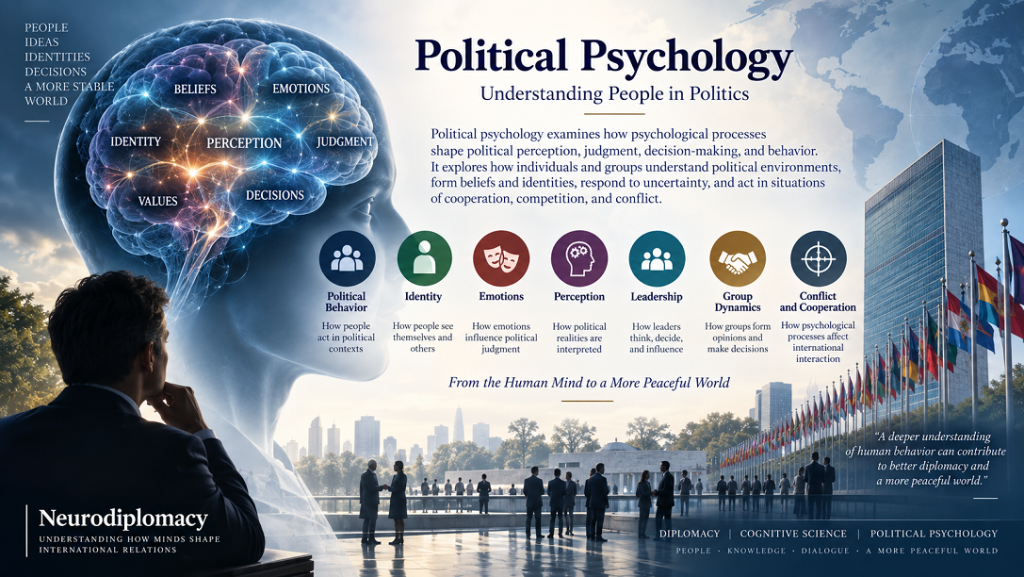
More than six decades after its publication, Peace and War remains highly relevant. Its discussion of diplomacy, strategy, deterrence, alliances, and international order continues to influence scholars of International Relations, security studies, and foreign policy analysis. From the perspective of the emerging field of neurodiplomacy, Aron’s work also provides an important intellectual foundation for understanding how decision-makers interpret threats, manage uncertainty, and make strategic choices.
Structure and Central Themes
The book is organized around the central proposition that international politics differs fundamentally from domestic politics because no supreme authority exists above sovereign states. Consequently, states operate within an environment of uncertainty where diplomacy and military power coexist.
Aron examines several interconnected themes, including:
- The nature of international systems
- Diplomacy and strategic interaction
- Peace and war as recurring features of international life
- Power and the balance of power
- National interests
- Ideology and international conflict
- Nuclear deterrence
- Historical change in international politics
Rather than offering a single predictive theory, Aron develops a framework for understanding how different political, military, economic, and ideological factors combine to shape international outcomes.
Diplomacy and Strategy
One of Aron’s most significant contributions is his treatment of diplomacy and strategy as complementary instruments of statecraft.
Diplomacy represents the peaceful pursuit of national objectives through negotiation, persuasion, and cooperation.
Strategy concerns the use or potential use of military force to achieve political goals.
For Aron, these two dimensions cannot be separated. Diplomatic negotiations are influenced by military capabilities, while military strategies are shaped by diplomatic objectives. This integrated understanding distinguishes his work from approaches that treat diplomacy and military affairs independently.
His analysis reflects the enduring relevance of Clausewitz’s proposition that war is the continuation of politics by other means. However, Aron extends this insight by emphasizing that diplomacy and military power exist along a continuous spectrum rather than as mutually exclusive alternatives.
Power and International Order
Aron views power as a central element of international politics but rejects simplistic definitions based solely on military strength.
Power includes:
- Military capabilities
- Economic resources
- Technological development
- Political institutions
- Diplomatic influence
- National morale
This multidimensional understanding of power enables Aron to explain why some states exert influence disproportionate to their military size, while others fail to convert material resources into political influence.
His discussion of balance of power demonstrates that stability depends not merely on the distribution of capabilities but also on the perceptions and strategic calculations of political leaders.
Ideology and the Cold War
Writing during the Cold War, Aron devotes considerable attention to ideology as a source of international conflict.
He argues that ideological competition intensified tensions between the United States and the Soviet Union by transforming geopolitical rivalry into a broader struggle over political legitimacy and competing visions of world order.
Unlike purely material explanations of international politics, Aron recognizes that ideas, beliefs, and political identities shape state behavior.
This insight anticipated later developments in constructivist theory, which similarly emphasize the role of norms, identities, and shared meanings in international relations.
Nuclear Weapons and Strategic Stability
One of the most influential aspects of Peace and War is Aron’s discussion of nuclear strategy.
The emergence of nuclear weapons fundamentally transformed traditional concepts of war and peace. Victory in nuclear conflict became increasingly meaningless because large-scale nuclear war threatened the survival of all participants.
Aron argues that deterrence became the defining principle of strategic stability.
States increasingly sought security not by winning wars but by preventing them through credible threats of retaliation.
His analysis remains relevant in contemporary debates concerning nuclear proliferation, arms control, and strategic stability among major powers.
Methodological Contribution
Unlike many International Relations theorists who seek universal laws, Aron adopts a historical and sociological methodology.
He argues that international politics must be understood within its historical context.
Political systems evolve.
Technological developments transform strategic possibilities.
Diplomatic practices change over time.
Historical experience shapes national behavior.
Consequently, no single theoretical model can fully explain all international phenomena.
This methodological pluralism remains one of the book’s greatest strengths.
Relevance to Contemporary International Relations
Many of Aron’s central arguments remain applicable to twenty-first-century international politics.
Current issues such as:
- Great-power competition
- Strategic rivalry between the United States and China
- Regional conflicts
- Nuclear deterrence
- Economic interdependence
- Information warfare
continue to reflect the interaction between diplomacy, power, uncertainty, and strategic calculation that Aron described.
His emphasis on prudence, moderation, and strategic judgment remains particularly valuable in an era characterized by rapid technological change and geopolitical instability.
Peace and War from a Neurodiplomacy Perspective
Although Peace and War predates developments in cognitive neuroscience and political psychology, many of Aron’s insights are highly compatible with the emerging field of neurodiplomacy.
Aron repeatedly emphasizes that international politics is shaped by human judgment under conditions of uncertainty.
Neurodiplomacy extends this argument by examining the neurocognitive mechanisms underlying that judgment.
Several areas illustrate this connection.
Perception of Threats
Aron argues that international conflict often results from uncertainty and strategic competition.
Neurodiplomacy adds that threat perception depends upon cognitive processes involving attention, memory, emotional evaluation, and prior experience.
States do not respond directly to objective reality; policymakers interpret reality through cognitive frameworks.
Decision-Making Under Uncertainty
Aron recognizes that leaders rarely possess complete information.
Neurodiplomacy explains how limited cognitive capacity, information overload, and cognitive biases influence diplomatic decision-making.
This perspective deepens Aron’s understanding of strategic uncertainty by incorporating findings from cognitive science and neuroscience.
Diplomacy as Cognitive Interaction
For Aron, diplomacy is an instrument of communication and negotiation.
Neurodiplomacy expands this view by emphasizing:
- Strategic empathy
- Emotional regulation
- Perspective-taking
- Trust formation
- Cognitive flexibility
Successful diplomacy depends not only on material interests but also on understanding how other actors perceive intentions and risks.
Institutional Decision-Making
Aron’s work primarily analyzes states as political actors.
The Neurodiplomatic Institutional Decision-Making Model (NIDM) extends this analysis by examining how diplomatic institutions process information, evaluate alternatives, regulate emotions during crises, and learn from previous experiences.
In this sense, neurodiplomacy complements rather than replaces Aron’s theoretical framework.
Strengths
The principal strengths of Peace and War include:
- Comprehensive integration of diplomacy, strategy, history, and political theory.
- Balanced treatment of power without reducing international politics to military force.
- Historical sensitivity and methodological flexibility.
- Sophisticated analysis of diplomacy and strategic interaction.
- Enduring relevance for contemporary International Relations.
Limitations
Despite its significance, several limitations can be identified.
First, the book reflects the geopolitical realities of the Cold War and therefore gives limited attention to non-state actors, globalization, transnational networks, and environmental challenges.
Second, Aron pays relatively little attention to psychological and cognitive processes influencing foreign policy decisions.
Third, developments in behavioral economics, political psychology, and neuroscience occurred largely after the publication of the book. Consequently, the cognitive foundations of strategic judgment remain underdeveloped.
These limitations do not diminish the value of the work but instead create opportunities for theoretical extension through approaches such as neurodiplomacy.
Conclusion
Raymond Aron’s Peace and War: A Theory of International Relations remains one of the most important contributions to International Relations scholarship. Its sophisticated analysis of diplomacy, power, strategy, and international order continues to provide valuable insights for scholars and practitioners alike.
The book’s enduring contribution lies in demonstrating that international politics cannot be explained solely through military capabilities or abstract theoretical models. Instead, it requires an integrated understanding of history, diplomacy, political institutions, strategic interaction, and human judgment.
From a neurodiplomatic perspective, Aron’s work provides a strong conceptual foundation that can be further developed by incorporating contemporary knowledge about cognition, emotion, perception, and decision-making. Neurodiplomacy enriches Aron’s framework by exploring how diplomatic choices emerge from the interaction of neural processes, institutional environments, and international structures.
Thus, while Peace and War explains how states pursue peace and prepare for war, neurodiplomacy advances the discussion by asking how the minds of policymakers perceive threats, process information, regulate emotions, and make the strategic decisions that ultimately shape war and peace.
Reference
- Aron, R. (1966). Peace and war: A theory of international relations (R. Howard & A. B. Fox, Trans.). Doubleday. (Original work published 1962)