Introduction
Since its first publication in 1980, Metaphors We Live By by George Lakoff and Mark Johnson has become one of the most influential books in cognitive linguistics, philosophy, psychology, communication studies, and the social sciences. The book fundamentally challenged the traditional understanding of metaphor as merely a literary or rhetorical device. Instead, Lakoff and Johnson argued that metaphor is a central mechanism of human thought, shaping how people perceive reality, reason about abstract concepts, communicate with others, and make decisions.
This revolutionary perspective gave rise to what is now known as Conceptual Metaphor Theory (CMT), which maintains that metaphors are embedded within cognitive structures rather than simply within language. Human beings do not merely speak metaphorically; they think metaphorically. Consequently, metaphors influence political discourse, diplomatic negotiations, economic policy, legal reasoning, education, media communication, and international relations.
More than four decades after its publication, Metaphors We Live By continues to influence research across numerous disciplines. Its significance extends beyond linguistics because it provides a comprehensive explanation of how cognition structures human understanding of complex realities. For scholars of diplomacy and international relations, the book offers important insights into how political leaders construct strategic narratives, frame international conflicts, define national interests, and communicate foreign policy objectives.
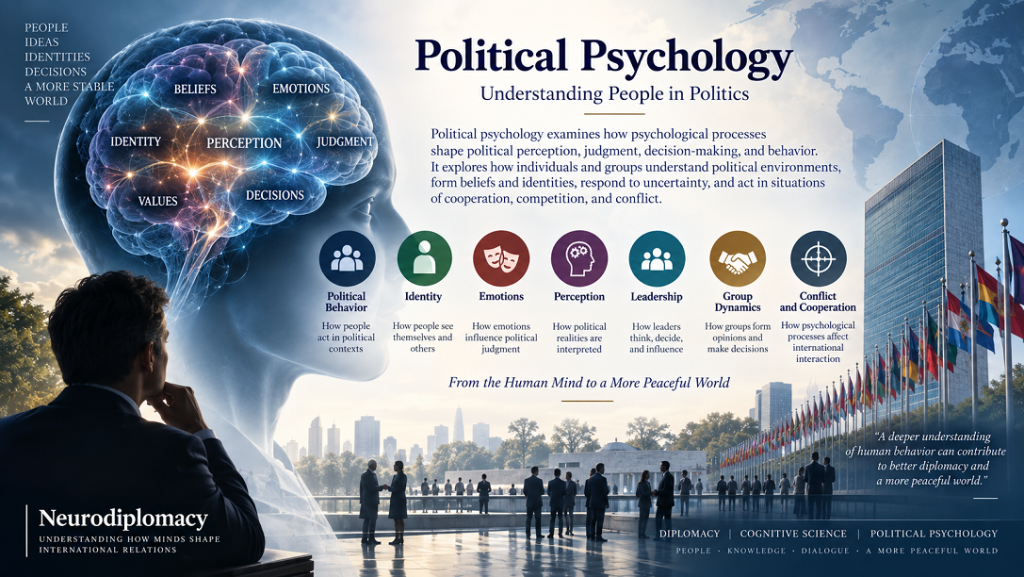
From the perspective of Neurodiplomacy, the book is particularly valuable because it demonstrates that language reflects underlying cognitive processes. Diplomatic communication is therefore not simply the exchange of information but also the construction of shared meanings through conceptual metaphors. This review examines the book’s principal arguments, evaluates its theoretical contributions, discusses its strengths and limitations, and explores its relevance for Neurodiplomacy and contemporary international relations.
Overview of the Book
Lakoff and Johnson begin with a simple yet profound observation: everyday language is saturated with metaphors that most speakers no longer recognize as metaphorical. Expressions such as “defending an argument,” “winning a debate,” “building a relationship,” or “investing time” reveal that abstract concepts are routinely understood through more concrete experiences.
One of the book’s most famous examples is the conceptual metaphor:
ARGUMENT IS WAR
This metaphor is reflected in common expressions such as:
- “He attacked my argument.”
- “She defended her position.”
- “Their criticism destroyed my case.”
- “I won the debate.”
The authors argue that these expressions are not isolated linguistic figures. Rather, they reveal an underlying conceptual system through which people understand argument as a form of conflict.
This insight transforms metaphor from a stylistic ornament into a cognitive mechanism. Human thought itself becomes structured by metaphorical mappings between familiar physical experiences and abstract concepts.
The Theory of Conceptual Metaphor
The central contribution of the book is the development of Conceptual Metaphor Theory. According to Lakoff and Johnson, human cognition relies upon mappings between a source domain, which is concrete and familiar, and a target domain, which is abstract and difficult to understand.
Examples include:
- TIME IS MONEY
- LIFE IS A JOURNEY
- LOVE IS A JOURNEY
- POLITICS IS WAR
- THE STATE IS A PERSON
These metaphors simplify complex concepts by grounding them in everyday bodily experiences. Because human beings experience movement, balance, space, force, and physical interaction from early childhood, these experiences become the foundation for understanding more abstract phenomena.
The authors therefore reject the traditional separation between language and thought. Instead, they argue that language reveals the conceptual structures through which people interpret reality.
Major Contributions
The intellectual contributions of Metaphors We Live By are profound.
First, the book transformed cognitive linguistics by establishing metaphor as a central component of human cognition rather than a peripheral feature of language.
Second, it challenged the classical philosophical assumption that abstract reasoning is entirely objective and independent of bodily experience. Lakoff and Johnson argue that human thought is fundamentally embodied, meaning that cognitive structures develop through interactions between the body and the environment.
Third, the book created an interdisciplinary bridge connecting linguistics, psychology, philosophy, anthropology, communication studies, education, and political science.
Finally, the authors demonstrated that metaphor influences reasoning itself. Consequently, political debates often depend less upon factual disagreement than upon competing metaphorical frameworks through which those facts are interpreted.
Relevance to Political Psychology and International Relations
Although Lakoff and Johnson rarely discuss diplomacy directly, their theoretical framework has significant implications for international relations.
Political leaders routinely employ metaphors to frame international events.
Examples include:
- the “War on Terror”;
- the “Iron Curtain”;
- the “Axis of Evil”;
- the “Cold War”;
- the “Global Village.”
Such expressions do not merely describe reality. They shape how citizens, diplomats, and policymakers interpret international events.
Metaphors influence:
- threat perception;
- national identity;
- alliance formation;
- diplomatic communication;
- public opinion;
- crisis management;
- foreign policy legitimacy.
For example, describing international politics as a “game” encourages different strategic expectations than describing it as a “family,” a “marketplace,” or a “battlefield.”
Consequently, metaphor becomes an instrument of strategic communication.
Strengths
The book possesses numerous strengths.
Its greatest achievement lies in demonstrating that language reflects cognitive organization rather than simply vocabulary.
The interdisciplinary scope is equally impressive. Few books have influenced as many academic disciplines while remaining accessible to non-specialists.
The writing style is clear, engaging, and supported by abundant everyday examples, making complex theoretical concepts understandable.
Moreover, the authors fundamentally changed subsequent research concerning framing, communication, political discourse, and cognitive science.
Limitations
Despite its enormous influence, the book has several limitations.
First, it pays relatively little attention to empirical neuroscience because the field was still in its infancy when the book was written.
Second, although Conceptual Metaphor Theory explains how metaphors structure thought, it provides less guidance regarding how competing metaphors are selected, modified, or abandoned within institutional decision-making.
Third, the book focuses primarily on individual cognition and language rather than collective decision-making within governments and international organizations.
Finally, while Lakoff and Johnson explain metaphorical cognition, they devote comparatively little attention to diplomacy, negotiations, or foreign policy institutions.
These limitations create opportunities for later theoretical developments.
A Neurodiplomatic Perspective
From the perspective of Neurodiplomacy, Metaphors We Live By provides one of the cognitive foundations for understanding diplomatic communication.
Neurodiplomacy argues that foreign policy decisions emerge through interactions among perception, memory, language, emotion, strategic empathy, and institutional learning. Conceptual metaphors influence each of these processes.
Diplomats rarely communicate through neutral language. Instead, they employ metaphors that frame international relationships, define threats, construct identities, and justify policy choices.
For example, describing another state as a “partner,” “competitor,” “enemy,” “bridge,” “buffer,” or “regional pillar” immediately activates different cognitive expectations.
Similarly, describing negotiations as a “battle” encourages competitive behavior, whereas describing them as a “bridge-building process” promotes cooperation.
Neurodiplomacy therefore extends Lakoff and Johnson’s work by examining how conceptual metaphors influence institutional decision-making, strategic communication, conflict resolution, and international negotiations.
Within the Neurodiplomatic Institutional Decision-Making Model (NIDM), metaphor analysis becomes an important analytical tool. Before adopting a particular policy narrative, foreign ministries should evaluate how metaphorical framing shapes perception, influences emotional responses, affects public diplomacy, and guides strategic choices.
Such analysis can improve diplomatic communication while reducing misunderstandings that arise from conflicting conceptual frameworks.
Overall Assessment
Metaphors We Live By is rightly regarded as one of the most important books of the twentieth century in cognitive science and linguistics. Its central insight—that metaphor structures human thought rather than merely decorating language—has transformed research across numerous disciplines.
For scholars of international relations, the book demonstrates that diplomacy is not solely about power, interests, or institutions. It is also about language, perception, and the cognitive frameworks through which international actors understand one another.
From a Neurodiplomatic perspective, Lakoff and Johnson’s work represents an essential theoretical foundation. However, Neurodiplomacy expands their framework by integrating conceptual metaphor with political psychology, cognitive neuroscience, strategic empathy, and institutional decision-making. In doing so, it provides a more comprehensive explanation of how language influences diplomacy, negotiations, foreign policy, and international cooperation.
Consequently, Metaphors We Live By should be regarded not only as a classic contribution to cognitive linguistics but also as an indispensable resource for scholars seeking to understand the cognitive dimensions of diplomacy and global politics.
Reference
- Lakoff, G., & Johnson, M. (1980). Metaphors we live by. University of Chicago Press.