Abstract
Behavioral International Relations (Behavioral IR) represents one of the most important developments in contemporary International Relations (IR) scholarship. Challenging the traditional assumption that states and policymakers behave as perfectly rational actors, Behavioral IR integrates insights from psychology, behavioral economics, cognitive science, and political psychology to explain how individuals actually make foreign policy decisions under conditions of uncertainty. Rather than assuming that decision-makers always maximize national interests through objective calculations, Behavioral IR argues that human cognition is constrained by limited information, cognitive biases, emotions, heuristics, and social influences. Consequently, international outcomes often reflect psychological processes as much as structural conditions or material capabilities.
This article examines the origins, theoretical foundations, major concepts, contributions, and criticisms of Behavioral IR. It argues that Behavioral IR has significantly enriched the study of international politics by introducing a more realistic understanding of human decision-making. The article also discusses the relationship between Behavioral IR and emerging interdisciplinary approaches such as neurodiplomacy, suggesting that neuroscience and cognitive science may represent the next stage in the evolution of behavioral approaches to International Relations.
Keywords: Behavioral International Relations, Behavioral IR, Political Psychology, Decision-Making, Foreign Policy Analysis, Cognitive Biases, Bounded Rationality, Neurodiplomacy.
Introduction
For much of the twentieth century, International Relations theory was dominated by approaches that viewed states as rational actors pursuing clearly defined national interests. Classical Realism, Neorealism, Neoliberal Institutionalism, and Rational Choice Theory generally assumed that policymakers objectively evaluate available information and choose the most efficient means of achieving strategic goals.
However, empirical evidence from diplomacy, crisis management, military conflicts, and foreign policy increasingly demonstrated that decision-makers frequently deviate from ideal rationality. Historical events such as the outbreak of the First World War, the Vietnam War, the Cuban Missile Crisis, and intelligence failures before the 2003 Iraq War revealed that perception, emotion, organizational dynamics, and cognitive limitations significantly influence foreign policy decisions.
Behavioral International Relations emerged in response to these observations. Drawing upon advances in psychology and behavioral economics, it argues that international politics cannot be fully understood without considering the human cognitive processes underlying state behavior.
The Origins of Behavioral IR
Behavioral IR developed from several intellectual traditions.
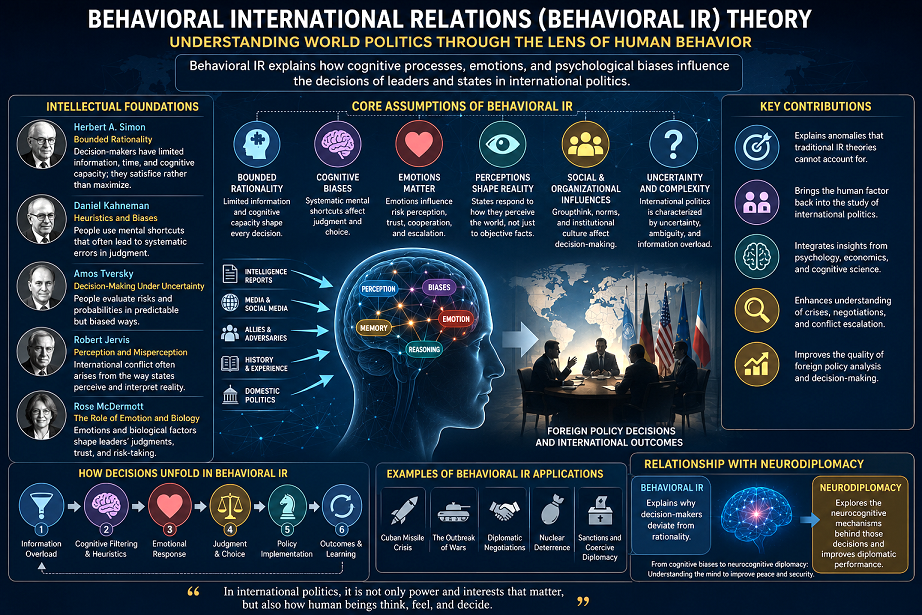
The first is Herbert Simon’s concept of bounded rationality, which challenged the assumption that individuals possess unlimited cognitive capacity. Simon argued that decision-makers operate under conditions of incomplete information, limited time, and restricted analytical capability. Rather than identifying optimal solutions, they often choose alternatives that are satisfactory within existing constraints.
A second major influence came from Daniel Kahneman and Amos Tversky, whose research demonstrated that people rely on cognitive shortcuts, or heuristics, when making decisions under uncertainty. Although heuristics simplify complex decisions, they also produce systematic biases.
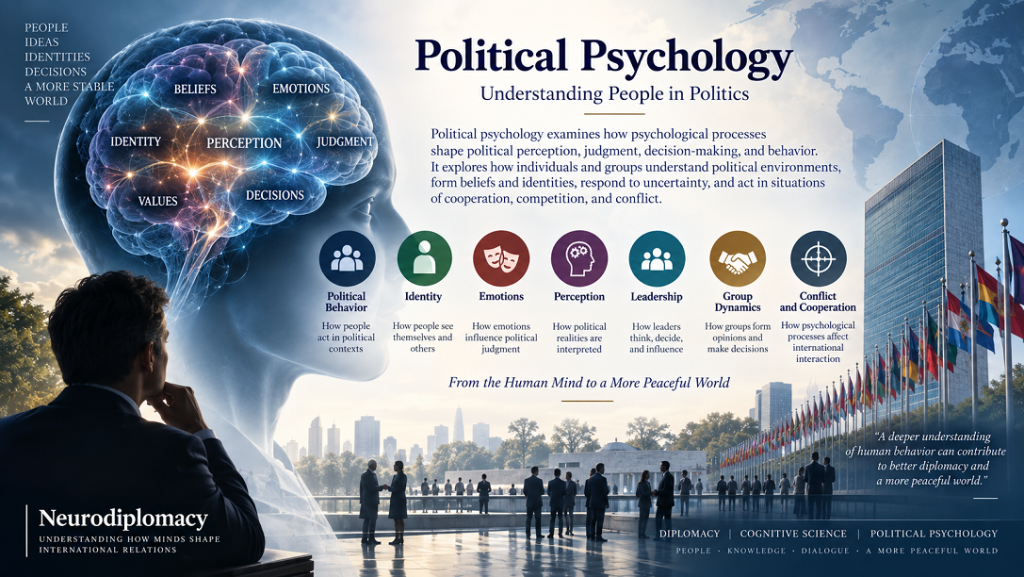
Political psychology further contributed by showing that leaders’ beliefs, personalities, perceptions, and emotional responses influence international political behavior. Robert Jervis’s work on perception and misperception in international politics illustrated that foreign policy failures frequently arise from incorrect interpretations rather than objective realities.
Together, these contributions transformed the understanding of decision-making in International Relations.
Core Assumptions of Behavioral IR
Behavioral IR rests upon several central assumptions.
Bounded Rationality
Behavioral IR rejects the notion of perfect rationality. Policymakers rarely possess complete information or unlimited analytical capacity. Decisions are therefore constrained by time pressures, uncertainty, organizational limitations, and cognitive complexity.
Instead of maximizing outcomes, decision-makers frequently “satisfice” by selecting solutions that appear acceptable rather than optimal.
Cognitive Biases
Behavioral IR emphasizes that human judgment is influenced by systematic cognitive biases.
Among the most important are:
- Confirmation bias
- Availability heuristic
- Anchoring
- Overconfidence
- Loss aversion
- Framing effects
These biases shape threat perception, intelligence assessment, diplomatic negotiations, and military planning.
For example, leaders may selectively interpret intelligence that confirms existing beliefs while overlooking contradictory evidence.
Emotions in Foreign Policy
Traditional International Relations often viewed emotions as obstacles to rational decision-making.
Behavioral IR instead recognizes emotions as essential components of political judgment.
Fear may increase perceptions of external threats.
Anger may encourage risk-taking.
Trust facilitates cooperation.
Empathy enhances conflict resolution.
Emotions therefore influence both crisis escalation and diplomatic compromise.
Perception and Interpretation
Behavioral IR argues that states do not react directly to objective reality.
Rather, policymakers respond to their perceptions of reality.
The same international event may generate entirely different responses depending upon historical experience, institutional culture, political ideology, and individual cognitive frameworks.
Consequently, international politics becomes a process of interpretation as much as objective interaction.
Behavioral IR and Foreign Policy Decision-Making
One of the greatest contributions of Behavioral IR lies in explaining foreign policy decisions.
Foreign policy is produced by individuals operating within organizations.
Decision-makers must evaluate:
- Massive quantities of information
- Conflicting intelligence reports
- Domestic political pressures
- International uncertainty
- Time constraints
Behavioral IR demonstrates that decisions emerge through complex psychological processes rather than purely rational calculations.
For example, during international crises, leaders often rely upon previous experiences and intuitive judgments because analytical deliberation becomes increasingly difficult under pressure.
Behavioral IR and International Conflict
Behavioral IR has significantly improved understanding of conflict escalation.
Wars frequently result not because leaders seek conflict, but because they:
- Misperceive opponents’ intentions.
- Overestimate military capabilities.
- Underestimate risks.
- Become trapped by previous commitments.
- Misinterpret signals during crises.
Robert Jervis famously argued that many international conflicts originate from misperception rather than deliberate aggression.
Behavioral IR therefore shifts attention from structural causes of war toward the psychological mechanisms that produce strategic mistakes.
Contributions to International Relations Theory
Behavioral IR has made several important contributions.
First, it humanizes International Relations by recognizing that states act through individuals.
Second, it integrates empirical findings from psychology with political analysis.
Third, it explains anomalies that traditional rational models struggle to address.
Fourth, it improves Foreign Policy Analysis by examining how institutions and leaders process information.
Finally, Behavioral IR encourages interdisciplinary collaboration between political science, psychology, economics, and cognitive science.
Criticisms of Behavioral IR
Despite its strengths, Behavioral IR has also been criticized.
Some scholars argue that it focuses too heavily on individual decision-makers while underestimating structural constraints such as the international distribution of power.
Others contend that laboratory findings from psychology cannot always be generalized to complex geopolitical environments.
Additionally, measuring emotions and cognitive processes in real-world diplomacy remains methodologically challenging.
Nevertheless, these criticisms have encouraged greater methodological sophistication rather than diminishing the importance of Behavioral IR.
Behavioral IR and Neurodiplomacy
The emergence of Neurodiplomacy represents a promising extension of Behavioral IR.
Behavioral IR primarily explains how psychological factors influence international behavior.
Neurodiplomacy seeks to explain the neurocognitive mechanisms that generate those psychological processes.
For example:
Behavioral IR asks:
Why do leaders exhibit overconfidence during crises?
Neurodiplomacy asks:
What cognitive and emotional mechanisms contribute to overconfidence, and how can diplomatic institutions reduce its effects?
Similarly:
Behavioral IR explains that emotions influence negotiations.
Neurodiplomacy investigates how emotional regulation, empathy, attention, memory, and information processing can improve diplomatic performance.
This perspective broadens behavioral research by integrating neuroscience, cognitive science, political psychology, and diplomatic practice.
It also supports institutional innovations such as the Neurodiplomatic Institutional Decision-Making Model (NIDM), which seeks to improve foreign policy decisions by strengthening information processing, cognitive flexibility, emotional regulation, and organizational learning.
Future Directions
Behavioral IR continues to evolve rapidly.
Emerging research increasingly explores:
- Artificial intelligence and decision support
- Digital misinformation
- Information overload
- Social media and political cognition
- Neurocognitive approaches to diplomacy
- Behavioral approaches to international negotiations
- Cross-cultural cognition in foreign policy
These developments suggest that future International Relations scholarship will become increasingly interdisciplinary.
Conclusion
Behavioral International Relations represents one of the most significant advances in the study of world politics over the past several decades. By challenging unrealistic assumptions of perfect rationality, it offers a richer and more empirically grounded understanding of foreign policy, diplomacy, negotiation, and international conflict.
Its principal contribution lies in demonstrating that international politics is ultimately conducted by human beings whose decisions are shaped by bounded rationality, emotions, perceptions, and cognitive biases.
As neuroscience and cognitive science continue to develop, Behavioral IR is likely to expand further through approaches such as neurodiplomacy. While Behavioral IR explains why decision-makers depart from rationality, neurodiplomacy seeks to understand the cognitive and neural foundations of those departures and to design institutional mechanisms that improve diplomatic judgment.
Together, these approaches point toward a more comprehensive science of international decision-making—one that integrates the study of power, institutions, psychology, cognition, and the human brain in order to better understand and manage the complexities of contemporary world politics.
References
- Allison, G. T., & Zelikow, P. (1999). Essence of decision: Explaining the Cuban Missile Crisis (2nd ed.). Longman.
- George, A. L. (1969). The “operational code”: A neglected approach to the study of political leaders and decision-making. International Studies Quarterly, 13(2), 190–222.
- Hermann, M. G. (1980). Explaining foreign policy behavior using the personal characteristics of political leaders. International Studies Quarterly, 24(1), 7–46.
- Hudson, V. M. (2014). Foreign policy analysis: Classic and contemporary theory (2nd ed.). Rowman & Littlefield.
- Janis, I. L. (1972). Victims of groupthink: A psychological study of foreign-policy decisions and fiascoes. Houghton Mifflin.
- Jervis, R. (1976). Perception and misperception in international politics. Princeton University Press.
- Kahneman, D. (2011). Thinking, fast and slow. Farrar, Straus and Giroux.
- Kahneman, D., Slovic, P., & Tversky, A. (Eds.). (1982). Judgment under uncertainty: Heuristics and biases. Cambridge University Press.
- McDermott, R. (2004). Political psychology in international relations. University of Michigan Press.
- Simon, H. A. (1957). Models of man: Social and rational. Wiley.
- Snyder, R. C., Bruck, H. W., & Sapin, B. (1954). Decision-making as an approach to the study of international politics. Princeton University Press.
- Tversky, A., & Kahneman, D. (1974). Judgment under uncertainty: Heuristics and biases. Science, 185(4157), 1124–1131. https://doi.org/10.1126/science.185.4157.1124