Introduction
One of the most influential presuppositions associated with Neuro-Linguistic Programming (NLP) is the idea that:
“Flexibility means more choices.”
This principle suggests that individuals who possess a wider range of behavioral, cognitive, and communicative options are more likely to achieve successful outcomes than those who rely on a limited set of responses. In complex environments, adaptability becomes a source of effectiveness because it enables individuals to respond appropriately to changing circumstances.
Although originally developed within the context of communication and personal development, this principle has significant relevance for Neurodiplomacy. In the context of international relations, flexibility can be understood as the capacity of diplomats, leaders, and states to adapt their perceptions, strategies, communication styles, and negotiation approaches in response to evolving political realities.
From a neurodiplomatic perspective, flexibility is not merely a tactical advantage; it is a cognitive and diplomatic necessity in an increasingly complex and interconnected world.
Understanding the Principle: “Flexibility Means More Choices”
The principle rests on a simple but powerful assumption:
When individuals possess only one response to a problem, they become vulnerable to failure if that response proves ineffective.
By contrast, individuals with multiple alternatives can adjust their behavior according to circumstances.
For example:
A negotiator with one communication style may struggle with diverse counterparts.
A negotiator with multiple communication strategies can adapt more effectively.
Thus, flexibility expands the range of possible actions and increases the likelihood of achieving desired outcomes.
In diplomatic contexts, flexibility involves the ability to:
Reframe issues.
Modify negotiation strategies.
Adapt communication styles.
Explore alternative solutions.
Respond constructively to uncertainty.
Flexibility as a Neurocognitive Capacity
Neurodiplomacy views flexibility through the lens of cognitive science.
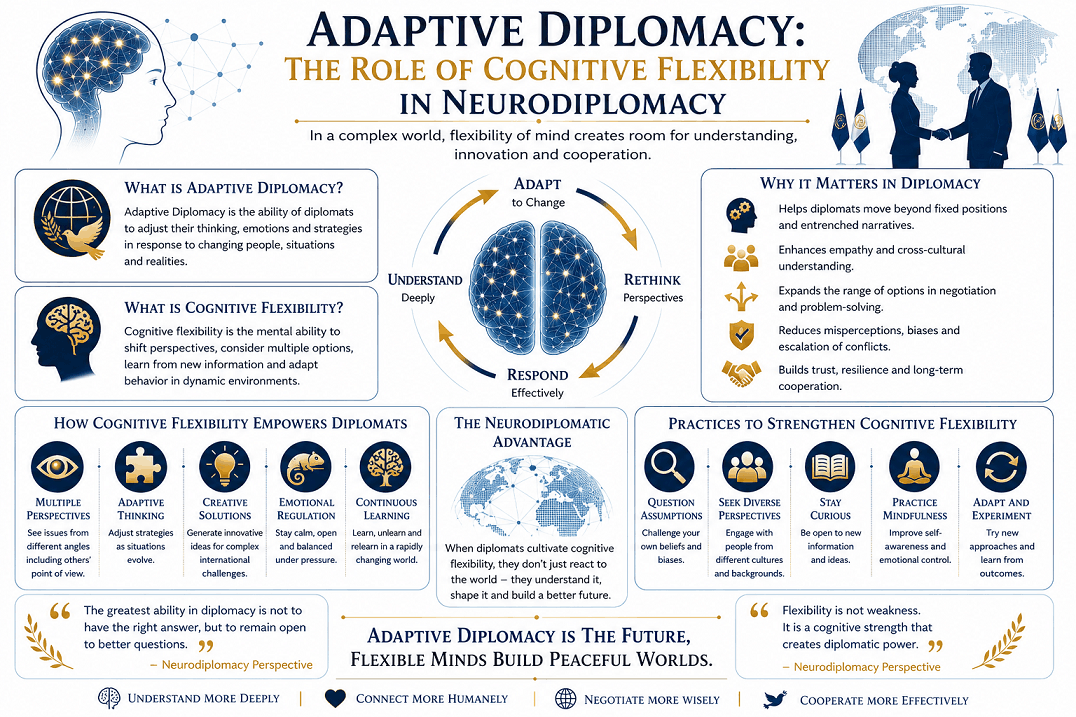
Modern cognitive research emphasizes the importance of cognitive flexibility, which refers to the capacity to:
Shift perspectives.
Adjust thinking patterns.
Consider alternative explanations.
Adapt to new information.
Cognitive flexibility enables individuals to revise their mental models when circumstances change.
In diplomacy, this capacity is crucial because international politics is characterized by:
Uncertainty.
Ambiguity.
Rapid change.
Conflicting information.
Leaders who lack cognitive flexibility may become trapped within rigid interpretations of reality, increasing the likelihood of misperception and policy failure.
Flexibility and the Neurodiplomatic Concept of Perception
As discussed in Neurodiplomacy, political actors respond to their perceptions rather than objective reality.
However, perceptions can become rigid.
Rigid perceptions often produce:
Stereotyping
Strategic miscalculations
Diplomatic deadlock
Escalation of conflicts
Flexibility allows decision-makers to reconsider their perceptions.
Instead of asking:
“How can I defend my existing view?”
flexible diplomats ask:
“What alternative interpretations might exist?”
This capacity to generate multiple perspectives reduces the risk of misperception and improves diplomatic judgment.
Flexibility and the Principle “The Map Is Not the Territory”
The famous principle:
“The map is not the territory”
provides an important neurodiplomatic foundation for flexibility.
If perceptions are merely maps of reality, then no single map can fully capture the complexity of the international environment.
Flexible diplomats recognize that:
Their own map may be incomplete.
Other actors possess different maps.
Multiple interpretations may coexist.
Consequently, flexibility encourages openness to alternative viewpoints and facilitates diplomatic dialogue.
In Neurodiplomacy, flexibility becomes the ability to move among multiple cognitive maps rather than becoming trapped within one.
Flexibility and Diplomatic Negotiation
Diplomatic negotiations often fail because parties become locked into fixed positions.
Rigid negotiation strategies tend to produce:
Polarization
Distrust
Communication breakdowns
Flexible negotiators possess more options.
They can:
Reframe issues.
Explore creative compromises.
Identify shared interests.
Modify communication approaches.
From a neurodiplomatic perspective, negotiation success often depends less on power than on the ability to generate alternative pathways toward agreement.
Flexibility and Emotional Regulation
Neurodiplomacy emphasizes that emotions strongly influence diplomatic behavior.
Fear, anger, humiliation, and anxiety can narrow cognitive focus and reduce flexibility.
Under emotional stress, leaders may:
Become more rigid.
Reject alternative viewpoints.
Overestimate threats.
Escalate conflicts.
Flexible leaders regulate emotions more effectively and maintain the ability to consider multiple options.
This emotional flexibility enhances diplomatic resilience during crises and negotiations.
Flexibility and Strategic Communication
Effective diplomacy requires adapting communication to diverse audiences.
Different actors may possess:
Different cultural backgrounds.
Different values.
Different historical experiences.
Different political priorities.
A rigid communication style may fail across cultural contexts.
Flexible communicators can:
Adjust language.
Modify framing.
Tailor messages.
Increase mutual understanding.
Thus, communicative flexibility becomes a key neurodiplomatic skill.
Flexibility and Trust Building
Trust development often requires adaptability.
When trust is absent, diplomatic actors must experiment with different approaches to relationship-building.
Flexible strategies may include:
Confidence-building measures.
Informal dialogue.
Third-party mediation.
Incremental cooperation.
States that possess multiple diplomatic options are often better positioned to create trust and reduce tensions.
Flexibility in Conflict Resolution
Many international conflicts persist because actors become attached to rigid narratives.
Examples include:
Historical grievances.
Fixed territorial claims.
Exclusive identities.
Zero-sum thinking.
Neurodiplomacy suggests that conflict transformation requires cognitive flexibility.
Peace becomes more achievable when parties can:
Reinterpret historical narratives.
Recognize alternative perspectives.
Imagine different futures.
Generate new diplomatic possibilities.
In this sense, flexibility becomes a prerequisite for reconciliation.
The Neurodiplomatic Principle of Adaptive Choice
Drawing upon the NLP presupposition, a neurodiplomatic principle can be formulated as follows:
The effectiveness of diplomacy increases with the number of cognitive, emotional, communicative, and strategic choices available to diplomatic actors.
This principle highlights the relationship between flexibility and diplomatic success.
The diplomat, negotiator, or leader who possesses the greatest range of adaptive responses is often the most effective in managing complexity and uncertainty.
Applications in Contemporary World Politics
In today’s international environment, flexibility is increasingly important because states confront:
Geopolitical competition
Climate change
Technological disruption
Cybersecurity threats
Global health crises
Transnational conflicts
These challenges require adaptive rather than rigid diplomatic approaches.
Neurodiplomacy suggests that future diplomatic effectiveness will depend on the ability to:
Learn continuously.
Adapt rapidly.
Integrate diverse perspectives.
Generate innovative solutions.
Conclusion
The NLP presupposition “Flexibility means more choices” offers a valuable conceptual contribution to Neurodiplomacy. When interpreted through the lenses of cognitive science, political psychology, and diplomacy, flexibility emerges as a crucial determinant of diplomatic effectiveness. It enables leaders and negotiators to adapt their perceptions, regulate emotions, reconsider assumptions, explore alternative strategies, and respond constructively to complex international challenges.
Within a neurodiplomatic framework, flexibility is not merely a communication technique; it is a cognitive capacity that enhances perception, reduces misperception, strengthens trust-building, and facilitates conflict resolution. In an increasingly uncertain and interconnected world, the ability to generate multiple choices may become one of the most important skills for diplomats and policymakers seeking to navigate the complexities of international relations and global governance.
Neurodiplomatic Maxim
The more flexible the mind, the greater the number of diplomatic possibilities; the greater the number of diplomatic possibilities, the greater the potential for cooperation, conflict resolution, and sustainable peace.