Abstract
Raymond Aron’s Peace and War: A Theory of International Relations (1962; English translation, 1966) remains one of the most significant contributions to the study of International Relations (IR). By integrating diplomacy, strategy, history, sociology, and political philosophy, Aron developed a multidimensional explanation of international politics that transcended the limitations of both idealism and classical realism. While Aron recognized that diplomacy and war are products of political judgment under conditions of uncertainty, his work preceded the emergence of contemporary cognitive science, political psychology, and neuroscience. Consequently, the neurocognitive foundations of strategic judgment, perception, and diplomatic decision-making remain largely unexplored within his framework.
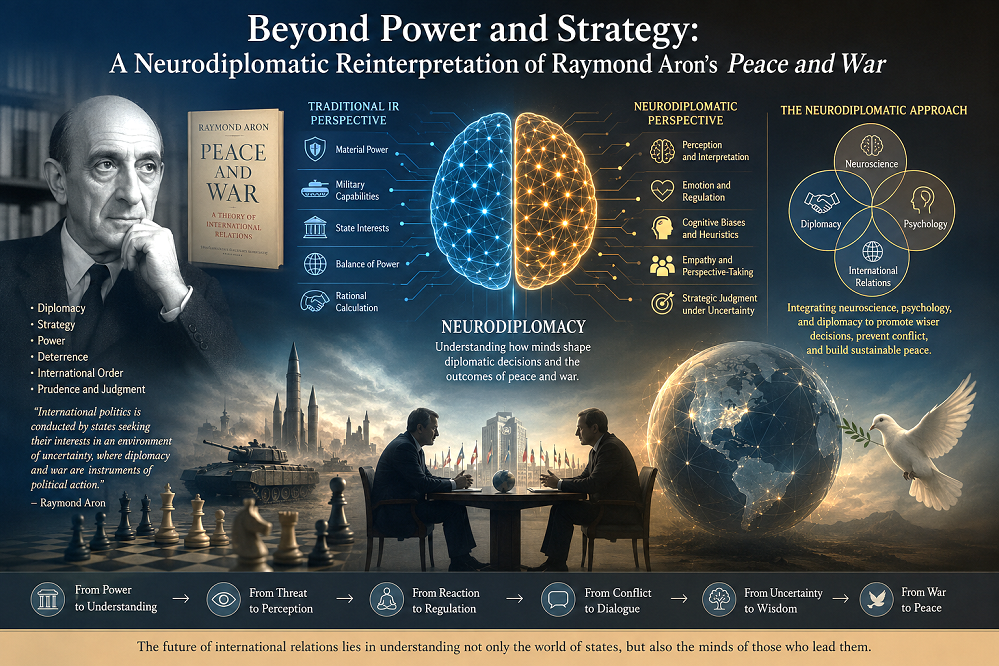
This article argues that neurodiplomacy provides an important extension of Aron’s theory by incorporating insights from neuroscience, cognitive psychology, political psychology, and decision science into the study of diplomacy and international relations. Rather than replacing Aron’s theoretical framework, neurodiplomacy complements it by explaining how policymakers perceive threats, process information, regulate emotions, construct strategic narratives, and make foreign policy decisions. The article demonstrates that Aron’s concepts of diplomacy, power, deterrence, prudence, and strategic judgment acquire additional explanatory power when examined through a neurocognitive lens. It concludes that neurodiplomacy represents an evolutionary development in International Relations by shifting the analytical focus from the external behavior of states to the cognitive processes underlying state behavior.
Keywords: Neurodiplomacy; Raymond Aron; Peace and War; International Relations Theory; Foreign Policy Decision-Making; Political Psychology; Cognitive Science; Diplomacy.
1. Introduction
Few scholars have influenced the study of International Relations as profoundly as Raymond Aron. At a time when the Cold War dominated global politics, Aron sought to develop a theory capable of explaining both conflict and cooperation without reducing international politics to either moral idealism or mechanical power calculations. His landmark work, Peace and War: A Theory of International Relations, argued that diplomacy and military strategy are inseparable dimensions of statecraft operating within an international system characterized by uncertainty and the absence of a central governing authority.
Aron’s work remains highly influential because it integrates historical analysis with political realism while recognizing the importance of ideology, diplomacy, and strategic judgment. Yet, despite its sophistication, Peace and War was written before the emergence of modern neuroscience and the rapid development of research on cognition, emotion, and decision-making. As a result, Aron explains what states and leaders do, but provides less detail about how leaders cognitively arrive at those decisions.
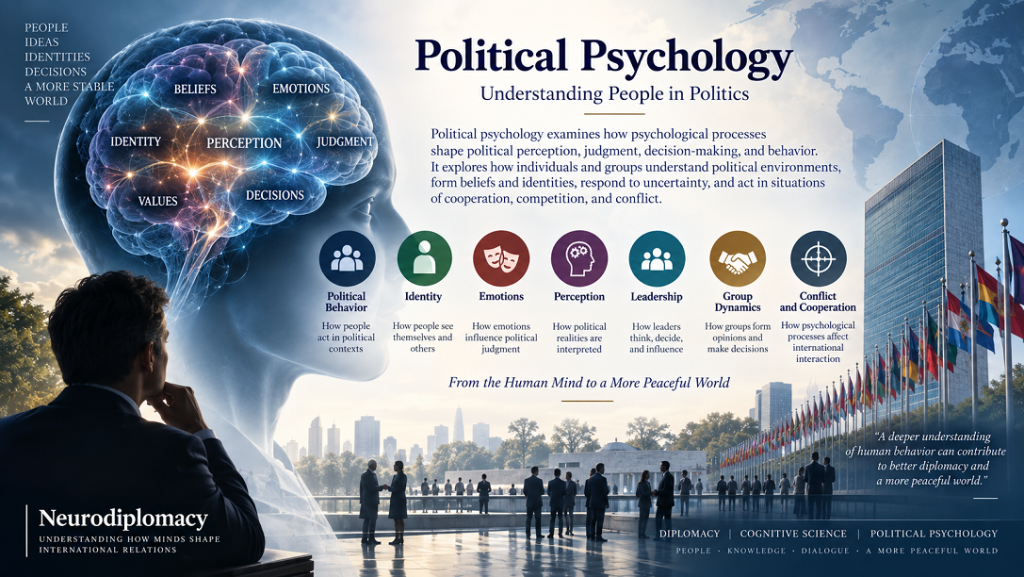
This article proposes that neurodiplomacy fills this gap. By integrating insights from neuroscience, cognitive psychology, and Foreign Policy Analysis, neurodiplomacy offers a framework for understanding how diplomatic decisions emerge from the interaction of perception, emotion, memory, reasoning, and institutional processes. In doing so, it complements Aron’s theory without challenging its central premises.
2. Raymond Aron’s Understanding of Peace and War
Aron rejected simplistic distinctions between peace and war. For him, they represented different expressions of political interaction rather than mutually exclusive conditions. Peace was maintained through diplomacy, deterrence, alliances, and negotiated cooperation, while war represented the breakdown—or deliberate continuation—of political interaction through organized violence.
Central to Aron’s theory is the proposition that states pursue their interests within an international environment lacking a supreme authority. This condition creates permanent uncertainty. Consequently, diplomacy and military power coexist as complementary instruments through which states attempt to secure their objectives.
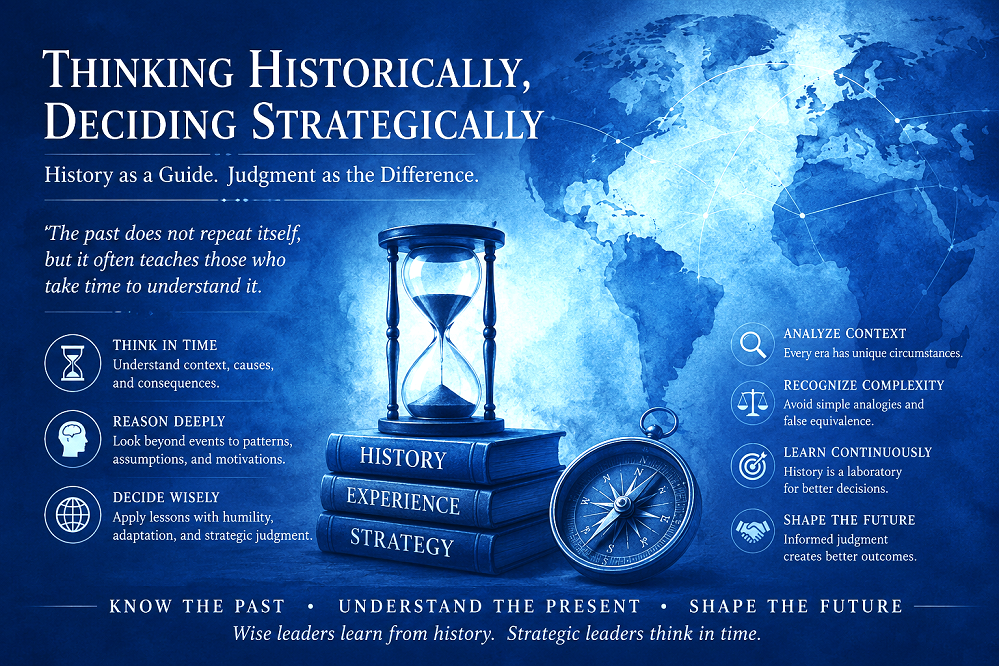
Unlike deterministic theories, Aron emphasized the importance of prudence, historical understanding, and political judgment. Leaders must interpret changing circumstances and adapt their policies accordingly. These observations make his work especially compatible with contemporary neurodiplomatic perspectives.
3. Neurodiplomacy: A Cognitive Extension of Aron’s Theory
Neurodiplomacy begins with a simple but profound assumption:
International politics is conducted by human beings whose perceptions, emotions, cognitive limitations, and neural processes shape diplomatic behavior.
Traditional International Relations theories primarily explain state behavior through material capabilities, institutional arrangements, or systemic structures. Neurodiplomacy argues that these factors are interpreted through the minds of policymakers before becoming foreign policy decisions.
This perspective does not reject structural explanations; rather, it introduces an additional analytical level between the international system and state behavior: the neurocognitive processes of decision-makers.
Applied to Aron’s work, neurodiplomacy helps explain why equally powerful states often respond differently to similar strategic environments. Differences arise not only from external conditions but also from variations in perception, emotional regulation, institutional culture, and cognitive interpretation.
4. Perception and Strategic Reality
One of Aron’s recurring themes is that international politics is characterized by uncertainty. States rarely possess complete information about the intentions or capabilities of others. Diplomatic decisions therefore depend on interpretation rather than certainty.
Neurodiplomacy extends this argument by emphasizing that perception is an active cognitive process. Policymakers do not merely observe reality; they construct mental representations based on previous experiences, beliefs, institutional assumptions, and emotional responses.
This insight has profound implications. Security dilemmas, alliance formation, and crisis escalation often emerge because states interpret identical events differently. Thus, international politics is shaped not only by objective realities but also by subjective cognitive realities.
5. Diplomacy Beyond Rational Calculation
Aron’s analysis assumes that diplomacy requires prudence, judgment, and strategic calculation. However, modern neuroscience demonstrates that rational analysis cannot be separated from emotional processes.
Research on decision-making indicates that emotions are essential for evaluating risks, prioritizing alternatives, and anticipating future consequences. Fear, trust, hope, and empathy all influence diplomatic behavior.
Neurodiplomacy therefore reframes diplomacy as a process involving both analytical reasoning and emotional intelligence. Successful diplomats must regulate emotions without eliminating them, balancing strategic calculation with the capacity to understand the perspectives and motivations of others.
This perspective strengthens Aron’s emphasis on prudence by providing a neurocognitive explanation for why emotional regulation is indispensable to effective statecraft.
6. Power, Deterrence, and Cognitive Interpretation
Aron viewed power as multidimensional, encompassing military, economic, political, and ideological capabilities. Yet power influences international politics only when it is perceived as credible.
From a neurodiplomatic perspective, deterrence is fundamentally cognitive. It depends on how adversaries interpret intentions, evaluate credibility, and assess risks. Nuclear weapons, for example, achieve deterrent value not merely because they exist but because decision-makers believe they may be used under certain circumstances.
Thus, strategic stability relies upon communication, perception, and mutual understanding as much as material capability. Misperceptions, cognitive biases, or failures of communication may undermine deterrence even when military balances remain unchanged.
7. The Neurodiplomatic Institutional Decision-Making Model (NIDM) and Aron’s Theory
The Neurodiplomatic Institutional Decision-Making Model (NIDM) offers a practical framework that complements Aron’s understanding of diplomacy and strategy.
The model proposes seven interconnected stages:
- Strategic information acquisition.
- Cognitive filtering and prioritization.
- Neurocognitive analysis.
- Emotional regulation.
- Strategic integration.
- Decision implementation.
- Institutional learning and adaptation.
Applied to Aron’s framework, NIDM demonstrates how foreign ministries, national security councils, and diplomatic institutions transform information into policy decisions. It also highlights the importance of continuous institutional learning, reducing cognitive biases, and improving decision quality in complex international environments.
8. Information Explosion and Contemporary Diplomacy
One challenge largely absent from Aron’s era is today’s information explosion. Modern policymakers confront enormous volumes of intelligence, media reports, satellite imagery, cyber data, and real-time communication.
While access to information has expanded dramatically, human cognitive capacity has not increased at the same pace.
Neurodiplomacy argues that future diplomatic effectiveness depends less on acquiring additional information than on managing attention, reducing cognitive overload, and distinguishing relevant signals from informational noise.
This insight extends Aron’s theory into the digital age, where the principal challenge is increasingly cognitive rather than informational.
9. Neurodiplomacy and the Future of Peace
Aron believed that peace depends upon prudence, diplomacy, deterrence, and political judgment. Neurodiplomacy agrees but suggests that each of these concepts rests upon neurocognitive foundations.
Long-term peace requires:
- Accurate perception of intentions.
- Strategic empathy.
- Emotional self-regulation.
- Institutional learning.
- Cognitive flexibility.
- Resilience against misinformation and polarization.
Accordingly, peace is not only an institutional achievement but also a cognitive achievement. Diplomatic institutions that understand how minds process uncertainty and conflict are better equipped to prevent escalation and sustain cooperation.
Conclusion
Raymond Aron’s Peace and War remains one of the most sophisticated analyses of diplomacy, strategy, and international politics. Its enduring value lies in demonstrating that international relations cannot be reduced to military power or abstract systemic models; they require historical understanding, prudence, and political judgment.
Neurodiplomacy enriches this intellectual legacy by adding a new level of analysis: the neurocognitive processes through which policymakers perceive, interpret, and respond to international events. Rather than replacing Aron’s theory, neurodiplomacy extends it into the twenty-first century by integrating contemporary research on cognition, emotion, neuroscience, and institutional decision-making.
Together, Aron and neurodiplomacy offer a more comprehensive understanding of world politics. Aron explains the structural and strategic dynamics of peace and war, while neurodiplomacy explains the cognitive mechanisms that shape diplomatic judgment within those dynamics.
The future of International Relations scholarship may therefore lie in integrating classical strategic thought with modern cognitive science. Such an interdisciplinary synthesis has the potential to improve not only theoretical understanding but also the practical quality of foreign policy decision-making, conflict prevention, and international cooperation in an increasingly complex and uncertain world.
Reference
- Aron, R. (1966). Peace and war: A theory of international relations (R. Howard & A. B. Fox, Trans.). Doubleday. (Original work published 1962)