Understanding Politics and Human Behavior
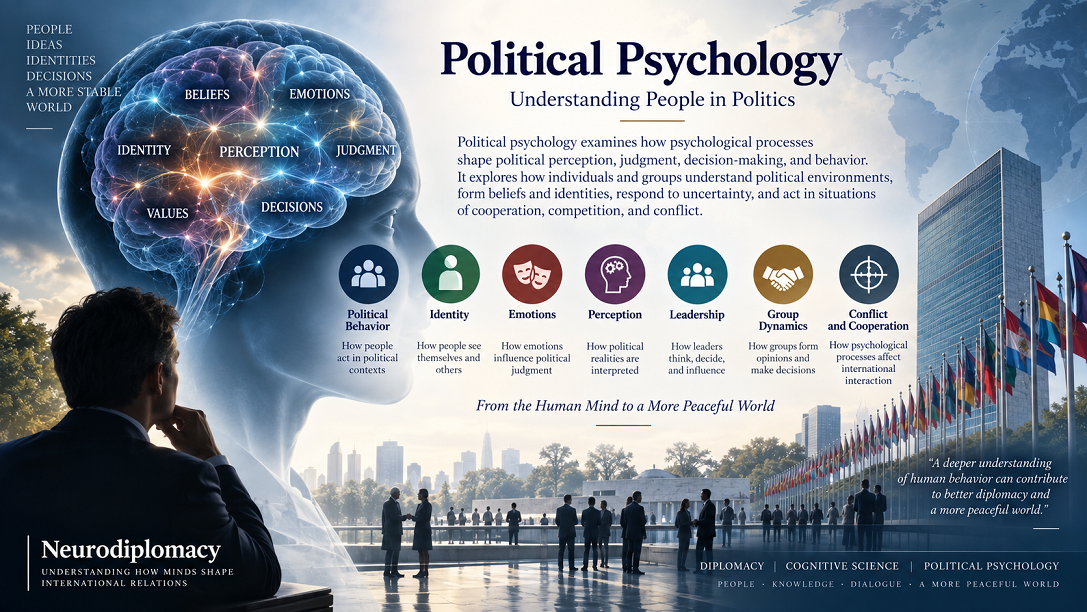
Political Psychology is the interdisciplinary scientific study of how psychological processes influence political behavior, decision-making, and political institutions. It seeks to understand how individuals and groups perceive political events, form political beliefs, make judgments about leaders and public policies, and behave in domestic and international political environments. By examining the interaction between psychology and politics, political psychology provides valuable insights into the cognitive, emotional, and social foundations of political behavior.
What makes political psychology particularly unique is its interdisciplinary approach. Rather than relying on a single discipline, it integrates knowledge from psychology, political science, sociology, neuroscience, history, communication studies, economics, and behavioral sciences. This combination enables researchers to examine political behavior from multiple perspectives and develop a more comprehensive understanding of how people think and act in political contexts.
In today’s increasingly interconnected and polarized world, political psychology plays an essential role in understanding elections, leadership, public opinion, diplomacy, conflict, international relations, and public policy. As political decisions become more complex and information environments become more saturated, the insights provided by political psychology have become increasingly valuable for governments, international organizations, businesses, and civil society.
What Is Political Psychology?
Political Psychology can be defined as the interdisciplinary scientific study of the psychological mechanisms underlying political behavior, political decision-making, political attitudes, leadership, group behavior, and international relations.
The field seeks to answer fundamental questions about how people develop political beliefs, perceive political threats, evaluate leaders, participate in political systems, and respond to social and international challenges. It examines how emotions, perceptions, values, identities, motivations, memory, reasoning, and social influences shape political judgment and behavior.
At its core, political psychology views political behavior as the product of interactions between individual cognition and broader social, cultural, institutional, and political environments. Political decisions are not determined solely by objective facts or rational calculations but are also influenced by perception, emotion, identity, and cognitive processes.
Political psychology is not limited to the study of voters and political leaders. It also examines diplomacy, negotiation, conflict resolution, public opinion, political communication, nationalism, ideology, terrorism, social movements, and international cooperation. Consequently, it serves as an important bridge between psychology and political science.
The Origins of Political Psychology
Political psychology emerged as a distinct field during the twentieth century as scholars sought to explain political behavior using insights from psychology. While classical political theory often emphasized institutions, laws, and rational decision-making, political psychologists became increasingly interested in understanding the mental processes that shape political choices.
The development of modern psychology, psychoanalysis, social psychology, and cognitive psychology significantly influenced the emergence of political psychology. Following the Second World War, scholars became particularly interested in explaining authoritarianism, propaganda, mass behavior, prejudice, political leadership, and international conflict.
The cognitive revolution of the 1950s and 1960s further transformed the field by shifting attention toward perception, information processing, decision-making, and judgment. Later developments in behavioral economics, neuroscience, and cognitive science expanded political psychology even further, providing new methods for studying the relationship between mind and politics.
Today, political psychology has become one of the most dynamic areas of political science and international relations.
The Interdisciplinary Nature of Political Psychology
One of the defining characteristics of political psychology is its interdisciplinary nature. Understanding political behavior requires contributions from multiple academic disciplines.
Psychology
Psychology contributes knowledge about perception, personality, motivation, attitudes, learning, emotion, memory, cognitive biases, and decision-making. Political psychologists examine how these processes influence political judgments and behavior.
Political Science
Political science provides theories of political institutions, governance, public policy, elections, international relations, comparative politics, and political behavior. These theories provide the broader context within which psychological processes operate.
Neuroscience
Neuroscience investigates the biological foundations of political behavior by examining how the brain processes information, regulates emotions, evaluates risks, and makes decisions. Advances in neuroimaging have expanded understanding of the neural mechanisms underlying political judgment.
Sociology
Sociology contributes knowledge about social identity, group behavior, social norms, culture, institutions, and collective action. Political psychologists investigate how social environments influence political beliefs and participation.
Communication Studies
Political communication examines how media, political campaigns, public discourse, framing, and persuasion influence political attitudes and public opinion.
Economics and Behavioral Economics
Behavioral economics contributes insights into decision-making under uncertainty, bounded rationality, heuristics, and cognitive biases, helping explain why political decisions often diverge from purely rational models.
Together, these disciplines provide a comprehensive framework for understanding political behavior in both domestic and international contexts.
Major Areas of Study in Political Psychology
Political Perception
Political perception refers to the way individuals interpret political information, leaders, institutions, and international events. Researchers investigate how perception shapes political attitudes and strategic judgments.
Political Attitudes
Political attitudes include beliefs, values, preferences, and ideological orientations. Political psychologists examine how these attitudes develop and change over time.
Identity
Political identity involves individuals’ identification with nations, ethnic groups, political parties, religions, or social movements. Identity strongly influences political behavior and international relations.
Leadership
Leadership is a central area of political psychology. Researchers study the personalities, cognitive styles, motivations, and decision-making processes of political leaders and how these characteristics affect governance and foreign policy.
Decision-Making
Political decision-making examines how leaders and citizens evaluate alternatives, assess risks, process information, and make political choices under conditions of uncertainty.
Emotions
Emotions such as fear, hope, trust, anger, pride, and empathy significantly influence political behavior. Political psychologists investigate how emotional responses affect voting, negotiations, diplomacy, and conflict.
Group Behavior
Individuals rarely make political decisions in isolation. Political psychology studies group dynamics, conformity, polarization, groupthink, leadership influence, and collective decision-making.
Political Communication
Political communication explores how language, narratives, metaphors, symbols, and media shape public understanding of political events and influence political behavior.
Why Is Political Psychology Important?
Understanding Political Behavior
The primary importance of political psychology lies in its ability to explain why people think and behave politically as they do. It helps scholars understand voting behavior, political participation, ideological change, and leadership.
Improving Public Policy
Political psychology provides policymakers with insights into public opinion, risk perception, motivation, and behavioral responses. These insights improve policy design, implementation, and communication.
Enhancing Diplomacy and International Relations
Political psychology contributes significantly to diplomacy by explaining how perceptions, identities, trust, emotions, and cognitive biases influence negotiations and interstate relations. Understanding these psychological processes helps diplomats reduce misunderstanding and build cooperation.
Strengthening Democratic Governance
Healthy democracies depend upon informed citizens, constructive political dialogue, and public trust. Political psychology helps explain political polarization, misinformation, political participation, and civic engagement.
Preventing Conflict
Many international and domestic conflicts arise from misperception, identity conflicts, prejudice, fear, and communication failures. Political psychology offers valuable tools for conflict prevention, mediation, and reconciliation.
Improving Political Leadership
Political psychology helps leaders better understand their own decision-making processes, recognize cognitive biases, communicate more effectively, and make more informed strategic choices.
Political Psychology in Everyday Life
Although many people associate political psychology exclusively with elections or governments, its influence extends into everyday life. It shapes how individuals interpret news, respond to political messages, evaluate public policies, trust institutions, and engage in civic activities.
Political psychology also influences how governments communicate during crises, how organizations manage public relations, how media frame political events, and how citizens respond to social change. From election campaigns and diplomatic negotiations to public health communication and conflict resolution, political psychology plays an increasingly important role in contemporary society.
Its influence extends well beyond academic research and directly affects how people understand politics, communicate with one another, make collective decisions, and participate in democratic life.
Conclusion
Political Psychology is the interdisciplinary scientific study of the psychological foundations of political behavior, leadership, decision-making, and international relations. By integrating insights from psychology, political science, neuroscience, sociology, communication studies, and behavioral sciences, it seeks to explain how individuals and groups perceive political events, form political attitudes, make decisions, and interact within political systems.
Its importance extends across public policy, diplomacy, international relations, elections, governance, conflict resolution, leadership, and political communication. By helping us understand the psychological dimensions of politics, political psychology provides valuable tools for improving democratic governance, strengthening diplomacy, enhancing decision-making, and reducing political conflict.
In an age increasingly characterized by global interdependence, technological transformation, information overload, and geopolitical uncertainty, political psychology offers one of the most powerful frameworks for understanding political behavior and international affairs. Ultimately, it is not merely the study of politics – it is the scientific study of how the human mind shapes political life.