Understanding the Mind and Intelligence
Cognitive Science is the scientific study of the mind, intelligence, and mental processes. It seeks to understand how humans acquire, process, store, and use information. By examining how people think, learn, reason, perceive, and communicate, cognitive science provides valuable insights into the nature of human intelligence and behavior.
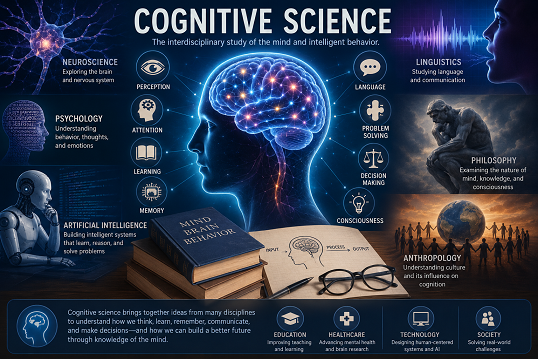
What makes cognitive science particularly unique is its interdisciplinary approach. Rather than relying on a single field of study, it combines knowledge from psychology, neuroscience, computer science, linguistics, philosophy, anthropology, education, and artificial intelligence. This integration of perspectives allows researchers to explore the mind from multiple angles and develop a more comprehensive understanding of cognition.
In today’s rapidly evolving world, cognitive science plays an increasingly important role in shaping education, healthcare, technology, artificial intelligence, and our understanding of human behavior. As society becomes more dependent on intelligent systems and information processing, the insights provided by cognitive science have become more valuable than ever.
What Is Cognitive Science?
Cognitive Science can be defined as the interdisciplinary scientific study of the mind and its processes, including perception, attention, memory, language, learning, reasoning, decision-making, and consciousness.
The field seeks to answer fundamental questions about how intelligent systems—both human and artificial—process information and interact with their environments. It examines how people receive information through their senses, interpret that information, store it in memory, make decisions based on it, and use it to solve problems.
At its core, cognitive science views the mind as an information-processing system. Just as computers receive, process, store, and retrieve information, the human mind performs similar functions, although in far more complex and sophisticated ways.
However, cognitive science is not limited to understanding human cognition. It also explores whether intelligence can be replicated in machines and how artificial systems can be designed to learn, reason, and make decisions.
The Origins of Cognitive Science
Cognitive science emerged during the mid-twentieth century as scholars sought new ways to understand human thought and behavior. Earlier psychological approaches often focused primarily on observable behavior, while cognitive scientists became interested in the mental processes occurring inside the mind.
The development of computers provided a powerful metaphor for understanding cognition. Researchers began comparing the human mind to an information-processing system capable of receiving inputs, performing computations, and producing outputs.
This shift led to what became known as the “Cognitive Revolution,” which transformed the study of the mind and laid the foundation for modern cognitive science.
Since then, advances in neuroscience, artificial intelligence, brain imaging technology, and computational modeling have significantly expanded the field’s scope and capabilities.
The Interdisciplinary Nature of Cognitive Science
One of the defining characteristics of cognitive science is its interdisciplinary nature. Understanding the human mind is an extremely complex challenge that requires contributions from multiple disciplines.
Psychology
Psychology contributes knowledge about human behavior, learning, memory, perception, emotions, and decision-making. Cognitive psychologists study how mental processes influence actions and experiences.
Neuroscience
Neuroscience investigates the biological foundations of cognition by examining the structure and function of the brain and nervous system. Through brain imaging and neurological research, scientists can identify the neural mechanisms underlying thought and behavior.
Computer Science and Artificial Intelligence
Computer science provides computational models that help researchers understand how information is processed. Artificial intelligence seeks to develop machines capable of performing tasks that typically require human intelligence, such as learning, reasoning, and problem-solving.
Linguistics
Linguistics studies language structure, meaning, and communication. Cognitive scientists investigate how humans acquire language, understand speech, and use language to express thoughts and ideas.
Philosophy
Philosophy explores fundamental questions about the nature of knowledge, consciousness, intelligence, and the mind. Philosophical inquiry helps clarify concepts and assumptions that guide cognitive research.
Anthropology
Anthropology contributes insights into how culture influences cognition, behavior, and communication. It examines how different societies perceive and interpret the world.
Together, these disciplines create a comprehensive framework for understanding the complexities of human thought and intelligence.
Major Areas of Study in Cognitive Science
Perception
Perception refers to the process through which individuals interpret information from their environment. Cognitive scientists study how people recognize objects, faces, sounds, and patterns.
Understanding perception helps explain how humans construct meaningful experiences from sensory information.
Attention
Attention involves focusing mental resources on specific information while ignoring distractions. Researchers examine how attention operates, why it is limited, and how it affects learning and performance.
Memory
Memory is one of the most important areas of cognitive science. Researchers investigate how information is encoded, stored, and retrieved.
Studies of memory help explain how people learn, recall experiences, and adapt their behavior based on past events.
Learning
Learning involves acquiring new knowledge, skills, and behaviors. Cognitive scientists study how learning occurs and how educational methods can be improved to enhance understanding and retention.
Language
Language is a uniquely human capability that allows complex communication and abstract thinking. Cognitive scientists explore how language is acquired, processed, understood, and produced.
Reasoning and Problem Solving
Humans constantly make decisions and solve problems. Cognitive science investigates the mental processes involved in reasoning, judgment, creativity, and critical thinking.
Decision-Making
Decision-making research examines how individuals evaluate options, assess risks, and choose among alternatives. Understanding these processes has important implications for economics, business, public policy, and psychology.
Consciousness
Consciousness remains one of the most profound mysteries in science. Cognitive scientists explore questions about self-awareness, subjective experience, and the nature of conscious thought.
Why Is Cognitive Science Important?
Understanding Human Intelligence
The primary importance of cognitive science lies in its ability to explain how the human mind works. By studying cognition, researchers gain insights into how people think, learn, reason, and interact with their environments.
Understanding intelligence helps answer fundamental questions about human nature and behavior.
Improving Education
Cognitive science has transformed educational theory and practice. Research on learning, memory, attention, and motivation helps educators design more effective teaching methods.
By understanding how students process information, educators can develop strategies that improve learning outcomes and academic performance.
Advancing Artificial Intelligence
Modern artificial intelligence owes much of its development to cognitive science. Researchers use insights from human cognition to create intelligent systems capable of learning, reasoning, and problem-solving.
As AI continues to influence industries and societies worldwide, cognitive science remains central to its advancement.
Enhancing Healthcare and Mental Health
Cognitive science contributes significantly to healthcare by improving our understanding of neurological and psychological conditions.
Research on cognition helps professionals diagnose and treat disorders affecting memory, attention, language, and decision-making. It also supports rehabilitation programs for individuals recovering from brain injuries and neurological illnesses.
Improving Human-Technology Interaction
Technology is most effective when it aligns with human cognitive abilities. Cognitive science helps designers create user-friendly software, websites, mobile applications, and digital tools.
By understanding how people think and process information, developers can design systems that are intuitive, efficient, and accessible.
Supporting Business and Organizational Success
Organizations increasingly rely on cognitive science to improve decision-making, leadership, communication, and employee performance.
Understanding cognitive biases, motivation, and problem-solving enables businesses to make better strategic decisions and create more effective work environments.
Solving Complex Global Problems
Many modern challenges require an understanding of human behavior. Climate change, public health, misinformation, political polarization, and technological ethics all involve cognitive processes.
Cognitive science provides valuable insights that help policymakers and organizations design effective solutions to these complex issues.
Cognitive Science in Everyday Life
Although many people may not realize it, cognitive science influences daily life in countless ways. It affects how students learn, how businesses market products, how doctors diagnose conditions, how technology is designed, and how governments develop public policies.
From the recommendation algorithms used by streaming platforms to educational apps and medical diagnostic tools, cognitive science plays a vital role in shaping modern society.
Its influence extends far beyond academic research and directly impacts how people live, work, communicate, and make decisions.
Conclusion
Cognitive Science is the interdisciplinary study of the mind, intelligence, and mental processes. By combining insights from psychology, neuroscience, computer science, linguistics, philosophy, and other fields, it seeks to understand how humans perceive, learn, remember, reason, communicate, and make decisions.
Its importance extends across education, healthcare, artificial intelligence, technology, business, and public policy. By helping us understand how the mind works, cognitive science provides the foundation for improving learning, enhancing human performance, advancing intelligent technologies, and addressing some of society’s most complex challenges.
In an age increasingly defined by information, technology, and innovation, cognitive science offers one of the most powerful tools for understanding both human intelligence and the future of intelligent systems. Ultimately, it is not merely the study of how we think—it is the study of what makes us human.