Introduction
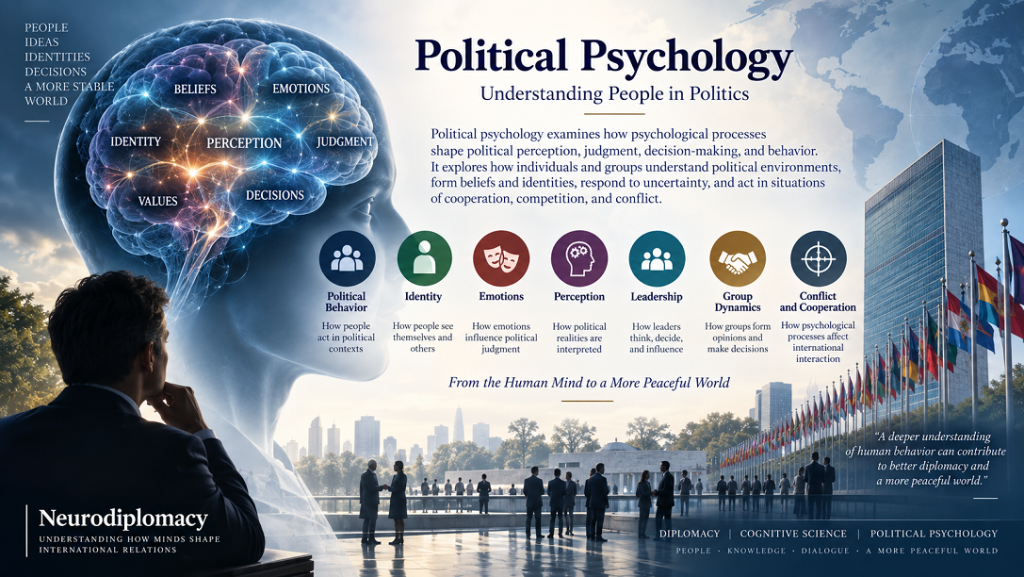
Neurodiplomacy is an emerging interdisciplinary field that examines how cognition, perception, emotion, communication, and decision-making shape diplomacy and international relations. Although the term Neurodiplomacy is relatively new, the intellectual foundations upon which it rests have been developing for almost a century.
Rather than emerging from a single discipline, Neurodiplomacy integrates insights from political science, diplomacy, political psychology, cognitive psychology, neuroscience, behavioral economics, communication studies, decision science, and international relations theory. Each of these disciplines has contributed essential concepts that help explain how diplomats, political leaders, and foreign policy institutions perceive international events, interpret information, construct meaning, negotiate agreements, and make strategic decisions.
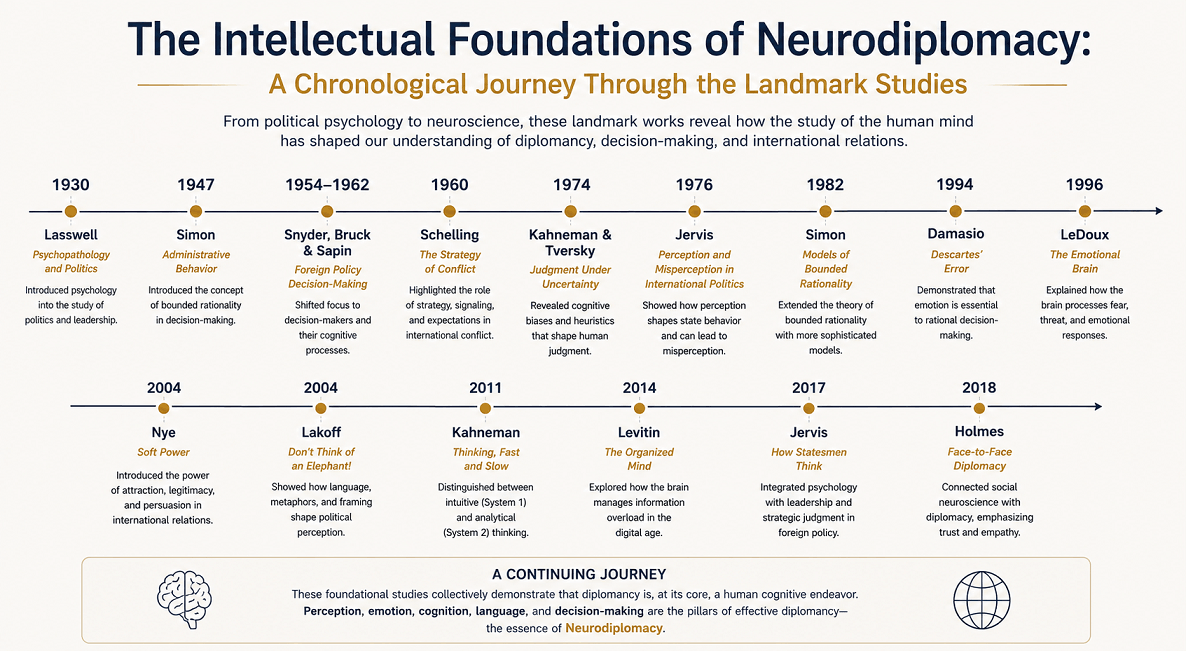
The following landmark studies are presented chronologically to illustrate the historical evolution of ideas that collectively form the scientific and theoretical foundations of Neurodiplomacy.
1930
Harold D. Lasswell
Psychopathology and Politics
Harold D. Lasswell was among the first political scientists to argue that political behavior cannot be understood solely through institutions or ideology. Instead, he demonstrated that political leadership is profoundly influenced by personality, motivation, emotion, and unconscious psychological processes.
His pioneering work shifted political analysis from external political structures toward the psychological characteristics of leaders themselves. In doing so, Lasswell established one of the earliest intellectual bridges between psychology and political science.
Contribution to Neurodiplomacy
- Introduced psychology into political analysis.
- Demonstrated that leadership behavior is influenced by personality.
- Established the importance of psychological variables in politics.
Reference
Lasswell, H. D. (1930). Psychopathology and politics. University of Chicago Press.
1947
Herbert A. Simon
Administrative Behavior
Herbert Simon fundamentally transformed the study of decision-making by introducing the concept of bounded rationality. Contrary to classical assumptions that decision-makers possess complete information and unlimited cognitive capacity, Simon argued that human beings operate under severe limitations of time, knowledge, and mental processing.
Decision-makers therefore “satisfice” rather than optimize.
This insight remains one of the central theoretical foundations of Neurodiplomatic decision-making.
Contribution to Neurodiplomacy
- Explains cognitive limitations in diplomacy.
- Demonstrates realistic foreign policy decision-making.
- Introduces bounded rationality.
Reference
Simon, H. A. (1997). Administrative behavior: A study of decision-making processes in administrative organizations (4th ed.). Free Press. (Original work published 1947)
1954–1962
Richard C. Snyder, H. W. Bruck & Burton Sapin
Foreign Policy Decision-Making
This landmark study revolutionized foreign policy analysis by shifting attention from states as abstract actors toward the individuals responsible for making foreign policy decisions.
The authors argued that international politics should be understood through the perceptions, judgments, and decisions of policymakers rather than through structural variables alone.
Contribution to Neurodiplomacy
- Established decision-makers as the primary unit of analysis.
- Connected cognition with foreign policy.
- Created the foundations of cognitive foreign policy analysis.
Reference
Snyder, R. C., Bruck, H. W., & Sapin, B. (1962). Foreign policy decision-making: An approach to the study of international politics. Free Press.
1960
Thomas C. Schelling
The Strategy of Conflict
Thomas Schelling demonstrated that diplomacy depends upon signaling, credibility, communication, and expectations rather than military force alone.
His strategic theory highlighted the cognitive dimensions of negotiation and conflict management.
Contribution to Neurodiplomacy
- Explains strategic communication.
- Demonstrates the importance of perception.
- Connects cognition with negotiation.
Reference
Schelling, T. C. (1960). The strategy of conflict. Harvard University Press.
1974
Daniel Kahneman & Amos Tversky
Judgment Under Uncertainty
Kahneman and Tversky transformed cognitive psychology by identifying heuristics and cognitive biases that systematically influence human judgment.
Their work demonstrated that people often make predictable errors when making complex decisions under uncertainty.
Contribution to Neurodiplomacy
- Explains cognitive biases.
- Demonstrates limitations of rational judgment.
- Supports evidence-based diplomatic decision-making.
Reference
Kahneman, D., & Tversky, A. (1974). Judgment under uncertainty: Heuristics and biases. Science, 185(4157), 1124–1131.
1976
Robert Jervis
Perception and Misperception in International Politics
Few books have influenced Neurodiplomatic thinking as profoundly as Jervis’s classic work.
Jervis demonstrated that statesmen rarely respond to objective reality itself; rather, they respond to their perceptions of reality.
Contribution to Neurodiplomacy
- Places perception at the center of diplomacy.
- Explains misperception and cognitive bias.
- Foundation of cognitive international relations.
Reference
Jervis, R. (1976). Perception and misperception in international politics. Princeton University Press.
1982
Herbert A. Simon
Models of Bounded Rationality
Simon expanded his theory of bounded rationality by developing more sophisticated models of realistic human decision-making.
Contribution to Neurodiplomacy
- Extends bounded rationality.
- Strengthens cognitive approaches to foreign policy.
- Supports adaptive decision-making.
Reference
Simon, H. A. (1982). Models of bounded rationality (Vols. 1–2). MIT Press.
1994
Antonio Damasio
Descartes’ Error
Antonio Damasio demonstrated that emotions are not obstacles to rational thinking but essential components of intelligent decision-making.
His research fundamentally reshaped neuroscience and decision science.
Contribution to Neurodiplomacy
- Explains emotional decision-making.
- Connects neuroscience with diplomacy.
- Demonstrates the role of emotions in judgment.
Reference
Damasio, A. R. (1994). Descartes’ error: Emotion, reason, and the human brain. G. P. Putnam’s Sons.
1996
Joseph LeDoux
The Emotional Brain
LeDoux explained how the brain processes fear, threat, and emotional responses.
His research is particularly relevant for understanding crisis diplomacy and international security.
Contribution to Neurodiplomacy
- Explains threat perception.
- Supports crisis decision-making.
- Connects neuroscience with international security.
Reference
LeDoux, J. (1996). The emotional brain: The mysterious underpinnings of emotional life. Simon & Schuster.
2004
Joseph S. Nye Jr.
Soft Power
Joseph Nye demonstrated that attraction, legitimacy, and persuasion constitute major sources of international influence.
Contribution to Neurodiplomacy
- Connects perception with influence.
- Explains psychological dimensions of diplomacy.
- Foundation of public diplomacy.
Reference
Nye, J. S., Jr. (2004). Soft power: The means to success in world politics. PublicAffairs.
2004
George Lakoff
Don’t Think of an Elephant!
Lakoff demonstrated that political language, metaphors, and framing shape how people interpret political reality.
Contribution to Neurodiplomacy
- Explains diplomatic framing.
- Shows how language shapes perception.
- Supports strategic communication.
Reference
Lakoff, G. (2004). Don’t think of an elephant!: Know your values and frame the debate. Chelsea Green Publishing.
2011
Daniel Kahneman
Thinking, Fast and Slow
Kahneman synthesized decades of cognitive research by distinguishing intuitive and analytical thinking.
Contribution to Neurodiplomacy
- Explains intuitive diplomatic judgment.
- Clarifies analytical reasoning.
- Supports strategic decision-making.
Reference
Kahneman, D. (2011). Thinking, fast and slow. Farrar, Straus and Giroux.
2014
Daniel J. Levitin
The Organized Mind
Levitin examined how the human brain manages information overload in the digital age.
Contribution to Neurodiplomacy
- Explains information overload.
- Supports digital diplomacy.
- Improves cognitive efficiency.
Reference
Levitin, D. J. (2014). The organized mind: Thinking straight in the age of information overload. Dutton.
2017
Robert Jervis
How Statesmen Think
Jervis expanded his earlier work by integrating psychology with foreign policy leadership and strategic judgment.
Contribution to Neurodiplomacy
- Explains leadership cognition.
- Demonstrates psychological dimensions of diplomacy.
- Bridges political psychology and international relations.
Reference
Jervis, R. (2017). How statesmen think: The psychology of international politics. Princeton University Press.
2018
Marcus Holmes
Face-to-Face Diplomacy
Marcus Holmes introduced social neuroscience into diplomatic studies by demonstrating how trust, empathy, and interpersonal interaction influence negotiations.
Contribution to Neurodiplomacy
- Connects neuroscience with diplomacy.
- Explains face-to-face interaction.
- Represents one of the closest predecessors to Neurodiplomacy.
Reference
Holmes, M. (2018). Face-to-face diplomacy: Social neuroscience and international relations. Cambridge University Press.
Conclusion
Viewed chronologically, these landmark studies reveal a gradual yet profound transformation in the study of diplomacy and international relations. Beginning with Lasswell’s psychological analysis of political leadership and progressing through Simon’s bounded rationality, Snyder’s decision-making approach, Jervis’s work on perception, Kahneman’s cognitive psychology, Damasio’s neuroscience, Nye’s soft power, and Holmes’s social neuroscience, a common theme emerges: diplomacy is ultimately a human cognitive activity.
Neurodiplomacy synthesizes these intellectual traditions into a comprehensive framework for understanding how perception, cognition, emotion, communication, and strategic thinking shape diplomatic behavior and foreign policy. Rather than replacing established theories of international relations, it complements them by placing the human mind at the center of diplomatic analysis, offering a scientifically informed approach to diplomacy in an era of artificial intelligence, digital transformation, and global complexity.