Abstract
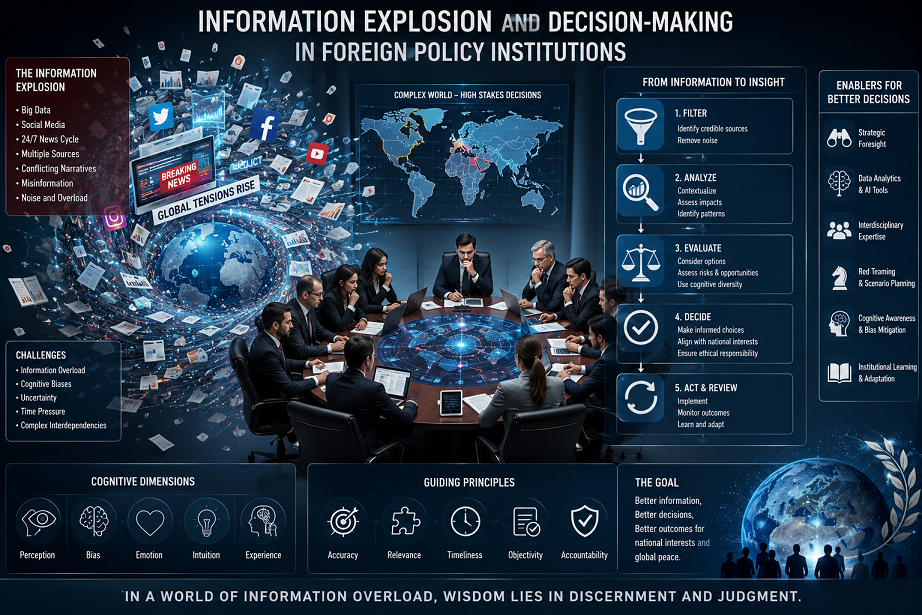
The digital revolution has fundamentally transformed the information environment within which foreign policy institutions operate. Governments today possess unprecedented access to intelligence, open-source information, satellite imagery, artificial intelligence (AI)-generated analyses, social media content, cyber intelligence, and real-time diplomatic reporting. Although this information explosion has significantly enhanced situational awareness, it has simultaneously created new challenges for foreign policy decision-making. Excessive information, cognitive overload, misinformation, algorithmic bias, emotional manipulation, and compressed decision timelines increasingly complicate strategic judgment. This article examines these challenges through the emerging framework of neurodiplomacy, an interdisciplinary approach that integrates neuroscience, cognitive psychology, behavioral science, and diplomatic studies. It argues that the quality of foreign policy decisions depends not on the quantity of available information but on the ability of institutions to understand and optimize the cognitive processes through which information is perceived, interpreted, evaluated, and transformed into strategic action. The article proposes a neurodiplomatic framework for institutional decision-making that combines human cognition with artificial intelligence while minimizing cognitive bias and improving strategic resilience.
Introduction
The twenty-first century is frequently described as the age of information abundance. Never before have foreign policy institutions possessed access to such vast quantities of information. Ministries of foreign affairs, national security councils, intelligence agencies, military organizations, and international organizations receive continuous streams of political, economic, military, technological, environmental, and social data from thousands of interconnected sources.
Ironically, the greatest challenge facing modern diplomacy is no longer information scarcity but information overload. Diplomatic institutions increasingly struggle to distinguish relevant signals from overwhelming noise. Decision-makers must evaluate conflicting intelligence, misinformation campaigns, rapidly evolving crises, and AI-generated analyses while operating under severe time constraints.
Traditional foreign policy theories generally assume that decision-makers seek to maximize national interests through rational analysis. However, advances in cognitive neuroscience demonstrate that human judgment is constrained by biological limits, emotional influences, cognitive biases, and social dynamics. Consequently, understanding how the brain processes information has become essential for improving institutional decision-making.
Neurodiplomacy provides an innovative framework for addressing this challenge by integrating neuroscience with diplomatic theory and practice. Rather than asking only what information institutions possess, neurodiplomacy asks how institutional decision-makers think, perceive, and decide.
The Information Explosion in Contemporary Foreign Policy
The exponential growth of digital technologies has transformed international politics into an information-intensive environment. Contemporary foreign policy institutions receive information from numerous interconnected sources, including:
-
Intelligence agencies
-
Diplomatic missions
-
International organizations
-
Satellite and geospatial intelligence
-
Cybersecurity monitoring systems
-
Open-source intelligence (OSINT)
-
Academic research
-
Social media platforms
-
Global news networks
-
Artificial intelligence systems
-
Private technology companies
-
Economic and financial databases
These diverse sources provide valuable insights but also create significant complexity. Information often arrives simultaneously, varies in reliability, and may present contradictory interpretations of the same event.
The emergence of generative AI has further accelerated information production. Machine-generated reports, predictive models, automated translations, and algorithmic forecasts greatly expand analytical capacity while introducing new challenges concerning transparency, explainability, and reliability.
Herbert Simon famously observed that “a wealth of information creates a poverty of attention.” This observation is particularly relevant to modern diplomacy, where attention—not information—has become the most valuable strategic resource.
Cognitive Constraints in Institutional Decision-Making
Although institutions possess sophisticated technologies, decisions are ultimately made by human beings whose brains evolved under vastly different informational conditions.
Neuroscience demonstrates that the human brain has limited attentional capacity. The prefrontal cortex, responsible for executive functions such as planning, reasoning, and decision-making, cannot simultaneously process unlimited information. As information volume increases, attention becomes fragmented and cognitive performance declines.
Working memory also has severe limitations. When excessive information exceeds cognitive capacity, individuals increasingly rely on heuristics, or mental shortcuts, to simplify complex decisions.
These shortcuts improve efficiency but also increase vulnerability to systematic errors. Information overload therefore reduces the quality rather than the quantity of strategic reasoning.
Within foreign policy institutions, cognitive overload may contribute to delayed decisions, analytical paralysis, inconsistent policy recommendations, and strategic miscalculation.
Cognitive Biases in Foreign Policy Institutions
Neurodiplomacy emphasizes that institutional decisions are influenced by predictable cognitive biases.
Confirmation bias encourages analysts and policymakers to favor information consistent with existing assumptions while discounting contradictory evidence.
Availability bias causes recent crises or emotionally memorable events to appear disproportionately important.
Anchoring bias allows initial intelligence assessments to shape later evaluations, even after additional evidence emerges.
Overconfidence bias encourages leaders to overestimate their understanding of complex international situations.
Groupthink discourages dissent within decision-making teams, leading to premature consensus and reduced analytical diversity.
Status quo bias favors existing policies even when changing circumstances require adaptation.
These biases are amplified under conditions of uncertainty, stress, political pressure, and information overload. Consequently, institutional design should focus not merely on increasing analytical capacity but also on reducing systematic cognitive error.
The Emotional Brain and Foreign Policy
Contrary to traditional rational-choice models, neuroscience demonstrates that emotion is indispensable for effective decision-making.
Brain regions involved in emotional processing—including the amygdala, anterior cingulate cortex, and ventromedial prefrontal cortex—interact continuously with cognitive systems during judgment.
Fear heightens vigilance but may encourage excessive caution or military escalation.
Anger increases confidence and risk-taking while reducing openness to compromise.
Empathy strengthens negotiation, trust-building, and conflict resolution.
Hope promotes long-term strategic thinking and international cooperation.
Emotional contagion also affects institutional environments. During crises, anxiety and uncertainty can rapidly spread across organizations, influencing collective judgment.
Neurodiplomacy therefore emphasizes emotional regulation rather than emotional suppression. Institutions capable of managing emotional dynamics are more likely to produce balanced strategic decisions.
Artificial Intelligence: Opportunity and Challenge
Artificial intelligence has become an indispensable component of foreign policy decision-making. AI systems rapidly process enormous datasets, identify hidden patterns, detect emerging threats, and generate predictive analyses.
However, AI cannot replace human strategic judgment.
Algorithms lack contextual understanding, historical interpretation, cultural sensitivity, ethical reasoning, and diplomatic intuition. Moreover, AI systems inherit biases embedded within their training data and may generate inaccurate or misleading outputs.
Neurodiplomacy advocates a complementary relationship between human cognition and machine intelligence.
Artificial intelligence should augment rather than replace diplomats by:
-
Filtering irrelevant information
-
Detecting emerging trends
-
Supporting scenario analysis
-
Visualizing complex relationships
-
Automating routine analytical tasks
Human experts remain responsible for ethical judgment, strategic interpretation, diplomatic negotiation, and final policy decisions.
Neurodiplomacy: A New Framework for Institutional Decision-Making
Neurodiplomacy proposes that effective foreign policy institutions should be designed around the strengths and limitations of human cognition.
This approach rests upon several principles.
- Cognitive Awareness
Decision-makers should receive education in neuroscience, cognitive psychology, behavioral economics, and decision science. Understanding how the brain functions enables policymakers to recognize their own cognitive limitations.
- Structured Information Management
Institutions should prioritize information quality rather than information quantity.
Decision-support systems should filter, categorize, summarize, and visualize information according to strategic relevance.
This reduces unnecessary cognitive load while preserving analytical accuracy.
- Cognitive Diversity
Foreign policy institutions benefit from interdisciplinary teams composed of diplomats, psychologists, neuroscientists, economists, military experts, regional specialists, and data scientists.
Cognitive diversity reduces blind spots and encourages creative problem-solving.
- Metacognition
Metacognition—the ability to think about one’s own thinking—allows decision-makers to identify assumptions, question biases, and evaluate alternative perspectives.
Institutions should encourage reflective decision-making rather than automatic reactions.
- Emotional Intelligence
Successful diplomacy requires emotional awareness alongside analytical competence.
Training in emotional regulation, empathy, negotiation psychology, and intercultural communication enhances diplomatic effectiveness.
- Ethical Decision-Making
Neurodiplomacy recognizes that neuroscience should strengthen—not replace—ethical reasoning.
Foreign policy institutions must balance national interests with international law, humanitarian principles, and global responsibility.
Institutional Strategies for Better Decisions
A neurodiplomatic approach suggests several practical reforms for foreign policy institutions.
First, institutions should establish multidisciplinary strategic assessment teams that combine expertise from diplomacy, intelligence, behavioral science, neuroscience, economics, and artificial intelligence.
Second, structured analytical techniques—including red teaming, devil’s advocacy, scenario planning, and alternative futures analysis—should become routine components of policy evaluation.
Third, AI-assisted decision-support systems should prioritize relevance rather than information volume.
Fourth, organizational cultures should encourage constructive disagreement rather than hierarchical conformity.
Fifth, crisis decision-making protocols should include mechanisms that reduce emotional escalation and prevent impulsive responses.
Finally, continuous professional education should include neuroscience-informed training on cognitive bias, attention management, stress resilience, and strategic thinking.
Toward Neuro-Informed Foreign Policy Institutions
The future foreign ministry will likely resemble a knowledge ecosystem rather than a traditional bureaucratic organization.
Decision-making will increasingly depend upon collaboration among diplomats, AI systems, neuroscientists, psychologists, economists, cyber specialists, and regional experts.
Neuro-informed institutions will emphasize adaptive learning rather than rigid procedures.
Information systems will prioritize clarity over quantity.
Leadership will value curiosity over certainty.
Institutional cultures will reward questioning assumptions rather than defending existing beliefs.
Such organizations will be better equipped to navigate geopolitical uncertainty while preserving democratic accountability and ethical legitimacy.
Conclusion
The information explosion has fundamentally altered the landscape of foreign policy decision-making. While technological advances have dramatically expanded access to information, they have also intensified cognitive overload, misinformation, emotional manipulation, and strategic complexity. The central challenge confronting contemporary foreign policy institutions is therefore not acquiring more information but transforming abundant information into sound strategic judgment.
Neurodiplomacy offers a promising interdisciplinary framework for meeting this challenge. By integrating neuroscience, cognitive psychology, behavioral science, artificial intelligence, and diplomatic studies, it provides a deeper understanding of how individuals and institutions perceive, process, and act upon complex information.
Future foreign policy institutions will succeed not because they possess the largest databases or the most advanced algorithms, but because they cultivate superior cognitive capabilities, emotional intelligence, ethical reasoning, and adaptive organizational cultures. In an era defined by accelerating technological change and geopolitical uncertainty, the decisive strategic advantage will belong to institutions that understand not only the international system but also the human mind that interprets it.
Ultimately, neurodiplomacy shifts the focus of foreign policy from information accumulation to cognitive excellence. It reminds us that wise diplomacy begins not with more data, but with better thinking. As global challenges become increasingly interconnected and complex, building neuro-informed decision-making institutions will be essential for achieving effective diplomacy, sustainable peace, and responsible global governance.This article also provides the foundation for what could become a novel theoretical contribution: a Neurodiplomatic Institutional Decision-Making Model (NIDM). Such a model could describe the complete foreign policy process—from information acquisition and cognitive filtering to strategic analysis, policy formulation, decision, implementation, feedback, and organizational learning—through the lens of neuroscience and cognitive science, making it a distinctive contribution to the emerging field of neurodiplomacy.