Introduction
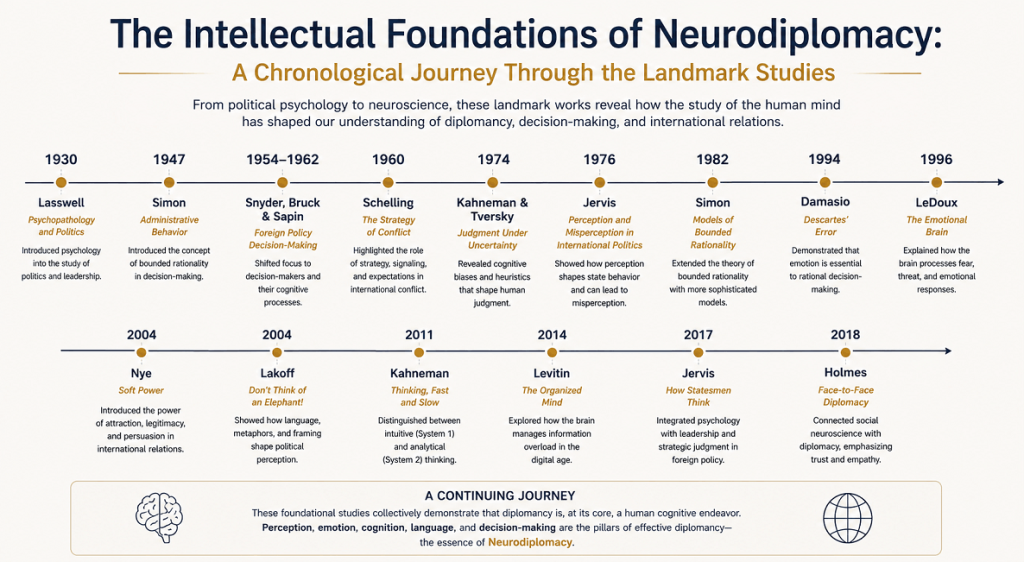
The Neurodiplomatic Institutional Decision-Making Model (NIDM) is an interdisciplinary framework that integrates neuroscience, cognitive psychology, behavioral economics, political psychology, organizational decision theory, systems thinking, artificial intelligence, and diplomatic studies. Its primary objective is to improve the quality of foreign policy decisions by aligning institutional processes with the strengths and limitations of the human brain.
Unlike traditional foreign policy models, which often assume that institutions are rational actors, NIDM recognizes that decisions are ultimately made by people whose cognition is constrained by limited attention, bounded rationality, emotional influences, memory limitations, and cognitive biases. Institutions therefore need decision architectures that compensate for these human constraints while leveraging technology and collective intelligence.
The Core Assumption
The quality of foreign policy decisions depends on five interconnected elements:
Decision Quality = High-Quality Information × Cognitive Processing × Emotional Regulation × Institutional Design × Ethical Judgment
If any one of these components is weak, the quality of strategic decisions declines.
For example:
- Excellent intelligence can be undermined by confirmation bias.
- Advanced AI systems can produce poor outcomes if leaders misunderstand their outputs.
- Emotional reactions can distort otherwise sound analyses.
- Organizational cultures that suppress dissent can amplify strategic errors.
Thus, NIDM focuses on optimizing the entire decision ecosystem rather than any single component.
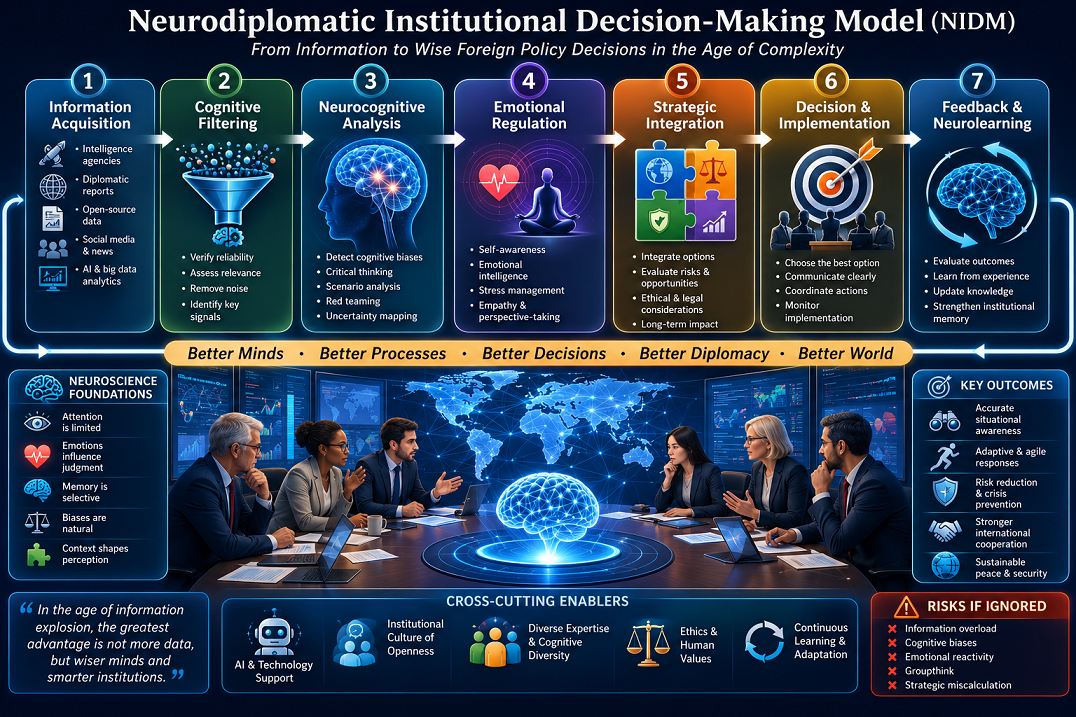
The Seven Stages of NIDM
Stage 1: Strategic Information Acquisition
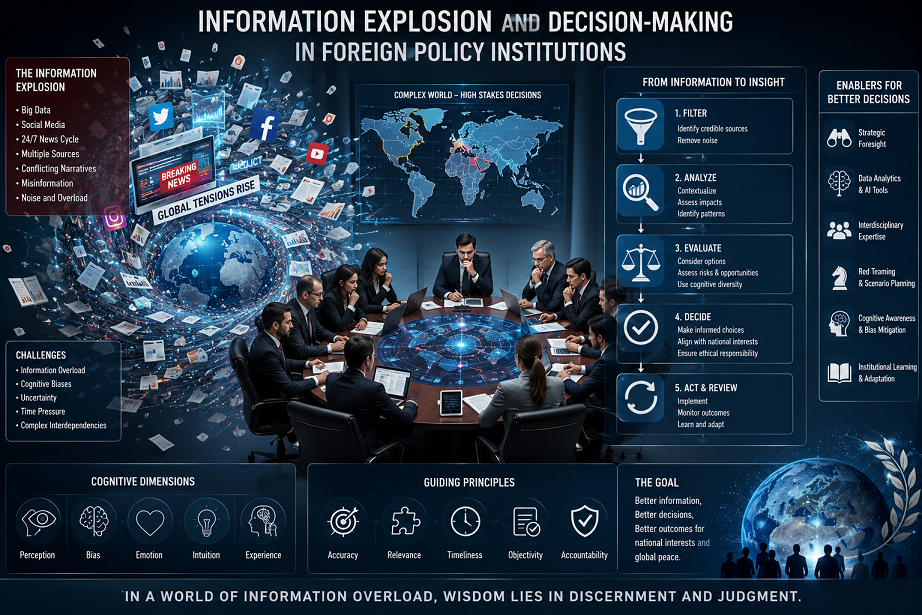
Foreign policy institutions gather information from multiple sources, including:
- Intelligence agencies
- Diplomatic missions
- Satellite imagery
- Open-source intelligence (OSINT)
- Economic indicators
- Academic expertise
- International organizations
- Social media
- AI-supported analytics
- Historical case studies
The goal is not to maximize the amount of information but to maximize its relevance, reliability, and diversity.
Neuroscientific principle: The brain performs better when exposed to structured rather than chaotic information.
Stage 2: Cognitive Filtering
At this stage, information is filtered before reaching senior decision-makers.
Questions include:
- Is the information reliable?
- Is it strategically relevant?
- Is it urgent?
- Does it duplicate existing knowledge?
- Does it contradict current assumptions?
AI can assist in filtering data, but human analysts remain essential for contextual interpretation.
This stage helps reduce information overload, one of the greatest challenges in modern diplomacy.
Stage 3: Neurocognitive Analysis
This is the core innovation of NIDM.
Rather than asking only:
“What does the evidence suggest?”
decision-makers also ask:
- Which cognitive biases may be influencing us?
- Are we relying on assumptions?
- Are emotions affecting our judgment?
- Are we interpreting evidence objectively?
- Are alternative explanations being ignored?
Institutions use structured analytical methods such as:
- Red teaming
- Devil’s advocacy
- Scenario planning
- Alternative futures analysis
- Premortem analysis
This stage strengthens metacognition—thinking about one’s own thinking.
Stage 4: Emotional Regulation
Modern neuroscience shows that emotions cannot be eliminated from decision-making.
Instead, they should be managed.
Decision-makers evaluate whether fear, anger, anxiety, or overconfidence are influencing strategic choices.
Practical methods include:
- Deliberate pauses before major decisions
- Diverse consultation
- Stress management
- Mindfulness training
- Crisis communication protocols
Emotional regulation improves executive functioning and reduces impulsive decisions.
Stage 5: Strategic Integration
Information, analysis, emotions, ethics, and geopolitical realities are integrated into coherent policy options.
Rather than producing one recommendation, institutions generate several alternative strategies.
Each option is evaluated according to:
- National interest
- International law
- Ethical implications
- Long-term consequences
- Economic costs
- Political feasibility
- Strategic risks
- Public perception
This stage emphasizes cognitive flexibility instead of premature certainty.
Stage 6: Decision and Implementation
Senior political leaders make the final decision.
However, NIDM recommends that every major foreign policy decision include explicit documentation of:
- Key assumptions
- Remaining uncertainties
- Alternative scenarios
- Risks
- Ethical considerations
- Indicators of success
- Conditions requiring policy revision
This creates institutional transparency and accountability.
Stage 7: Feedback and Neurolearning
Traditional foreign policy models often end once a decision is implemented.
NIDM treats implementation as the beginning of institutional learning.
Questions include:
- Was the prediction accurate?
- Which assumptions proved incorrect?
- Which biases emerged?
- What surprised us?
- What should be learned?
This continuous feedback loop develops what may be called an institutional brain—an organization that learns, adapts, and improves over time.
Cross-Cutting Principles
Several principles apply throughout all seven stages:
Cognitive Bias Mitigation
Every decision process should actively identify:
- Confirmation bias
- Anchoring
- Overconfidence
- Availability bias
- Loss aversion
- Groupthink
Emotional Intelligence
Institutions should cultivate:
- Empathy
- Self-awareness
- Emotional regulation
- Perspective-taking
- Cultural sensitivity
These skills improve negotiation and crisis management.
Human–AI Collaboration
AI should:
- Process large datasets
- Detect patterns
- Generate scenarios
- Visualize complex information
Humans should:
- Interpret context
- Exercise ethical judgment
- Build trust
- Negotiate
- Make final decisions
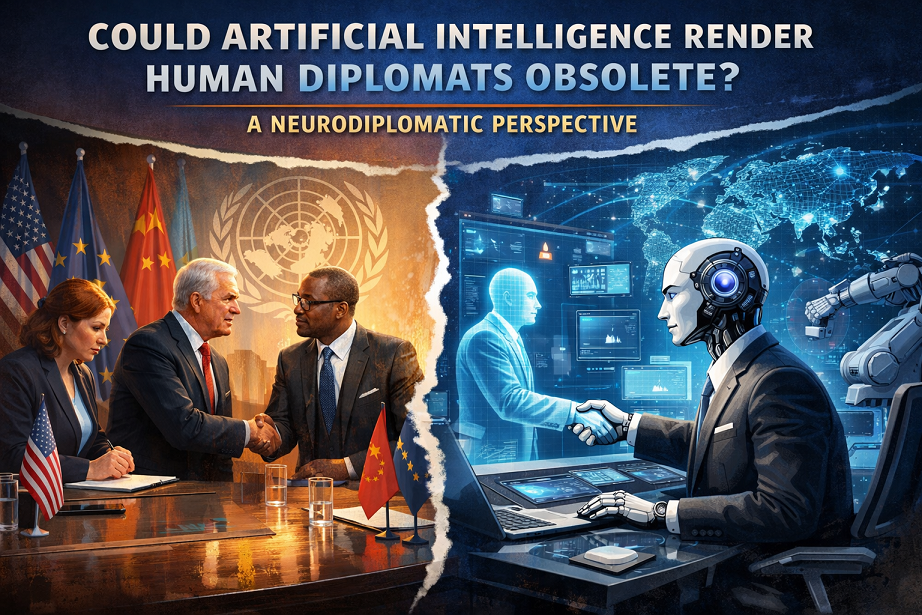
NIDM views AI as an intelligent partner rather than a substitute for human decision-makers.
Cognitive Diversity
Decision-making teams should include experts from:
- Diplomacy
- Neuroscience
- Psychology
- Economics
- Military strategy
- Regional studies
- Cybersecurity
- Data science
- Ethics
Diverse perspectives reduce blind spots and improve strategic creativity.
The NIDM Framework
The model can be summarized as follows:
Information Acquisition
          ↓
   Cognitive Filtering
          ↓
 Neurocognitive Analysis
          ↓
 Emotional Regulation
          ↓
 Strategic Integration
          ↓
 Decision & Implementation
          ↓
Feedback → Institutional Learning
          ↑
      Continuous Improvement
This cyclical structure reflects the idea that foreign policy institutions should be adaptive learning systems rather than static bureaucracies.
Theoretical Contributions
NIDM offers several contributions to scholarship:
- It integrates neuroscience into institutional foreign policy analysis.
- It shifts attention from rational-actor assumptions to realistic models of human cognition.
- It provides a structured approach to managing information overload.
- It combines AI-assisted analysis with human judgment in a principled way.
- It embeds ethical reasoning throughout the decision process.
- It promotes institutional learning through continuous feedback.
Future Research Directions
NIDM opens new avenues for empirical and theoretical research. Scholars could examine how ministries of foreign affairs apply neurocognitive principles, assess whether cognitive bias training improves diplomatic judgment, evaluate the effects of AI-supported decision systems on policy outcomes, compare neuro-informed and traditional decision-making during international crises, or develop metrics to measure the “neurocognitive readiness” of foreign policy institutions.
As the field of neurodiplomacy matures, the Neurodiplomatic Institutional Decision-Making Model (NIDM) could serve as a foundational framework for understanding how foreign policy organizations can make wiser, more adaptive, and ethically grounded decisions in an era of information abundance and geopolitical complexity. It has the potential to bridge neuroscience, international relations, organizational behavior, and diplomatic practice into a unified model of twenty-first-century foreign policy decision-making.