Introduction
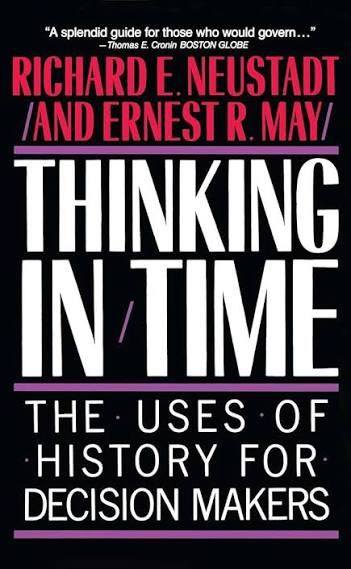
Few books have influenced the study and practice of foreign policy decision-making as profoundly as Richard E. Neustadt and Ernest R. May’s Thinking in Time: The Uses of History for Decision-Makers. Since its publication in 1986, the book has become a classic text for diplomats, military officers, intelligence analysts, civil servants, and scholars of international relations. Rather than presenting history as a chronological record of past events, Neustadt and May argue that historical thinking constitutes a practical discipline capable of improving contemporary policymaking.
The central premise of the book is deceptively simple: policymakers frequently use history, but they often use it poorly. Decision-makers tend to rely upon memorable historical analogies, simplified narratives, and superficial comparisons without adequately considering contextual differences or causal mechanisms. Such misuse of history can produce serious policy errors.
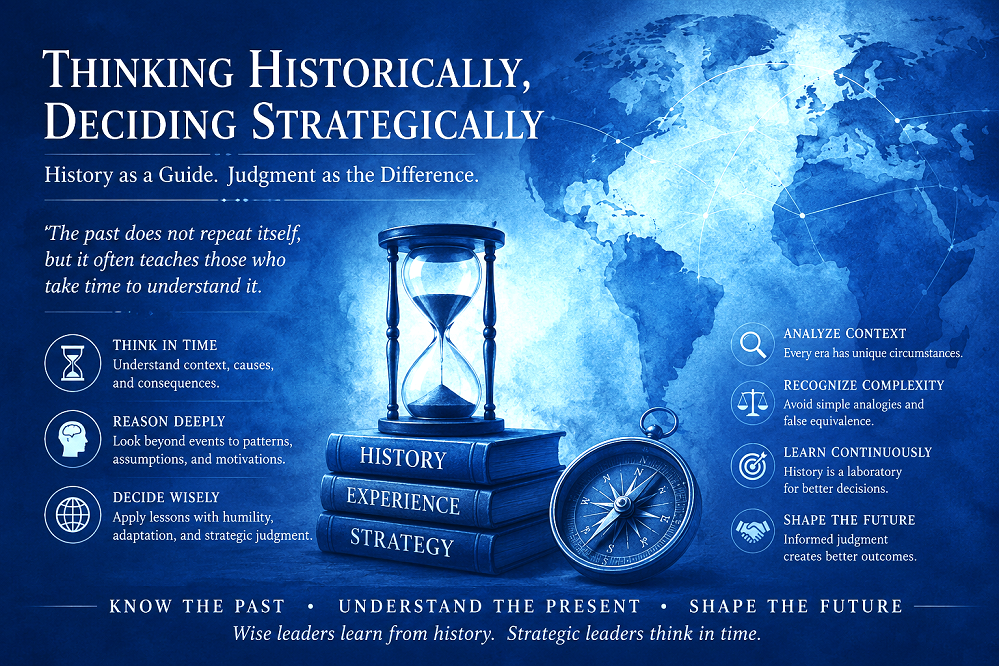
Neustadt and May seek to replace this intuitive approach with disciplined historical inquiry. They argue that policymakers should investigate the origins, contexts, assumptions, and consequences of historical events before drawing lessons applicable to contemporary problems. In doing so, the authors establish history not merely as an academic subject but as an indispensable analytical tool for strategic judgment.
Nearly four decades after its publication, Thinking in Time remains remarkably relevant. Contemporary foreign policy challenges—including geopolitical competition, nuclear deterrence, cyber conflict, terrorism, pandemics, and emerging technologies—continue to be interpreted through historical analogies. Consequently, the book provides enduring insights into how leaders reason under uncertainty.
Overview of the Book
The book addresses an enduring problem in public policy: how should decision-makers use historical experience when confronting new and uncertain situations?
Neustadt and May argue that policymakers rarely approach problems without historical reference points. Instead, they instinctively compare current events with previous crises. Such analogies help reduce uncertainty and facilitate rapid judgment, but they also risk oversimplifying complex realities.
The authors reject both extremes: the belief that history automatically repeats itself and the belief that every historical event is entirely unique. Instead, they advocate disciplined comparison, emphasizing careful examination of similarities, differences, causal relationships, and institutional contexts.
Throughout the book, numerous historical case studies demonstrate how thoughtful historical reasoning can improve decision-making while exposing the dangers of superficial analogies. Their examples range across presidential decision-making, military strategy, diplomacy, economic policy, and public administration.
Rather than providing fixed policy prescriptions, the authors encourage decision-makers to cultivate habits of critical inquiry. Their goal is not to teach history for its own sake but to improve strategic judgment.
Methodological Contributions
One of the book’s greatest strengths is its interdisciplinary methodology. Neustadt and May combine diplomatic history, political science, leadership studies, and practical governance into a coherent analytical framework.
Instead of relying upon statistical models or formal theories, they employ qualitative historical analysis. Policymakers are encouraged to ask systematic questions:
- What actually happened?
- Why did it happen?
- Which conditions produced the outcome?
- Which assumptions guided previous leaders?
- Which contextual factors differ today?
This methodology transforms historical inquiry into an instrument of policy analysis rather than retrospective description.
Unlike deterministic interpretations of history, Neustadt and May emphasize contingency. Political outcomes emerge through interactions among leadership, institutions, economics, culture, public opinion, and international circumstances. Consequently, policymakers must resist simplistic historical lessons and instead investigate underlying causal mechanisms.
This approach significantly enriches foreign policy analysis because it encourages intellectual humility and contextual understanding.
Historical Analogies and Strategic Judgment
A central theme of the book concerns the use and misuse of historical analogies.
Decision-makers naturally compare current situations with familiar historical events. Such analogies provide cognitive structure, facilitate communication, and reduce uncertainty. However, Neustadt and May demonstrate that analogies become dangerous when they replace analytical reasoning.
The Munich Agreement of 1938, for example, has frequently served as an analogy justifying resistance to perceived aggression. Likewise, the Vietnam War has influenced debates concerning military intervention for decades. While these historical episodes contain valuable lessons, treating every contemporary crisis as another Munich or another Vietnam ignores significant contextual differences.
The authors therefore advocate disciplined comparison rather than automatic analogy. Historical precedents should stimulate questions instead of providing immediate answers.
This insight has profoundly influenced later scholarship, particularly the work of Yuen Foong Khong on analogical reasoning, Robert Jervis on perception and misperception, and research in political psychology concerning heuristics and cognitive biases.
Contributions to Foreign Policy Analysis
Thinking in Time occupies a unique position within foreign policy literature because it successfully bridges historical scholarship and practical policymaking.
The book makes several enduring contributions.
First, it demonstrates that history remains directly relevant to contemporary policy decisions.
Second, it encourages policymakers to examine causal relationships instead of relying upon superficial similarities.
Third, it promotes institutional learning by emphasizing systematic analysis of previous successes and failures.
Fourth, it highlights the importance of asking better questions before selecting policy alternatives.
Finally, the book reinforces the importance of critical thinking under conditions of uncertainty.
These contributions remain highly applicable to diplomacy, international negotiations, intelligence analysis, crisis management, and strategic planning.
Strengths of the Book
The enduring popularity of Thinking in Time reflects several important strengths.
The book is intellectually rigorous while remaining accessible to practitioners. Neustadt and May successfully translate sophisticated historical reasoning into practical guidance for policymakers.
Its interdisciplinary character also distinguishes the work. Few books integrate history, diplomacy, leadership, public administration, and strategic analysis so effectively.
Another major strength lies in its emphasis on disciplined judgment rather than predetermined policy prescriptions. Instead of advocating particular political positions, the authors provide analytical methods that improve decision-making regardless of ideological orientation.
The extensive historical case studies further strengthen the book by demonstrating how abstract principles operate in real-world policymaking.
Limitations
Despite its considerable achievements, the book also exhibits certain limitations when viewed from the perspective of contemporary scholarship.
First, because it was published in 1986, it predates major advances in cognitive neuroscience, behavioral economics, and political psychology. Consequently, the authors explain how policymakers use history but devote comparatively less attention to the cognitive mechanisms underlying historical reasoning.
Second, the discussion of cognitive biases remains limited. Concepts such as confirmation bias, framing effects, loss aversion, availability heuristics, and motivated reasoning had not yet become central components of foreign policy analysis.
Third, the book focuses primarily on individual policymakers, especially presidents and senior government officials. Modern foreign policy, however, increasingly depends upon collective institutional processes involving ministries, intelligence agencies, international organizations, and multinational alliances.
Finally, although the authors emphasize historical reasoning, they devote less attention to communication, language, emotions, and perception—all of which play increasingly important roles in diplomatic practice.
These limitations do not diminish the book’s value but instead create opportunities for subsequent theoretical development.
Relevance to International Relations
The significance of Thinking in Time extends far beyond public administration. The book contributes directly to several areas of international relations scholarship.
It complements classical realism by emphasizing prudent judgment in an uncertain international environment.
It enriches foreign policy analysis by demonstrating how leaders interpret international events through historical experience.
It supports political psychology by recognizing the influence of memory and perception on strategic decision-making.
It also provides an intellectual bridge toward behavioral approaches that examine heuristics, biases, and bounded rationality.
Consequently, the book occupies an important position within the cognitive evolution of international relations theory.
A Neurodiplomatic Reinterpretation
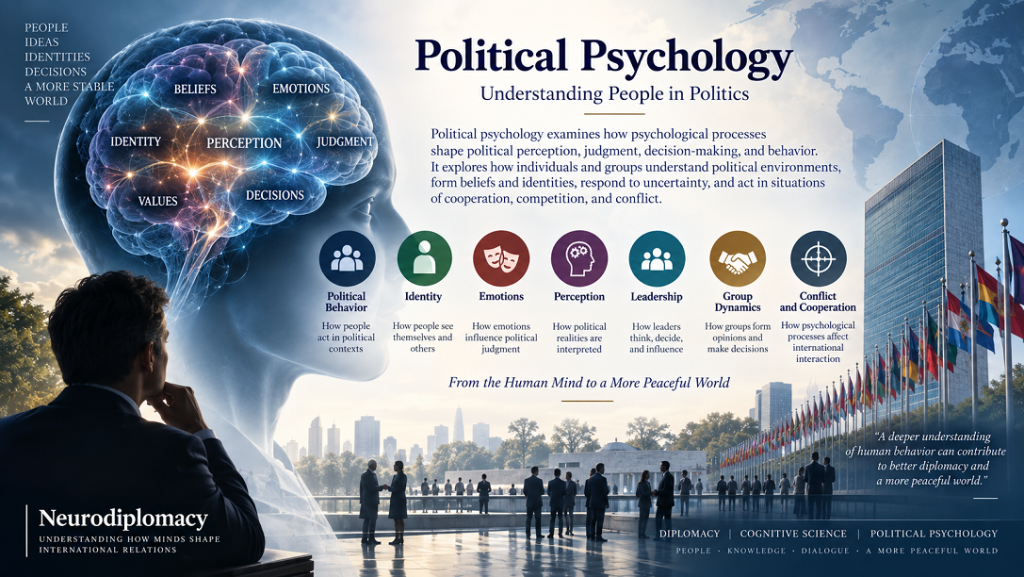
From the perspective of Neurodiplomacy, Thinking in Time represents an important precursor to a broader cognitive understanding of diplomacy and foreign policy.
Neustadt and May correctly recognize that historical reasoning shapes policy decisions. However, Neurodiplomacy seeks to explain the underlying neurocognitive processes through which this occurs.
Historical analogies originate in memory systems that organize previous experiences into cognitive schemas. When policymakers confront unfamiliar situations, the brain naturally searches for comparable experiences that simplify interpretation.
These processes involve interactions among perception, memory, emotion, language, attention, and institutional learning.
Neurodiplomacy therefore extends the authors’ framework in several important ways.
First, it examines how emotions influence historical interpretation. Fear, trust, humiliation, pride, and hope all affect which historical analogies become cognitively salient.
Second, Neurodiplomacy emphasizes strategic empathy. Policymakers must understand not only their own historical narratives but also those employed by allies and adversaries. Different societies remember history differently, and these differences influence diplomatic behavior.
Third, Neurodiplomacy incorporates communication and framing into historical reasoning. Historical analogies are not merely cognitive tools; they are also persuasive instruments employed in diplomacy, public communication, and international negotiations.
Fourth, the Neurodiplomatic Institutional Decision-Making Model (NIDM) proposes structured institutional procedures for evaluating historical analogies. Rather than accepting intuitive comparisons, policymakers should systematically assess factual similarities, contextual differences, cognitive biases, emotional influences, and alternative interpretations before allowing historical analogies to shape policy decisions.
Finally, Neurodiplomacy addresses the challenges of twenty-first-century diplomacy, including information overload, artificial intelligence, digital communication, and rapid geopolitical change. Historical reasoning remains valuable, but it must be integrated with contemporary cognitive science to improve institutional decision-making.
Conclusion
Richard E. Neustadt and Ernest R. May’s Thinking in Time remains one of the most influential books ever written on public policy and foreign policy decision-making. Its enduring contribution lies in demonstrating that history should function as an analytical discipline rather than a collection of simplistic lessons. By encouraging policymakers to investigate causal mechanisms, contextual differences, and institutional complexity, the authors provide an intellectual framework that continues to improve strategic judgment.
The book anticipated many later developments in political psychology and foreign policy analysis by emphasizing perception, memory, and historical reasoning. Nevertheless, advances in cognitive science now permit a deeper understanding of the mechanisms underlying these processes.
Neurodiplomacy builds upon the foundation established by Neustadt and May by integrating historical reasoning with cognitive neuroscience, strategic communication, political psychology, and institutional learning. Within this broader framework, diplomacy is understood not merely as the management of interstate relations but as the management of cognition, perception, language, emotion, and collective decision-making.
For scholars of international relations, diplomacy, public administration, and foreign policy analysis, Thinking in Time remains indispensable reading. Its lessons continue to shape how governments interpret history, confront uncertainty, and make strategic decisions. At the same time, its insights provide an essential foundation for emerging interdisciplinary approaches such as Neurodiplomacy, which seek to explain not only how policymakers use history but also how the human mind transforms historical experience into diplomatic judgment.
Reference
- May, E. R., & Neustadt, R. E. (1986). Thinking in time: The uses of history for decision-makers. Free Press.