Abstract
Foreign policy decision-making has traditionally been studied through the lenses of rational choice, organizational behavior, and bureaucratic politics. During the second half of the twentieth century, however, scholars increasingly recognized that political decisions are not produced solely by rational calculations but also by psychological, cognitive, and organizational processes. Irving L. Janis’s theory of groupthink represented one of the earliest and most influential attempts to explain why highly competent decision-makers sometimes produce disastrous foreign policy outcomes. By emphasizing the role of group cohesion, conformity, and the suppression of dissent, Janis shifted attention from the external environment to the internal psychological dynamics of policymaking institutions.
In the twenty-first century, advances in cognitive science, behavioral economics, political psychology, and neuroscience have further transformed the study of decision-making. These developments have given rise to neurodiplomacy, an emerging interdisciplinary approach that examines how neurocognitive processes—including perception, attention, memory, emotion, learning, and executive control—shape diplomatic behavior and institutional decision-making. Rather than replacing psychological theories such as groupthink, neurodiplomacy builds upon them by providing a deeper explanation of the cognitive mechanisms underlying foreign policy choices.
This article traces the evolution of foreign policy decision-making from Janis’s theory of groupthink to the emerging framework of neurodiplomacy. It argues that neurodiplomacy represents the next stage in the cognitive evolution of International Relations by integrating insights from neuroscience with Foreign Policy Analysis (FPA), political psychology, and diplomatic studies. The article further proposes that combining Janis’s psychological insights with neurodiplomatic principles can improve institutional decision-making in an era characterized by information overload, technological disruption, and increasing geopolitical complexity.
Keywords: Groupthink, Neurodiplomacy, Foreign Policy Analysis, Political Psychology, Decision-Making, Cognitive Science, Neuroscience, International Relations.
1. Introduction
Foreign policy decisions often determine whether states cooperate, negotiate, deter adversaries, or resort to military conflict. Consequently, understanding how governments make strategic decisions has long been a central concern of International Relations (IR) scholarship. Classical realist and rational choice theories generally portray states as coherent actors pursuing national interests through objective calculations of costs and benefits. While these perspectives illuminate important structural aspects of international politics, they frequently overlook the fact that decisions are ultimately made by human beings operating within complex institutional environments.
Beginning in the 1950s and 1960s, scholars of Foreign Policy Analysis increasingly questioned the assumption of perfect rationality. The work of Richard Snyder, Graham Allison, Herbert Simon, Robert Jervis, and Irving Janis demonstrated that perceptions, organizational routines, bureaucratic politics, and psychological dynamics profoundly influence governmental decisions. Among these contributions, Janis’s theory of groupthink became particularly influential because it explained how collective decision-making processes themselves could generate policy failures.
Today, new developments in neuroscience and cognitive science provide opportunities to deepen these psychological explanations. Neurodiplomacy extends earlier behavioral approaches by examining how the brain processes information, regulates emotion, constructs meaning, and supports strategic judgment. This article argues that the intellectual trajectory from groupthink to neurodiplomacy reflects a broader cognitive evolution in the study of foreign policy decision-making.
2. Groupthink: A Turning Point in Foreign Policy Analysis
Irving Janis introduced the concept of groupthink to explain why highly intelligent and experienced decision-makers sometimes adopt policies that later prove catastrophic. He argued that decision-making groups characterized by strong cohesion, directive leadership, isolation from external criticism, and intense political pressure may prioritize consensus over critical evaluation.
According to Janis, groupthink is characterized by several recurring symptoms, including illusions of invulnerability, collective rationalization, stereotypes of opponents, pressure on dissenters, self-censorship, illusions of unanimity, and the presence of “mindguards” who shield leaders from conflicting information. Together, these dynamics reduce the quality of collective reasoning and increase the likelihood of strategic errors.
Janis illustrated his theory through historical case studies such as the Bay of Pigs invasion, the escalation of the Vietnam War, the failure to anticipate the attack on Pearl Harbor, and the successful management of the Cuban Missile Crisis. These examples demonstrated that the internal dynamics of policymaking groups could significantly influence foreign policy outcomes, independent of external strategic conditions.
The theory fundamentally transformed Foreign Policy Analysis by shifting attention from the behavior of states to the psychology of decision-making institutions.
3. Limitations of the Groupthink Framework
Although groupthink remains one of the most influential theories in political psychology, it has several limitations that become increasingly evident in contemporary diplomacy.
First, Janis focused primarily on social dynamics rather than underlying cognitive mechanisms. While he identified conformity, pressure, and consensus as causes of poor decision-making, he offered relatively little explanation of how these processes emerge from human cognition.
Second, the theory predates major advances in neuroscience, behavioral economics, and cognitive psychology. Consequently, concepts such as attentional control, executive functioning, emotional regulation, cognitive biases, and neural plasticity are largely absent from the original framework.
Third, modern diplomatic institutions operate in an environment characterized by artificial intelligence, cyber threats, social media, big data, and information overload. These conditions introduce new cognitive challenges that extend beyond the organizational settings examined by Janis.
These limitations do not diminish the significance of groupthink. Rather, they highlight the need for an expanded theoretical framework capable of incorporating contemporary knowledge about human cognition.
4. Behavioral and Cognitive Approaches as Transitional Stages
Between Janis’s psychological model and contemporary neurodiplomacy lies a broader intellectual movement often described as Behavioral International Relations (Behavioral IR).
Behavioral IR integrates insights from psychology, behavioral economics, and decision science to explain why policymakers depart from ideal rationality. Scholars such as Herbert Simon, Daniel Kahneman, Amos Tversky, Robert Jervis, and Rose McDermott demonstrated that foreign policy decisions are influenced by bounded rationality, heuristics, emotions, and cognitive biases.
This body of research broadened the study of decision-making by emphasizing that leaders:
- Operate with incomplete information.
- Face severe time constraints.
- Depend on cognitive shortcuts.
- Interpret rather than simply observe reality.
- Respond emotionally to uncertainty and risk.
Behavioral IR therefore serves as an important bridge between Janis’s social psychology and the emerging neurocognitive perspective.
5. Neurodiplomacy: A New Paradigm
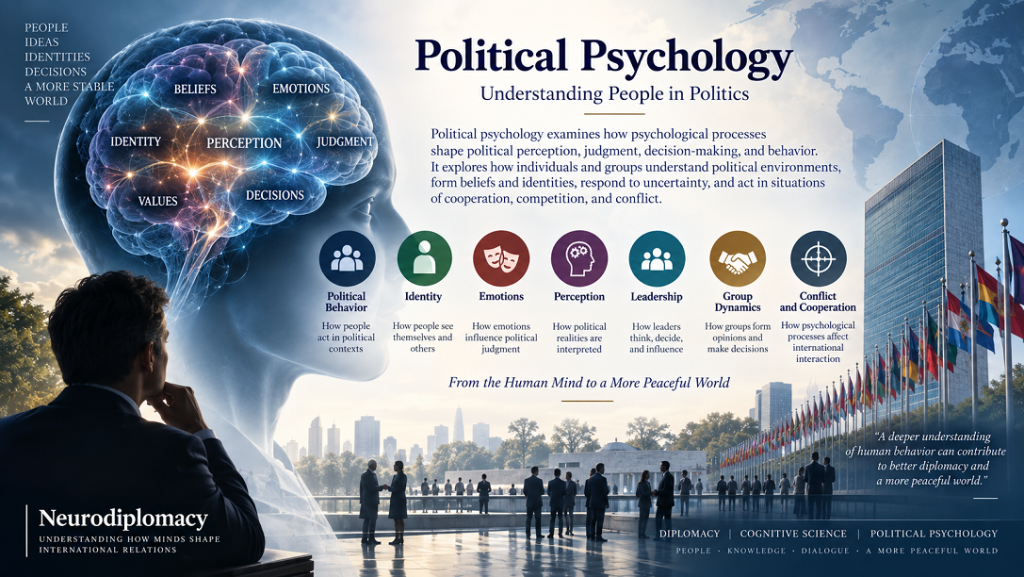
Neurodiplomacy represents an interdisciplinary framework that integrates International Relations, diplomacy, cognitive science, political psychology, neuroscience, and Foreign Policy Analysis.
Its central assumption is that international politics is conducted by individuals and institutions whose decisions are shaped by neurocognitive processes.
Rather than asking only why leaders make certain choices, neurodiplomacy investigates how those choices emerge through perception, attention, memory, emotional regulation, learning, and executive control.
Unlike traditional psychological approaches, neurodiplomacy treats cognition not as a static characteristic but as a dynamic process that can be improved through institutional design, training, and organizational learning.
6. From Social Psychology to Neurocognition
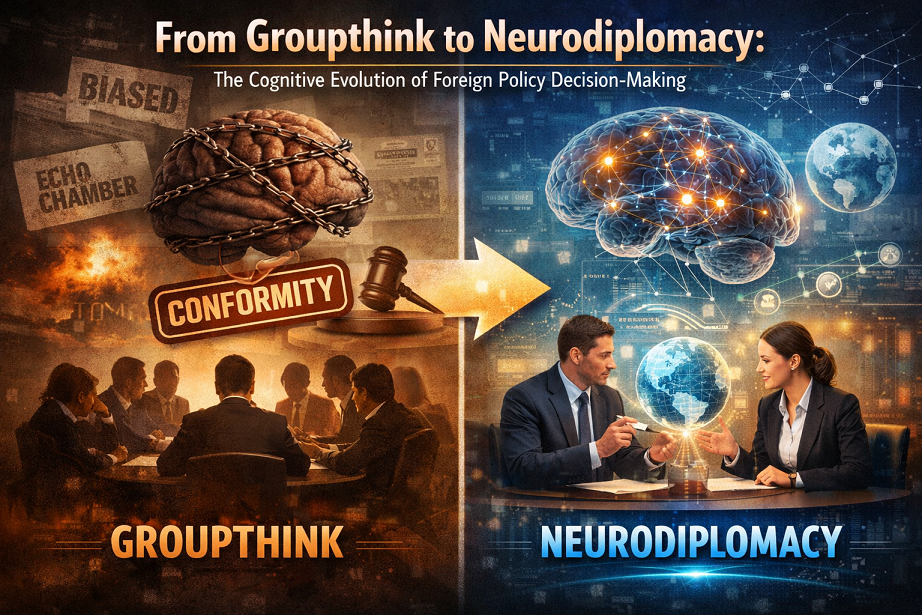
The transition from groupthink to neurodiplomacy reflects an expansion of analytical focus.
Groupthink emphasizes the social environment surrounding decision-makers.
Behavioral IR emphasizes the psychological mechanisms influencing individual judgment.
Neurodiplomacy examines the neurocognitive architecture supporting both individual and institutional decision-making.
This progression represents a movement from observing decision outcomes toward understanding the mechanisms that produce them.
For example, where Janis attributes poor decisions to conformity pressures, neurodiplomacy investigates how stress, attentional narrowing, emotional arousal, cognitive overload, and executive functioning influence susceptibility to conformity.
7. Information Explosion and Cognitive Complexity
One of the defining characteristics of contemporary diplomacy is the unprecedented expansion of available information.
Foreign ministries now receive:
- Intelligence reports.
- Satellite imagery.
- Cybersecurity assessments.
- Economic indicators.
- Social media analytics.
- Open-source intelligence.
- Artificial intelligence forecasts.
While information availability has increased dramatically, human cognitive capacity remains limited.
This imbalance creates new risks.
Decision-makers may experience:
- Information overload.
- Cognitive fatigue.
- Reduced attention.
- Increased reliance on heuristics.
- Greater vulnerability to misinformation.
Neurodiplomacy therefore argues that the principal challenge of twenty-first-century diplomacy is no longer information scarcity but information management.
8. The Neurodiplomatic Institutional Decision-Making Model (NIDM)
One practical contribution of neurodiplomacy is the Neurodiplomatic Institutional Decision-Making Model (NIDM).
The model proposes a structured institutional process consisting of:
- Strategic information acquisition.
- Cognitive filtering and prioritization.
- Neurocognitive analysis.
- Emotional regulation.
- Strategic integration.
- Policy implementation.
- Institutional feedback and learning.
Compared with Janis’s framework, NIDM moves beyond identifying sources of error to proposing mechanisms for improving decision quality.
The model encourages:
- Diverse analytical teams.
- Structured dissent.
- Bias-awareness training.
- Cognitive resilience.
- Continuous institutional learning.
In this sense, neurodiplomacy transforms psychological diagnosis into institutional design.
9. Diplomatic Implications
The integration of neurodiplomacy into Foreign Policy Analysis has several practical implications.
First, diplomatic training should include cognitive skills such as strategic empathy, critical thinking, emotional regulation, and bias recognition.
Second, institutions should design decision-making procedures that encourage intellectual diversity and constructive disagreement.
Third, foreign ministries should increasingly integrate behavioral science and cognitive expertise into policy development.
Fourth, artificial intelligence should be viewed as a decision-support system rather than a substitute for human judgment.
These developments reflect a broader understanding that effective diplomacy depends not only on information or military power but also on the quality of cognitive processes within policymaking institutions.
10. Toward a Neurocognitive Theory of Foreign Policy
The future of Foreign Policy Analysis is likely to become increasingly interdisciplinary.
Structural theories explain international constraints.
Behavioral theories explain psychological influences.
Neurodiplomacy seeks to integrate these perspectives by examining the interaction between:
- International structures.
- Political institutions.
- Organizational processes.
- Human cognition.
- Emotional regulation.
- Learning and adaptation.
Such a framework provides a more comprehensive explanation of foreign policy decision-making than any single theoretical tradition alone.
Conclusion
The intellectual evolution from Irving Janis’s theory of groupthink to the emerging field of neurodiplomacy reflects a broader transformation in the study of International Relations. Janis demonstrated that foreign policy failures often arise from dysfunctional group dynamics rather than insufficient intelligence or poor intentions. His work redirected scholarly attention toward the psychological dimensions of collective decision-making and established a foundation for subsequent developments in political psychology and Foreign Policy Analysis.
Behavioral International Relations expanded this foundation by incorporating bounded rationality, cognitive biases, heuristics, and emotional influences into the analysis of international politics. Neurodiplomacy represents the next stage of this evolution by integrating neuroscience, cognitive science, and diplomatic studies into a unified framework for understanding how policymakers perceive, interpret, and respond to complex international environments.
Rather than replacing groupthink, neurodiplomacy builds upon its insights while addressing contemporary challenges such as information overload, digital diplomacy, artificial intelligence, and increasingly complex geopolitical environments. Through models such as the Neurodiplomatic Institutional Decision-Making Model (NIDM), neurodiplomacy also offers practical mechanisms for improving institutional judgment, reducing cognitive biases, and strengthening diplomatic resilience.
As international politics becomes increasingly shaped by rapid technological change and cognitive complexity, the future of Foreign Policy Analysis will likely depend on integrating structural theories, psychological insights, and neurocognitive research. In this context, the progression from groupthink to neurodiplomacy represents not merely a theoretical refinement but a significant evolution in understanding how the human mind shapes the conduct of international affairs.
References
Allison, G. T., & Zelikow, P. (1999). Essence of decision: Explaining the Cuban Missile Crisis (2nd ed.). Longman.
Damasio, A. R. (1994). Descartes’ error: Emotion, reason, and the human brain. G. P. Putnam’s Sons.
Hudson, V. M. (2014). Foreign policy analysis: Classic and contemporary theory (2nd ed.). Rowman & Littlefield.
Janis, I. L. (1972). Victims of groupthink: A psychological study of foreign-policy decisions and fiascoes. Houghton Mifflin.
McDermott, R. (2004). Political psychology in international relations. University of Michigan Press.
Simon, H. A. (1957). Models of man: Social and rational. Wiley.
Snyder, R. C., Bruck, H. W., & Sapin, B. (1954). Decision-making as an approach to the study of international politics. Princeton University Press.