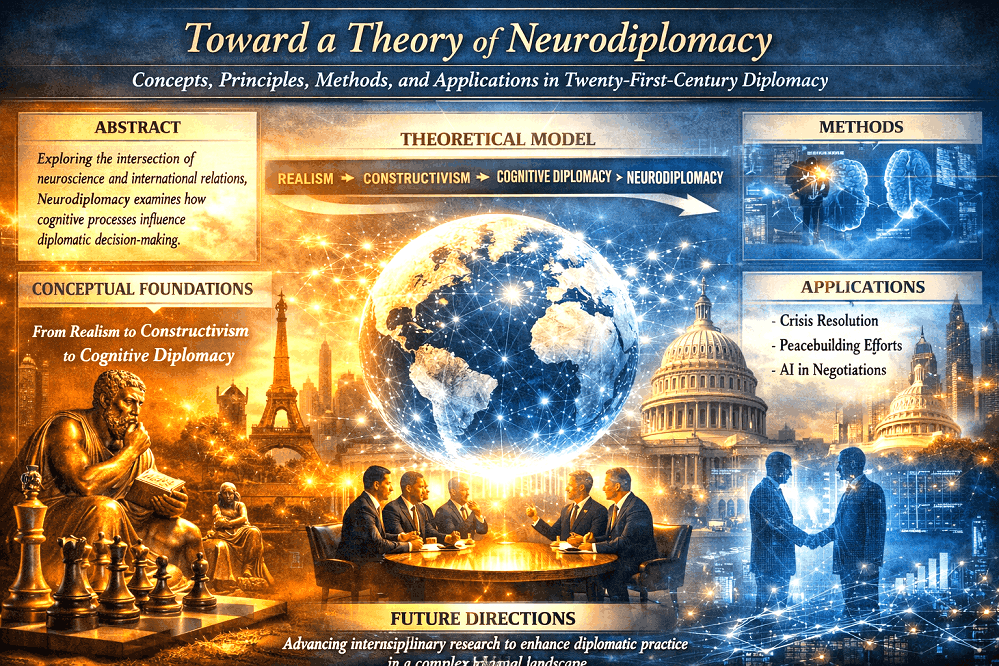
Part 3. Toward a Theory of Neurodiplomacy: Concepts, Principles, Methods, and Applications in Twenty-First-Century Diplomacy
17. Introduction: Why a Theory of Neurodiplomacy?
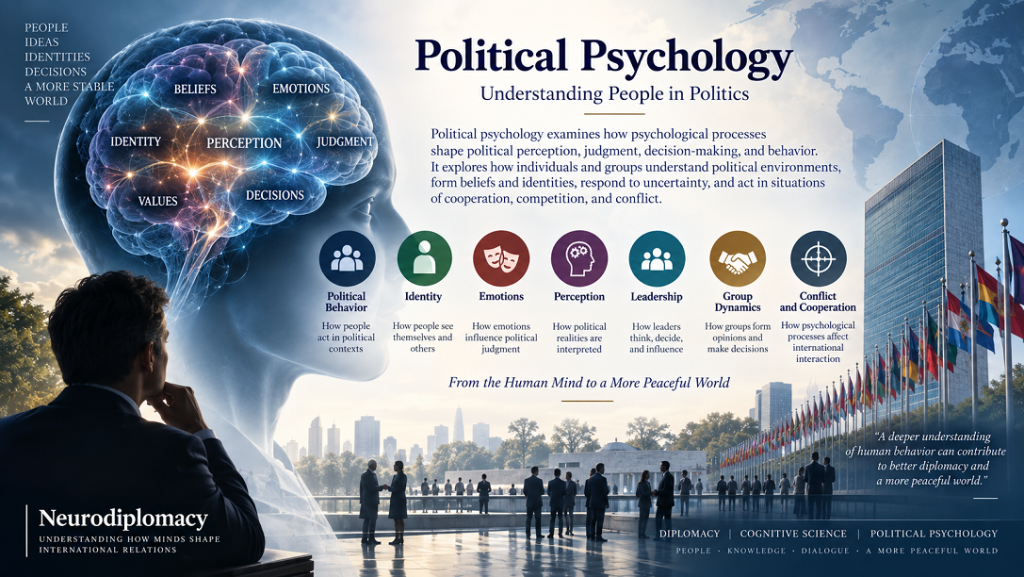
The evolution of International Relations (IR) theory reflects a continuous effort to explain the complexity of global politics. Classical theories have emphasized power, institutions, identities, norms, and international structures. More recent developments in political psychology and Foreign Policy Analysis have drawn attention to the role of individual leaders, perceptions, and decision-making. Yet, despite these advances, a significant analytical gap remains between the macro-level dynamics of international politics and the micro-level cognitive processes through which political actors perceive, interpret, and respond to international events.
Neurodiplomacy seeks to address this gap by integrating insights from diplomacy studies, cognitive science, neuroscience, psychology, linguistics, behavioral economics, and communication theory. Its central proposition is straightforward: international politics is conducted by human beings whose brains process information, generate emotions, construct meanings, and guide behavior. Consequently, diplomatic outcomes are shaped not only by the distribution of power or institutional arrangements but also by the cognitive and emotional mechanisms that influence perception, judgment, communication, and negotiation.
Rather than replacing established IR theories, neurodiplomacy offers an additional level of analysis that complements structural, institutional, and normative explanations. It provides a human-centered perspective that explores the cognitive foundations of diplomacy and the neural processes underlying international decision-making.
18. Defining Neurodiplomacy
Neurodiplomacy may be defined as:
An interdisciplinary field of study that investigates how neural processes, cognition, emotions, language, perception, and decision-making influence diplomatic behavior, foreign policy, negotiation, conflict management, and international cooperation.
This definition highlights several important characteristics.
First, neurodiplomacy is interdisciplinary. It combines theories and methods from International Relations, diplomacy, neuroscience, cognitive science, psychology, linguistics, and communication studies.
Second, neurodiplomacy is multilevel. It links biological processes with individual cognition, interpersonal communication, organizational behavior, and international political outcomes.
Third, neurodiplomacy is explanatory rather than deterministic. It does not claim that neural activity alone explains diplomacy. Instead, it argues that biological, psychological, cultural, and institutional factors interact to shape international behavior.
Finally, neurodiplomacy is both descriptive and practical. It seeks not only to explain diplomatic processes but also to improve negotiation, communication, conflict resolution, and cross-cultural understanding.
19. The Core Concepts of Neurodiplomacy
A coherent theory of neurodiplomacy rests on several interconnected concepts.
Cognition
Cognition refers to the mental processes through which individuals perceive, interpret, remember, and evaluate information. In diplomacy, cognition influences how leaders assess threats, identify opportunities, and formulate policy options.
Perception
Diplomatic actors rarely respond directly to objective reality. Instead, they respond to their perceptions of reality. Historical experiences, cultural beliefs, ideological commitments, and previous interactions all shape how international events are interpreted.
Emotion
Emotions are integral to diplomatic decision-making. Fear, trust, pride, humiliation, empathy, anger, and hope influence negotiations, alliance formation, crisis management, and conflict resolution. Contemporary neuroscience demonstrates that emotion and reason are deeply interconnected rather than independent systems.
Communication
Diplomacy is fundamentally a communicative process. Successful diplomacy depends on framing messages effectively, interpreting verbal and nonverbal signals, establishing credibility, and developing mutual understanding across cultural and political boundaries.
Decision-Making
Diplomatic decisions are made under conditions of uncertainty, limited information, and time pressure. Neurodiplomacy examines how attention, memory, intuition, analytical reasoning, and cognitive biases shape these decisions.
Social Cognition
Social cognition concerns how individuals understand the intentions, beliefs, and emotions of others. In diplomacy, the ability to infer another actor’s perspective is essential for negotiation, mediation, and trust-building.
20. The Fundamental Principles of Neurodiplomacy
A theoretical framework requires a set of guiding principles. The following principles provide a foundation for neurodiplomacy.
Principle One: Diplomacy Is a Cognitive Process
Diplomatic activity begins with perception and interpretation. Before governments negotiate or act, individuals must understand situations, evaluate information, and construct mental representations of international reality.
Principle Two: Rationality Is Bounded
Decision-makers possess limited cognitive resources. They operate with incomplete information, finite attention, and imperfect memory. Consequently, diplomatic choices reflect bounded rationality rather than perfect optimization.
Principle Three: Emotion Is a Strategic Resource
Emotions should not be viewed as obstacles to rational diplomacy. Appropriate emotional regulation, empathy, and trust can facilitate negotiation, while unmanaged fear or humiliation may intensify conflict.
Principle Four: Communication Shapes Political Reality
Language does more than transmit information; it frames issues, constructs identities, and influences expectations. Diplomatic discourse therefore plays an active role in shaping international outcomes.
Principle Five: Cultural Context Influences Cognition
Neural processes operate within cultural environments. Collective memory, social norms, education, and political traditions influence perception, communication, and decision-making.
Principle Six: International Politics Emerges from Multiple Levels of Analysis
Diplomatic behavior reflects the interaction of international structures, domestic institutions, organizational processes, interpersonal relationships, and individual cognition. Neurodiplomacy complements rather than replaces these levels of analysis.
21. Methodological Foundations
As an interdisciplinary field, neurodiplomacy benefits from methodological pluralism. No single method is sufficient to explain the complexity of diplomatic behavior.
Qualitative Approaches
Case studies, diplomatic history, discourse analysis, archival research, and elite interviews can reveal how perception, communication, and cognition influence international events.
Quantitative Approaches
Experimental psychology, survey research, decision-analysis models, and behavioral simulations enable systematic investigation of cognitive processes relevant to diplomacy.
Neuroscientific Methods
Advances in neuroscience provide additional tools, including functional magnetic resonance imaging (fMRI), electroencephalography (EEG), eye-tracking, psychophysiological measures, and neurocognitive experiments. These methods should be employed ethically and interpreted cautiously, recognizing that laboratory findings do not directly translate to complex diplomatic environments.
Computational and Artificial Intelligence Methods
Machine learning, computational linguistics, sentiment analysis, and network analysis offer opportunities to examine diplomatic communication, negotiation dynamics, and public diplomacy at unprecedented scales. These approaches should complement—not replace—human interpretation and contextual analysis.
22. Applications of Neurodiplomacy in Twenty-First-Century Diplomacy
The practical value of neurodiplomacy lies in its ability to enrich diplomatic practice.
Diplomatic Negotiation
Negotiators who understand cognitive biases, emotional regulation, and communication framing may improve mutual understanding and increase the likelihood of reaching durable agreements.
Conflict Prevention and Resolution
Recognizing how fear, identity, historical memory, and misperception contribute to escalation may enable diplomats to design more effective confidence-building measures and de-escalation strategies.
Public Diplomacy
Public diplomacy increasingly depends on narratives, emotions, and digital communication. Neurodiplomatic insights can help explain how international audiences interpret messages, develop trust, and respond to strategic communication.
Cross-Cultural Diplomacy
Different societies process symbols, narratives, and communication styles through distinct cultural frameworks. Neurodiplomacy encourages diplomats to integrate cultural cognition into negotiation and dialogue.
Leadership Development
Training programs for diplomats and political leaders may benefit from incorporating research on attention, decision-making, emotional intelligence, stress management, and cognitive flexibility.
Digital Diplomacy
The rapid expansion of digital platforms has transformed diplomatic communication. Information now spreads globally within seconds, increasing both opportunities for engagement and risks of misinformation, polarization, and emotional escalation. Neurodiplomacy provides analytical tools for understanding how digital environments influence attention, trust, and public opinion.
23. Ethical Considerations
The integration of neuroscience into diplomacy raises important ethical questions.
Knowledge of cognition should be used to improve communication, mutual understanding, and peaceful conflict resolution—not to manipulate, exploit, or undermine individual autonomy. Transparency, informed consent in research, respect for privacy, and adherence to international ethical standards are essential.
Neurodiplomacy should therefore be guided by principles of responsibility, accountability, and respect for human dignity. Its objective is to strengthen diplomacy as a peaceful instrument of international cooperation rather than to develop new techniques of psychological influence.
24. A Conceptual Model of Neurodiplomacy
A general theoretical model may be summarized as follows:
International Environment
↓
Political and Cultural Context
↓
Perception and Information Processing
↓
Attention, Memory, Emotion, and Cognition
↓
Interpretation and Strategic Judgment
↓
Diplomatic Communication and Negotiation
↓
Foreign Policy Decisions
↓
International Outcomes
(Cooperation, Competition, Crisis Management, or Conflict Resolution)
This model illustrates that international outcomes emerge through successive stages of cognitive and communicative processing rather than solely from material capabilities or institutional structures.
25. Future Directions
Several promising avenues for future research include:
- Developing formal theoretical models that integrate neurodiplomacy with existing IR theories.
- Examining the relationship between emotional intelligence and diplomatic effectiveness.
- Investigating the cognitive foundations of trust in international negotiations.
- Exploring the interaction between artificial intelligence and human decision-making in diplomacy.
- Conducting cross-cultural studies of perception, negotiation, and strategic communication.
- Assessing the implications of neurotechnology for diplomacy, security, and international governance.
These directions suggest that neurodiplomacy has the potential to become a significant interdisciplinary research program while remaining grounded in established theories of international relations.
26. Conclusion of Part 3
The evolution of International Relations demonstrates a progressive broadening of analytical perspectives—from power politics and institutional design to identities, norms, perceptions, and decision-making. Neurodiplomacy represents the next stage in this intellectual trajectory by incorporating advances in neuroscience and cognitive science into the study of diplomacy.
Its contribution lies not in replacing realism, liberalism, constructivism, or other established theories, but in enriching them with a deeper understanding of the human mind. Diplomacy is ultimately practiced by individuals who perceive, interpret, communicate, negotiate, and decide within complex political environments. Understanding these cognitive and emotional processes provides a more comprehensive account of how international relations unfold.
As neuroscience, cognitive science, and artificial intelligence continue to advance, neurodiplomacy offers a promising framework for examining the human dimensions of global politics. By integrating biological, psychological, social, and political levels of analysis, it encourages a more holistic understanding of diplomacy in the twenty-first century—one that recognizes that the pursuit of peace, cooperation, and international order begins not only with states and institutions, but also with the minds of those who represent them.
Sources:
- Bull, H. (1977). The anarchical society: A study of order in world politics. Columbia University Press.
- Damasio, A. (1994). Descartes’ error: Emotion, reason, and the human brain. Putnam.
- Deutsch, K. W. (1963). The nerves of government: Models of political communication and control. Free Press.
- Goleman, D. (1995). Emotional intelligence: Why it can matter more than IQ. Bantam Books.
- Hudson, V. M. (2005). Foreign policy analysis: Classic and contemporary theory. Rowman & Littlefield.
- Jervis, R. (1976). Perception and misperception in international politics. Princeton University Press.
- Kahneman, D., Slovic, P., & Tversky, A. (Eds.). (1982). Judgment under uncertainty: Heuristics and biases. Cambridge University Press.
- Kissinger, H. (1994). Diplomacy. Simon & Schuster.
- Morgenthau, H. J. (1948). Politics among nations: The struggle for power and peace. Alfred A. Knopf.
- Neisser, U. (1967). Cognitive psychology. Appleton-Century-Crofts.
- Nye, J. S. (2004). Soft power: The means to success in world politics. PublicAffairs.
- Onuf, N. (1989). World of our making: Rules and rule in social theory and international relations. University of South Carolina Press.
- Renshon, J. (2009). Psychological aspects of war and peace. Oxford University Press.
- Waltz, K. N. (1979). Theory of international politics. Addison-Wesley.
- Wendt, A. (1999). Social theory of international politics. Cambridge University Press.
- Wilson, E. O. (1998). Consilience: The unity of knowledge. Alfred A. Knopf.