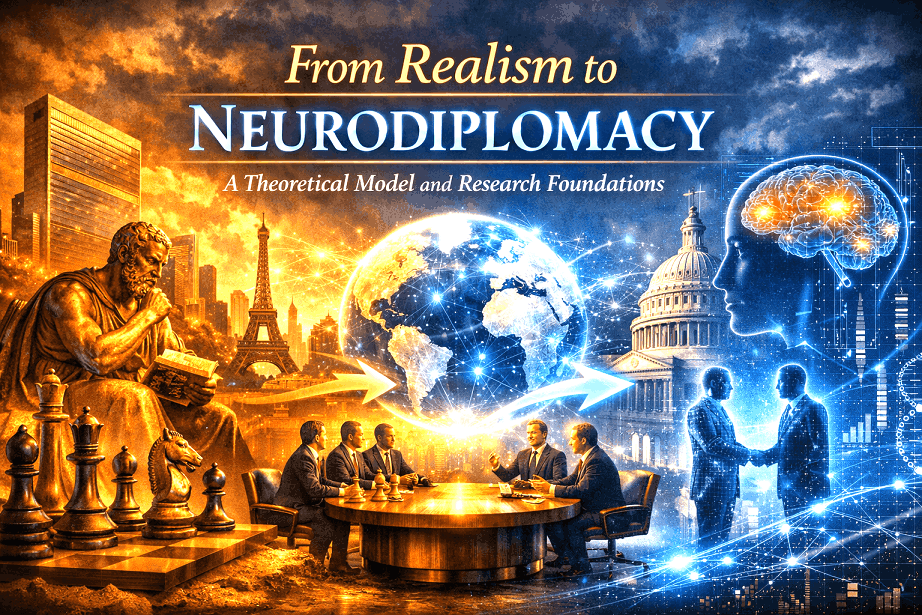
Part 2. From Realism to Neurodiplomacy: A Theoretical Model and Research Foundations
12. A Theoretical Model of the Evolution of International Relations Toward Neurodiplomacy
The evolution of International Relations theory can be understood as a gradual expansion of analytical focus. Early theories concentrated primarily on external structures, state interests, and material capabilities. Later approaches introduced institutions, identities, norms, psychology, and finally the cognitive and neurological foundations of political behavior.
The development from realism to neurodiplomacy does not represent the replacement of one theory by another. Instead, it reflects an expanding understanding of international politics in which different levels of analysis are connected.
The Evolutionary Model
                 THE EVOLUTION OF INTERNATIONAL RELATIONS THEORY

REALISM
(1940s–1970s)
│
│ Main Question:
│ How do states survive in a competitive world?
│
│ Core Concepts:
│ Power – Security – National Interest – Balance of Power
│
▼

NEOREALISM
(1970s–1980s)
│
│ Main Question:
│ How does the international system shape state behavior?
│
│ Core Concepts:
│ Anarchy – Structure – Strategic Competition
│
▼

LIBERALISM
(1940s–Present)
│
│ Main Question:
│ How is cooperation possible?
│
│ Core Concepts:
│ Institutions – Interdependence – Democracy – Cooperation
│
▼

ENGLISH SCHOOL
(1960s–Present)
│
│ Main Question:
│ How do states create international order?
│
│ Core Concepts:
│ International Society – Diplomacy – Rules – Norms
│
▼

CONSTRUCTIVISM
(1980s–Present)
│
│ Main Question:
│ How do ideas and identities shape world politics?
│
│ Core Concepts:
│ Identity – Culture – Norms – Meaning – Narratives
│
▼

FOREIGN POLICY ANALYSIS
(1960s–Present)
│
│ Main Question:
│ How do leaders make international decisions?
│
│ Core Concepts:
│ Leadership – Beliefs – Perception – Decision-Making
│
▼

POLITICAL PSYCHOLOGY & COGNITIVE APPROACHES
(1970s–Present)
│
│ Main Question:
│ How do human minds interpret international reality?
│
│ Core Concepts:
│ Biases – Memory – Emotions – Judgment
│
▼

NEURODIPLOMACY
(21st Century)
│
│ Main Question:
│ How do brain processes, cognition, and emotions influence diplomacy?
│
│ Core Concepts:
│ Neural Processes – Cognitive Decision-Making –
│ Emotional Intelligence – Communication – Empathy
13. The Multi-Level Framework of Neurodiplomacy
Neurodiplomacy introduces a multi-level model for understanding international relations:
Level One: The International System
This level includes traditional IR concerns:
- distribution of power,
- security competition,
- global institutions,
- geopolitical structures.
Realism and neorealism primarily operate at this level.
Level Two: The State and Society
This level examines:
- political culture,
- national identity,
- domestic institutions,
- historical narratives.
Liberalism and constructivism contribute significantly to this level.
Level Three: The Decision-Maker
This level focuses on:
- leaders,
- diplomats,
- advisors,
- negotiation teams.
Foreign Policy Analysis and political psychology emphasize this dimension.
Level Four: The Cognitive and Neural Level
This is the central contribution of neurodiplomacy.
It examines:
- perception,
- attention,
- emotional responses,
- cognitive biases,
- memory,
- language processing,
- empathy.
The neurodiplomatic approach argues that international outcomes emerge from the interaction between all four levels.
14. Theoretical Contributions of Neurodiplomacy
14.1 Moving Beyond the Rational Actor Model
Many traditional approaches assume that political actors make decisions through rational calculation. Neurodiplomacy does not reject rationality but demonstrates that rational choices are shaped by cognitive limitations and emotional influences.
Human decision-makers operate with:
- incomplete information,
- limited attention,
- previous experiences,
- psychological expectations.
Therefore, understanding diplomacy requires understanding how minds process complexity.
14.2 Explaining Misperception and Conflict
A central contribution of neurodiplomacy is explaining why states sometimes misunderstand each other.
Conflicts may emerge because actors:
- interpret signals differently,
- rely on historical memories,
- exaggerate threats,
- underestimate others’ intentions.
Neurodiplomacy connects traditional studies of misperception with contemporary research on cognition and neuroscience.
14.3 Understanding Diplomatic Communication
Diplomacy is fundamentally a process of communication.
Negotiation depends on:
- framing messages,
- interpreting language,
- recognizing emotions,
- establishing trust.
Neurodiplomacy suggests that successful diplomacy requires not only strategic knowledge but also cognitive and emotional intelligence.
14.4 Integrating Emotion into International Politics
Traditional theories often emphasized interests and institutions. Contemporary research demonstrates that emotions are central to political behavior.
International politics involves emotions such as:
- fear,
- pride,
- anger,
- empathy,
- hope.
Neurodiplomacy provides a framework for understanding how emotional processes influence diplomatic choices.
15. Future Research Agenda for Neurodiplomacy
Future research may develop several areas:
1. Neuroleadership and Foreign Policy
Examining how leaders’ cognitive styles influence international decisions.
2. Diplomatic Negotiation and the Brain
Studying how trust, empathy, and communication affect negotiations.
3. Cognitive Biases in International Crises
Exploring how biases contribute to escalation and conflict.
4. Artificial Intelligence and Diplomatic Decision-Making
Investigating how AI systems may support human diplomatic judgment.
5. Cross-Cultural Neuroscience and Global Communication
Understanding how cultural differences influence perception and interaction.
16. Conclusion of Part 2
The theoretical journey from realism to neurodiplomacy represents an expanding understanding of international politics. Realism explained power competition; liberalism explained cooperation; constructivism explained meaning and identity; foreign policy analysis explained decision-makers; and cognitive approaches revealed the importance of perception and judgment.
Neurodiplomacy builds upon these traditions by introducing the human brain and mind as important dimensions of international relations.
The central proposition of neurodiplomacy is:
International politics is shaped not only by structures, institutions, and interests, but also by the cognitive and emotional processes of the people who interpret and transform the world.
Understanding diplomacy therefore requires understanding both the international system and the human mind.