Abstract
Psychological approaches have played an important role in expanding the study of International Relations (IR) beyond traditional concerns with power, institutions, and material capabilities. Approaches such as political psychology, cognitive psychology, leadership studies, behavioral decision-making, and foreign policy analysis have demonstrated that perceptions, beliefs, emotions, and individual characteristics influence international political behavior. However, neurodiplomacy introduces a distinct analytical dimension by examining the neurocognitive foundations underlying diplomatic judgment, foreign policy decision-making, negotiation, and conflict management.
While existing psychological approaches primarily investigate the behavioral and social consequences of human cognition, neurodiplomacy seeks to understand the biological and neural mechanisms through which perception, emotion, memory, attention, empathy, and decision-making operate within diplomatic contexts. This article compares neurodiplomacy with major psychological approaches in International Relations and identifies its distinctive theoretical contribution.
1. Introduction: The Psychological Turn in International Relations
Traditional International Relations theories have often focused on states, power structures, institutions, and international systems. Realism emphasizes power competition; Liberalism highlights cooperation and institutions; Constructivism examines identities and norms. However, these approaches frequently treat states as strategic actors without fully examining the human cognitive processes behind state behavior.
The psychological turn in International Relations challenged this assumption by arguing that foreign policy decisions are made by human beings who possess:
- Limited information-processing capacity
- Emotional responses
- Belief systems
- Personal experiences
- Cognitive biases
- Social identities
Important psychological approaches emerged, including:
- Political psychology
- Cognitive psychology
- Foreign Policy Analysis
- Leadership psychology
- Behavioral decision theory
- Social psychology
These approaches significantly improved understanding of international politics.
However, neurodiplomacy asks a further question:
What happens inside the human cognitive and neural systems that produce diplomatic judgments, perceptions, and decisions?
This question defines its distinctive contribution.
2. Political Psychology vs. Neurodiplomacy
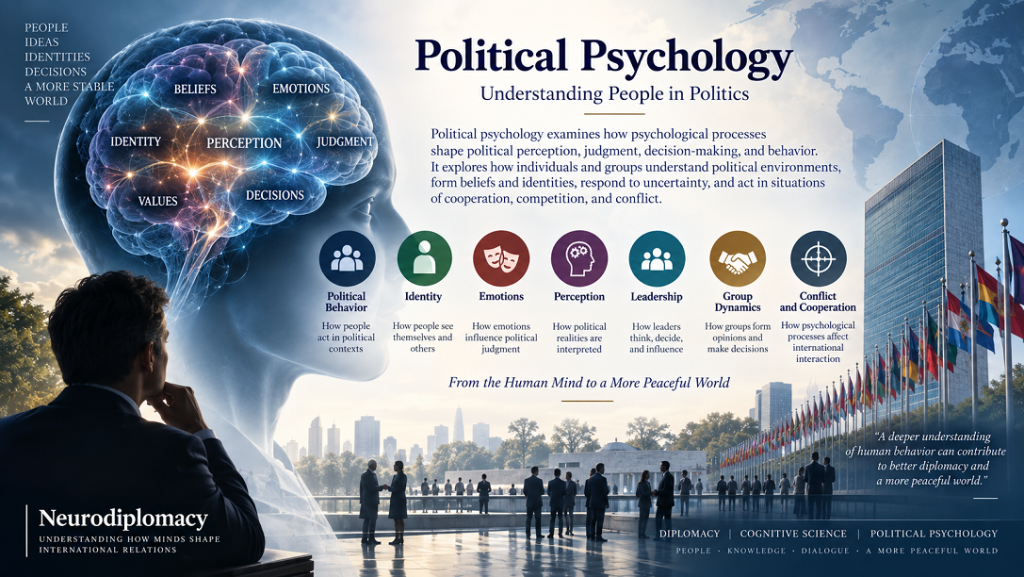
Political Psychology
Political psychology examines how psychological factors influence political behavior.
It studies:
- Leaders’ personalities
- Belief systems
- Political attitudes
- Identity formation
- Group behavior
- Public opinion
- Ideological motivations
Key scholars include:
- Robert Jervis
- Alexander George
- Margaret Hermann
Political psychology asks:
“How do psychological factors influence political decisions?”
Neurodiplomacy
Neurodiplomacy asks a deeper question:
“What are the cognitive and neural mechanisms through which psychological factors influence diplomatic decisions?”
It examines:
- Brain-based decision processes
- Emotional regulation
- Threat perception
- Cognitive flexibility
- Neural mechanisms of trust
- Empathy and perspective-taking
- Attention and information processing
Main Difference:
| Political Psychology | Neurodiplomacy |
|---|---|
| Studies psychological behavior | Studies cognitive and neural foundations |
| Focuses on beliefs and perceptions | Focuses on mechanisms producing perceptions |
| Primarily behavioral analysis | Integrates neuroscience and cognition |
| Explains political behavior | Explains how minds process political reality |
Example:
Political psychology may explain why a leader perceives another state as threatening.
Neurodiplomacy examines how threat perception is created through cognitive processes involving fear, memory, attention, and emotional evaluation.
3. Cognitive Psychology vs. Neurodiplomacy
Cognitive Psychology
Cognitive psychology examines mental processes such as:
- Memory
- Learning
- Reasoning
- Judgment
- Decision-making
- Problem-solving
In International Relations, cognitive approaches analyze:
- Cognitive biases
- Misperceptions
- Decision shortcuts
- Information processing
The work of Daniel Kahneman and Amos Tversky on heuristics and biases has strongly influenced foreign policy studies.
Neurodiplomacy
Neurodiplomacy incorporates cognitive psychology but adds a biological dimension.
It investigates:
- How the brain processes uncertainty
- How emotions influence reasoning
- How stress affects decision-making
- How neural systems influence cooperation and conflict
Main Difference:
| Cognitive Psychology | Neurodiplomacy |
|---|---|
| Studies mental processes | Studies mental processes plus neural foundations |
| Explains thinking patterns | Explains mechanisms behind thinking patterns |
| Focuses on cognition | Integrates cognition, emotion, and neuroscience |
4. Foreign Policy Analysis (FPA) vs. Neurodiplomacy
Foreign Policy Analysis
Foreign Policy Analysis examines how governments make foreign policy decisions.
It focuses on:
- Leaders
- Bureaucracies
- Institutions
- Decision groups
- Domestic politics
Important contributions include:
- Rational actor model
- Organizational behavior model
- Governmental politics model
For example, Graham Allison demonstrated that foreign policy decisions are shaped by organizational and bureaucratic processes.
Neurodiplomacy
Neurodiplomacy complements FPA by examining the cognitive processes within these institutions.
It asks:
- How do policymakers process intelligence?
- Why do institutions develop collective biases?
- How does stress influence crisis decisions?
- How can decision-making systems become cognitively resilient?
Main Difference:
| Foreign Policy Analysis | Neurodiplomacy |
|---|---|
| Focuses on institutions and actors | Focuses on cognition within institutions |
| Explains decision structures | Explains decision processes |
| Political-organizational level | Neurocognitive-institutional level |
5. Behavioral Decision Theory vs. Neurodiplomacy
Behavioral Decision Theory
Behavioral approaches challenge the assumption that decision-makers are perfectly rational.
They emphasize:
- Bounded rationality
- Heuristics
- Biases
- Risk perception
Herbert Simon’s concept of bounded rationality demonstrated that humans make decisions under limitations of information and cognitive capacity.
Neurodiplomacy
Neurodiplomacy accepts bounded rationality but examines its deeper origins.
It investigates:
- Why humans rely on shortcuts
- How emotions interact with reasoning
- How biological systems influence risk assessment
Main Difference:
Behavioral theory explains:
“Humans are not perfectly rational.”
Neurodiplomacy explains:
“Why human cognition operates this way.”
6. Social Psychology and Constructivist Approaches vs. Neurodiplomacy
Social Psychology in IR
Social psychological approaches examine:
- Identity
- Group relations
- Stereotypes
- Enemy images
- Collective emotions
Constructivism similarly emphasizes:
- Social meanings
- Norms
- Identity formation
Neurodiplomacy
Neurodiplomacy builds upon these approaches by examining how social experiences become cognitively and emotionally embedded.
For example:
Constructivism asks:
How are enemy identities socially constructed?
Neurodiplomacy asks:
How are these identities stored, reinforced, and activated through cognitive and emotional systems?
7. Leadership Psychology vs. Neurodiplomacy
Leadership psychology examines:
- Personality traits
- Leadership style
- Motivation
- Decision tendencies
It explains why different leaders respond differently to similar situations.
Neurodiplomacy extends leadership studies by examining:
- Cognitive flexibility
- Stress responses
- Emotional regulation
- Attention patterns
- Decision resilience
A neurodiplomatic analysis of leadership would examine not only who the leader is but also how the leader’s cognitive system processes international challenges.
8. The Unique Contribution of Neurodiplomacy
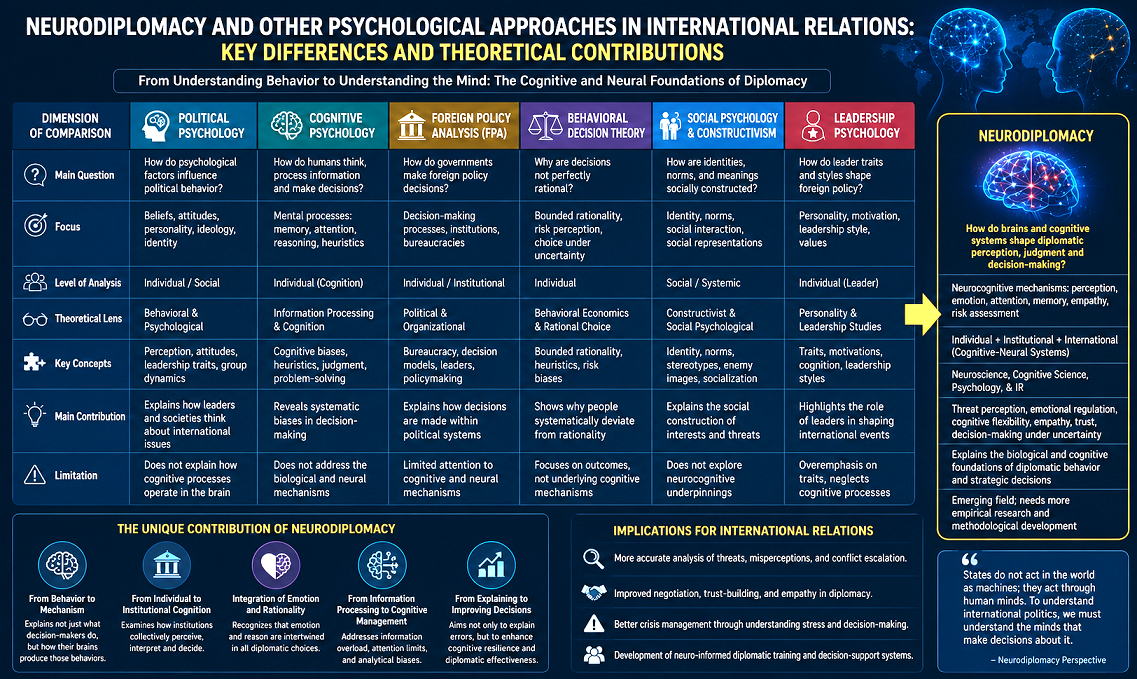
The distinctive contribution of neurodiplomacy can be summarized in five dimensions:
1. From Behavior to Mechanism
Other psychological approaches explain what decision-makers do.
Neurodiplomacy investigates the mechanisms producing those behaviors.
2. From Individual Psychology to Institutional Cognition
Traditional psychology often focuses on individuals.
Neurodiplomacy examines how institutions collectively:
- Process information
- Develop assumptions
- Learn
- Adapt
3. Integration of Emotion and Rationality
Neurodiplomacy rejects the traditional separation between emotion and reason.
It argues:
Effective diplomacy requires emotionally intelligent rationality.
4. From Information Processing to Cognitive Management
In an era of information explosion, the challenge is not simply obtaining information but managing human cognitive limitations.
Neurodiplomacy studies:
- Attention
- Information overload
- Analytical bias
- Decision fatigue
5. From Explaining Decisions to Improving Decisions
Many psychological approaches explain why mistakes occur.
Neurodiplomacy also seeks practical improvement through:
- Cognitive training
- Institutional design
- Decision-support systems
- Neuro-informed diplomacy education
9. Comparative Summary Table
| Approach | Main Question | Level of Analysis | Main Contribution |
|---|---|---|---|
| Political Psychology | How do psychological factors influence politics? | Individual/social | Beliefs and perceptions |
| Cognitive Psychology | How do humans think and decide? | Individual cognition | Biases and reasoning |
| Foreign Policy Analysis | How do governments make decisions? | Individual/institutional | Decision processes |
| Behavioral Decision Theory | Why are decisions imperfect? | Individual cognition | Bounded rationality |
| Social Psychology | How do groups perceive others? | Social/group | Identity and stereotypes |
| Leadership Psychology | How do leaders differ? | Individual | Personality and style |
| Neurodiplomacy | How do brains and cognitive systems shape diplomacy? | Individual + institutional + international | Neurocognitive foundations of diplomatic decision-making |
Conclusion
Neurodiplomacy represents an evolution rather than a rejection of existing psychological approaches in International Relations. Political psychology, cognitive psychology, foreign policy analysis, and behavioral decision theory created the intellectual foundation by demonstrating that human factors matter in world politics. Neurodiplomacy builds upon these contributions by adding insights from neuroscience and cognitive science.
Its central argument is:
International relations are ultimately relations between human minds operating within political systems.
States perceive threats, construct identities, negotiate agreements, and make strategic decisions through cognitive processes. Therefore, a complete understanding of world politics requires not only examining power, institutions, and norms but also understanding the neurocognitive foundations of diplomatic behavior.
In this sense, neurodiplomacy provides a new bridge between International Relations theory, psychology, neuroscience, and diplomacy, opening a pathway toward more effective decision-making, conflict prevention, and international cooperation.