Abstract
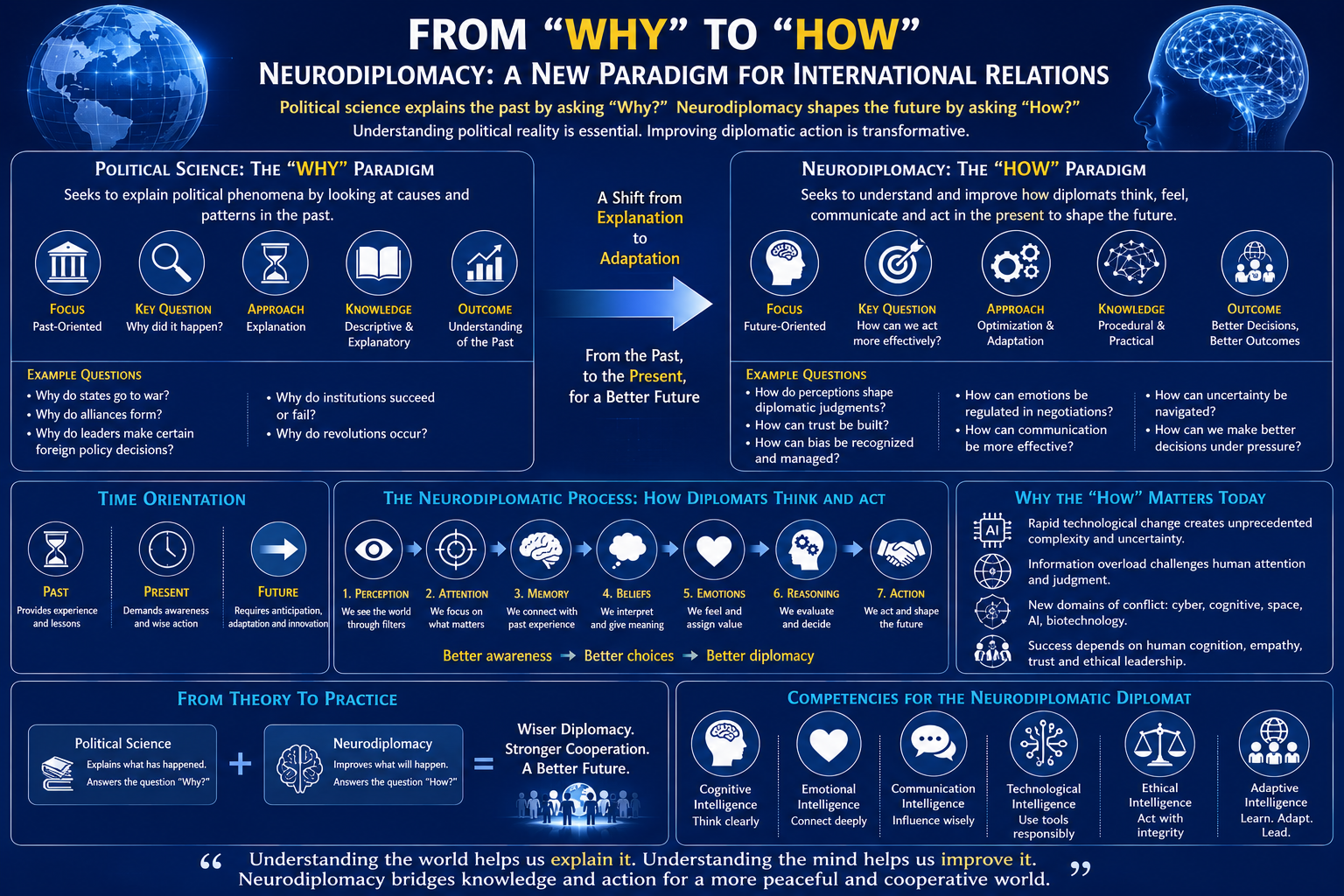
Political science has traditionally sought to explain political phenomena by asking “Why?” Why do states go to war? Why do alliances form? Why do revolutions occur? Why do leaders make certain foreign policy decisions? These questions have generated powerful explanatory theories that have shaped the discipline for over a century. Yet explanation alone does not necessarily improve future diplomatic practice. Neurodiplomacy introduces a complementary intellectual paradigm by shifting the central question from “Why?” to “How?” Rather than concentrating primarily on explaining past political events, Neurodiplomacy investigates how diplomats, political leaders, and negotiators perceive information, process uncertainty, construct meaning, regulate emotions, communicate, and make decisions in the present in order to shape more effective future outcomes. This article argues that this transition from explanation to adaptation represents one of the most significant conceptual innovations in contemporary diplomatic studies. By integrating neuroscience, cognitive science, psychology, behavioral economics, communication theory, and international relations, Neurodiplomacy offers a practical, forward-looking framework for improving diplomatic performance in an increasingly complex world.
Introduction
Every academic discipline is defined not only by its theories but also by the questions it asks.
Questions determine methods.
Methods determine knowledge.
Knowledge shapes practice.
Political science, since its emergence as a modern discipline, has largely been organized around explanatory questions. Scholars have sought to identify the causes of political behavior by asking:
-
Why do states cooperate?
-
Why do wars occur?
-
Why do institutions succeed or fail?
-
Why do leaders choose particular strategies?
-
Why does power shift among nations?
These questions have produced influential traditions such as realism, liberalism, constructivism, functionalism, and political psychology. They explain international events by identifying historical, structural, economic, institutional, and psychological causes.
Neurodiplomacy does not reject these explanatory traditions. Instead, it proposes that explanation alone is insufficient for the diplomatic challenges of the twenty-first century.
Diplomats operate in real time. They cannot change history, but they can influence what happens next.
Consequently, Neurodiplomacy begins with a different question:
How can diplomatic actors think, communicate, decide, and act more effectively under conditions of uncertainty?
This seemingly simple change—from why to how—fundamentally transforms the objectives of diplomatic scholarship.
The “Why” Paradigm of Political Science
Political science has traditionally pursued causal explanation.
Researchers seek relationships between independent and dependent variables in order to explain political outcomes.
For example:
Why did the Cold War end?
Possible explanations include:
-
economic decline
-
ideological competition
-
military balance
-
leadership change
-
institutional evolution
Similarly:
Why did World War I begin?
Scholars examine:
-
alliance systems
-
nationalism
-
security dilemmas
-
imperial competition
-
diplomatic failures
The objective is retrospective understanding.
Political science therefore develops theories that explain historical patterns. This approach has produced remarkable insights into international politics. Yet explanatory knowledge does not automatically generate practical wisdom.
Understanding why negotiations failed yesterday does not necessarily enable diplomats to negotiate more successfully tomorrow.
Neurodiplomacy and the “How” Question
Neurodiplomacy begins where explanation ends.
Rather than asking only:
Why did leaders make particular decisions?
it asks:
-
How is information processed?
-
How are perceptions constructed?
-
How are emotions regulated?
-
How are beliefs formed?
-
How is trust established?
-
How are biases recognized?
-
How can communication become more effective?
-
How can better diplomatic decisions be made?
The emphasis shifts from historical explanation to cognitive optimization.
This orientation is inherently practical.
It recognizes that diplomacy is not merely the study of international events but the practice of influencing future events.
Time Orientation: Past, Present, and Future
Another important distinction concerns time.
Political science often looks backward.
Historical analysis is indispensable because it explains how current political realities emerged.
Neurodiplomacy, by contrast, is primarily future-oriented.
Its temporal framework consists of three interconnected dimensions.
The past provides experience.
The present provides awareness.
The future provides possibility.
Instead of asking why a conflict occurred decades ago, Neurodiplomacy asks how current cognitive processes can prevent similar conflicts from emerging tomorrow.
Its emphasis is therefore adaptive rather than retrospective.
From Explanation to Adaptation
One of Neurodiplomacy’s defining characteristics is its emphasis on adaptation.
International politics is increasingly characterized by:
-
technological acceleration
-
artificial intelligence
-
digital diplomacy
-
information overload
-
cognitive warfare
-
hybrid conflict
-
global uncertainty
Static knowledge rapidly becomes obsolete.
Future diplomats require adaptive minds rather than merely accumulated information.
Consequently, Neurodiplomacy studies:
How do people adapt to complexity?
How do experts maintain cognitive flexibility?
How can diplomats continuously improve their thinking?
These questions transform diplomacy into a discipline of lifelong learning.
The Cognitive Turn in International Relations
Traditional international relations theories often assume that states behave rationally.
Political psychology demonstrated that leaders are influenced by perceptions, biases, emotions, and belief systems.
Neurodiplomacy extends this insight further.
It asks not only why cognition influences politics, but how cognition itself operates during diplomatic interaction.
Diplomatic decisions emerge through a sequence of neurocognitive processes.
External events are first perceived.
Attention selects certain information.
Memory connects present events to previous experience.
Belief systems interpret meaning.
Emotions assign value.
Only then does conscious reasoning occur.
Diplomatic action therefore represents the final stage of a much larger cognitive process.
Understanding this process allows diplomats to improve it.
Diplomacy as Human Performance
Traditional diplomacy is often viewed institutionally.
Attention focuses upon:
-
treaties
-
ministries
-
embassies
-
negotiations
-
international organizations
Neurodiplomacy shifts attention toward the diplomat.
The diplomat becomes the primary unit of analysis.
Diplomatic performance depends upon:
-
perception
-
attention
-
emotional regulation
-
empathy
-
communication
-
trust
-
creativity
-
adaptive thinking
Diplomacy thus becomes a science of human performance.
This resembles developments in medicine, aviation, and elite sport, where understanding human cognition has significantly improved professional practice.
The Centrality of “How”
The word how carries methodological significance.
It implies process rather than cause.
For example:
Political science asks:
Why do negotiations fail?
Neurodiplomacy asks:
How does misunderstanding emerge during negotiation?
How do emotions escalate conflict?
How does trust develop?
How does language influence perception?
How do diplomats regulate cognitive biases?
The focus shifts from identifying causes to understanding mechanisms.
Mechanisms can be trained.
Causes cannot always be changed.
Practical Knowledge Versus Descriptive Knowledge
Political science traditionally generates descriptive and explanatory knowledge.
Neurodiplomacy seeks procedural knowledge.
Procedural knowledge answers questions such as:
How should diplomats prepare before negotiations?
How can emotional escalation be prevented?
How should difficult conversations be structured?
How can attention be improved?
How can cognitive flexibility be cultivated?
How can leaders avoid decision-making traps?
This knowledge directly informs diplomatic education and professional development.
Neurodiplomacy and Strategic Learning
One of Neurodiplomacy’s greatest contributions lies in transforming diplomacy into a learning discipline.
Learning becomes continuous rather than episodic.
Reflection becomes systematic rather than accidental.
Mistakes become opportunities for cognitive improvement.
Diplomats develop:
-
metacognition
-
emotional intelligence
-
adaptive expertise
-
systems thinking
-
interdisciplinary competence
These capabilities cannot be derived solely from historical explanation.
They require continuous practice.
Implications for Diplomatic Education
If Neurodiplomacy begins with how, diplomatic education must also change.
Traditional diplomatic training emphasizes:
-
history
-
international law
-
economics
-
political science
-
foreign languages
These remain essential.
However, future diplomats also require education in:
-
neuroscience
-
cognitive science
-
behavioral psychology
-
emotional intelligence
-
strategic communication
-
decision science
-
negotiation psychology
-
adaptive leadership
The diplomat of the future must understand both international systems and the human mind.
Neurodiplomacy as an Action-Oriented Science
Unlike many theoretical approaches that primarily interpret international politics, Neurodiplomacy seeks to improve diplomatic action.
Its central concern is not merely knowledge.
Its concern is performance.
This makes Neurodiplomacy inherently interdisciplinary.
It integrates:
-
International Relations
-
Political Science
-
Neuroscience
-
Psychology
-
Communication Studies
-
Cognitive Science
-
Behavioral Economics
-
Artificial Intelligence
The objective is not only understanding diplomacy but enhancing it.
Conclusion
Political science and Neurodiplomacy should not be viewed as competing disciplines but as complementary intellectual traditions. Political science has provided indispensable explanations of power, institutions, conflict, and cooperation by asking why political events occur. These explanations remain fundamental to understanding international relations.
Neurodiplomacy builds upon this foundation by introducing a different, yet equally important, question: how can diplomats think, communicate, decide, and act more effectively in an increasingly complex world? Whereas political science often explains the past, Neurodiplomacy equips practitioners to navigate the present and shape the future. Its emphasis on cognition, perception, emotional regulation, strategic communication, and adaptive learning reflects the realities of contemporary diplomacy, where success depends as much on the quality of human judgment as on material capabilities or institutional arrangements.
The transition from why to how therefore represents more than a methodological adjustment. It signifies a broader evolution in diplomatic thought—from explanation to adaptation, from retrospective analysis to prospective action, and from the study of international politics as a system to the cultivation of diplomats as adaptive cognitive leaders. In an era defined by artificial intelligence, accelerating technological change, cognitive competition, and global uncertainty, Neurodiplomacy offers a human-centered paradigm that complements traditional political science by asking not only why the world is as it is, but how humanity can shape a more peaceful, cooperative, and resilient future.