Introduction
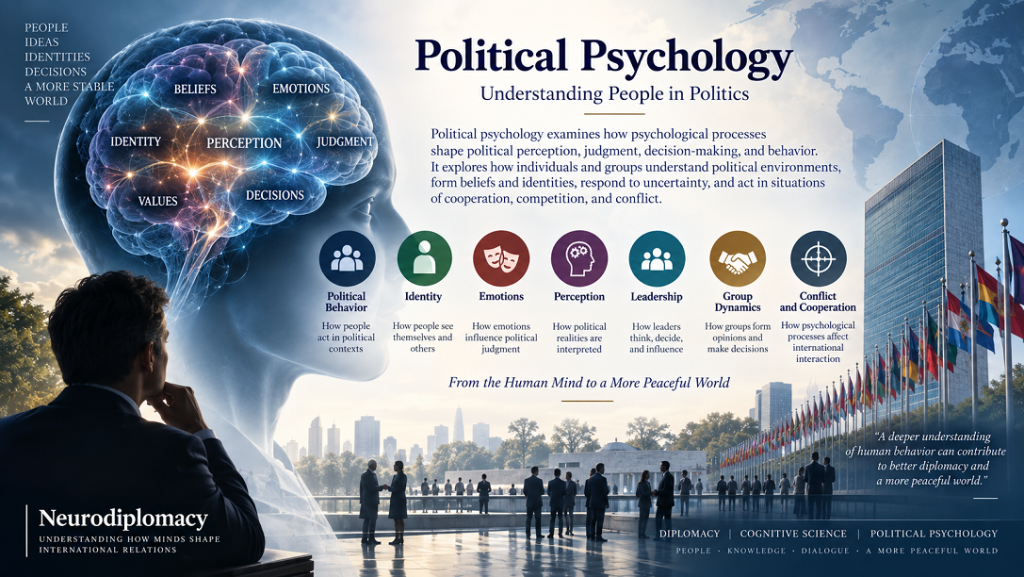
Among the major theoretical approaches in International Relations (IR), Constructivism is perhaps the most compatible with the emerging field of Neurodiplomacy. While traditional theories such as Realism and Liberalism primarily emphasize material power, institutions, and strategic interests, Constructivism focuses on the role of ideas, identities, norms, beliefs, and shared meanings in shaping international politics. Similarly, Neurodiplomacy examines how perceptions, cognition, emotions, communication, and social interactions influence diplomatic behavior and foreign policy decision-making.
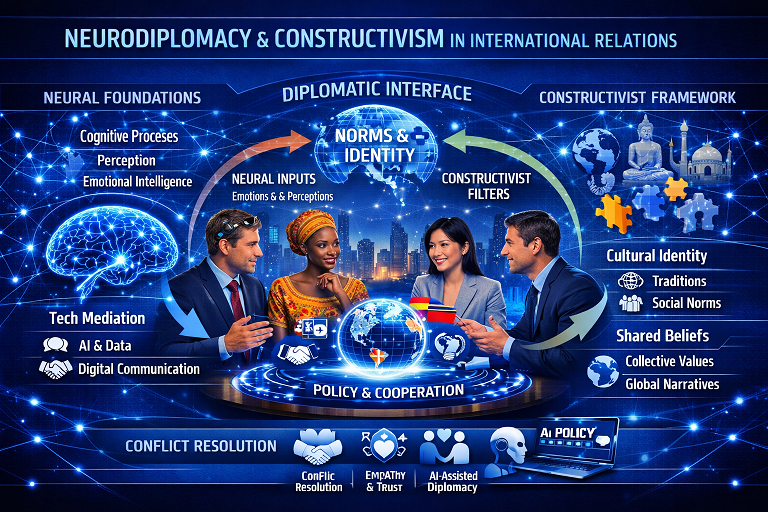
Both approaches challenge purely material explanations of international relations and emphasize the importance of how human beings construct and interpret reality. Consequently, Neurodiplomacy can be viewed as a complementary framework that provides micro-level cognitive and psychological foundations for many of the core assumptions of Constructivism.
In this sense, Constructivism explains how social realities are created, while Neurodiplomacy helps explain the cognitive and emotional mechanisms through which those realities are perceived, internalized, and reproduced.
Understanding Constructivism
Constructivism emerged as a major theoretical perspective through the work of scholars such as Alexander Wendt, Nicholas Onuf, and Peter Katzenstein.
Constructivists argue that international politics is socially constructed rather than determined solely by material factors.
Their central assumptions include:
Reality is socially constructed.
Ideas influence political behavior.
Identities shape interests.
Norms regulate state behavior.
Meanings emerge through interaction.
One of the most famous constructivist statements is Alexander Wendt’s assertion:
“Anarchy is what states make of it.”
This means that the international system does not possess inherent meaning; rather, states collectively construct its meaning through social interaction.
Understanding Neurodiplomacy
Neurodiplomacy is an interdisciplinary framework that combines:
Diplomacy
Cognitive Science
Neuroscience
Political Psychology
Communication Studies
International Relations
It investigates how:
Perceptions
Emotions
Cognitive biases
Trust
Empathy
Decision-making processes
influence diplomatic behavior and foreign policy outcomes.
Neurodiplomacy begins with the assumption that international politics is conducted by human beings whose perceptions and interpretations shape political reality.
Shared Foundations of Neurodiplomacy and Constructivism
The Importance of Ideas
Constructivism argues that ideas influence political behavior.
Neurodiplomacy helps explain why.
Ideas affect decision-making because they become embedded within cognitive structures.
Human beings interpret reality through:
Belief systems
Mental models
Narratives
Cognitive schemas
Thus, Neurodiplomacy provides a psychological explanation for how ideas shape international politics.
The Social Construction of Reality
Constructivists emphasize that international reality is socially constructed.
Neurodiplomacy complements this argument by demonstrating that social realities are also cognitively constructed.
Political actors interpret events through:
Perception
Memory
Emotion
Experience
Consequently, reality is both socially and cognitively constructed.
This creates a powerful connection between Constructivism and Neurodiplomacy.
Identity and Neurodiplomacy
Identity occupies a central position in Constructivist theory.
Constructivists argue that state interests emerge from identities.
For example:
A state may define itself as:
A democracy.
A regional leader.
A neutral actor.
A revolutionary state.
These identities shape foreign policy behavior.
Neurodiplomatic Perspective on Identity
Neurodiplomacy examines how identities are represented within the human mind.
Research in cognitive science suggests that identity influences:
Perception
Emotional responses
Group behavior
Trust formation
Leaders and societies often interpret international events through identity-based lenses.
Therefore, Neurodiplomacy provides a cognitive foundation for Constructivist theories of identity.
Perception and the Construction of International Reality
Perception is perhaps the most important bridge between Constructivism and Neurodiplomacy.
Constructivists argue that meanings are socially produced.
Neurodiplomacy explains how those meanings are perceived and processed.
For example:
A military alliance may be interpreted as:
A source of security.
A source of threat.
The material reality remains the same.
The meaning depends on perception.
This insight parallels both Constructivist and neurodiplomatic approaches.
“The Map Is Not the Territory” and Constructivism
The neurodiplomatic principle:
“The map is not the territory”
has strong constructivist implications.
Actors do not interact directly with objective reality.
Instead, they interact with their interpretations of reality.
Constructivism similarly argues that international politics is shaped by meanings rather than merely material conditions.
Thus, both perspectives emphasize the importance of subjective interpretation.
Norms and Neurodiplomacy
Norms are central to Constructivism.
Norms are shared expectations regarding appropriate behavior.
Examples include:
Human rights norms
Diplomatic immunity
Sovereignty
International law
Constructivists examine how norms emerge and spread.
Neurodiplomacy helps explain why norms influence behavior.
Individuals internalize norms through cognitive and emotional processes such as:
Social learning
Moral reasoning
Identity formation
Emotional attachment
Thus, Neurodiplomacy provides a psychological explanation for norm compliance.
Trust and Social Interaction
Constructivism emphasizes the importance of interaction in shaping international relationships.
Through repeated interactions, states develop:
Trust
Expectations
Shared understandings
Neurodiplomacy contributes by examining the cognitive and emotional foundations of trust.
Trust is not merely an institutional phenomenon.
It is also a psychological process involving:
Perception of intentions
Emotional regulation
Empathy
Predictability
This understanding enriches constructivist analyses of cooperation.
Communication and Meaning-Making
Constructivism views communication as a process through which social meanings are created.
Neurodiplomacy examines the cognitive mechanisms underlying communication.
The NLP-related principle:
“You cannot not communicate”
illustrates this relationship.
Every diplomatic action generates meaning.
States communicate through:
Language
Symbols
Policies
Gestures
Silence
Constructivism studies how these meanings emerge socially.
Neurodiplomacy studies how they are perceived psychologically.
Emotions and Constructivism
Traditional Constructivism often focuses on ideas and norms.
Neurodiplomacy expands this analysis by incorporating emotions.
Emotions influence:
Identity formation
National narratives
Political behavior
International cooperation
Examples include:
Fear shaping security policies.
Pride influencing national identity.
Humiliation affecting conflict dynamics.
Empathy encouraging reconciliation.
Thus, Neurodiplomacy adds an emotional dimension to Constructivist theory.
Neurodiplomacy as a Micro-Foundation for Constructivism
One of the most important theoretical contributions of Neurodiplomacy is that it provides micro-level foundations for Constructivist concepts.
Constructivism explains:
What is Constructed?
Identities
Norms
Narratives
Interests
Meanings
Neurodiplomacy explains:
How Are They Constructed?
Through perception.
Through cognition.
Through emotional processes.
Through communication.
Through social learning.
In this sense, Neurodiplomacy can be viewed as the cognitive and psychological underpinning of Constructivist international relations.
Applications in International Politics
The integration of Constructivism and Neurodiplomacy can improve understanding of:
Conflict Resolution
How perceptions and identities contribute to conflict and reconciliation.
Diplomatic Negotiations
How meanings and emotions shape bargaining behavior.
Public Diplomacy
How narratives influence international audiences.
Foreign Policy Analysis
How leaders interpret international events.
International Norm Diffusion
How norms become internalized and accepted.
Peacebuilding
How shared understandings and trust emerge.
Toward a Neuroconstructivist Approach
The convergence of Constructivism and Neurodiplomacy suggests the emergence of what might be called:
Neuroconstructivism in International Relations
This approach would examine how international realities are simultaneously:
Socially constructed through interaction.
Cognitively constructed through perception.
Emotionally reinforced through experience.
Communicated through language and symbols.
Such a framework could provide a richer understanding of diplomacy and world politics.
Conclusion
Neurodiplomacy and Constructivism share a common intellectual commitment to understanding the non-material dimensions of international relations. Both approaches emphasize that international politics is shaped not only by power and interests but also by perceptions, identities, norms, ideas, emotions, and communication. While Constructivism explains how social realities are created and maintained, Neurodiplomacy explains the cognitive and emotional processes through which those realities are perceived and acted upon.
Together, they offer a powerful interdisciplinary framework for understanding diplomacy, foreign policy, conflict resolution, and international cooperation. Neurodiplomacy enriches Constructivism by providing the psychological and neuroscientific foundations necessary to explain how ideas, identities, and norms influence political behavior. In doing so, it moves the study of international relations closer to a comprehensive understanding of the human mind as a central actor in world politics.
Neuroconstructivist Proposition
International reality is not merely constructed through social interaction; it is also constructed through perception, cognition, emotion, and communication. States act not only according to what the world is, but according to how their leaders and societies perceive and interpret what the world means.