Introduction
The growing importance of communication, perception, and human behavior in international relations has led to the emergence of new diplomatic approaches. Two concepts that emphasize the role of communication and perception are Public Diplomacy and Neurodiplomacy. Although they share several common characteristics, they differ significantly in their objectives, theoretical foundations, levels of analysis, and methods.
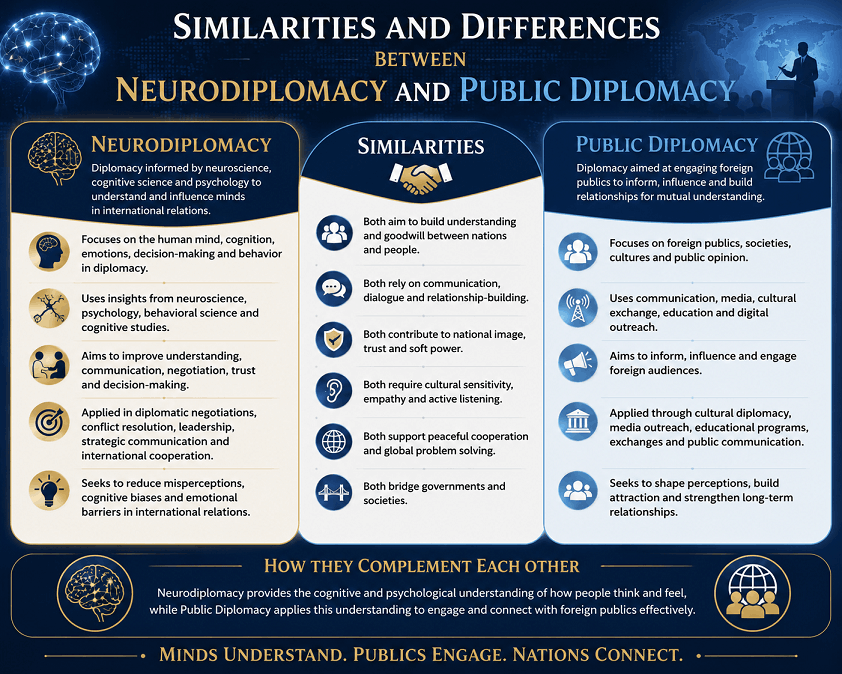
Public diplomacy focuses primarily on influencing foreign publics and shaping a country’s international image, whereas Neurodiplomacy seeks to understand and influence the cognitive, emotional, and perceptual processes that shape diplomatic behavior, decision-making, and international interactions.
While public diplomacy asks, “How can we communicate effectively with foreign audiences?” Neurodiplomacy asks, “How do people construct meaning, make decisions, and respond to diplomatic communication?”
What is Public Diplomacy?
Public diplomacy refers to the efforts of governments, international organizations, and other actors to communicate directly with foreign publics rather than solely through official diplomatic channels.
The concept is closely associated with:
International communication.
Soft power.
Nation branding.
Cultural diplomacy.
Public engagement.
Public diplomacy aims to:
Improve national image.
Build international trust.
Influence foreign public opinion.
Support foreign policy objectives.
A central assumption of public diplomacy is that public perceptions can influence international relations.
What is Neurodiplomacy?
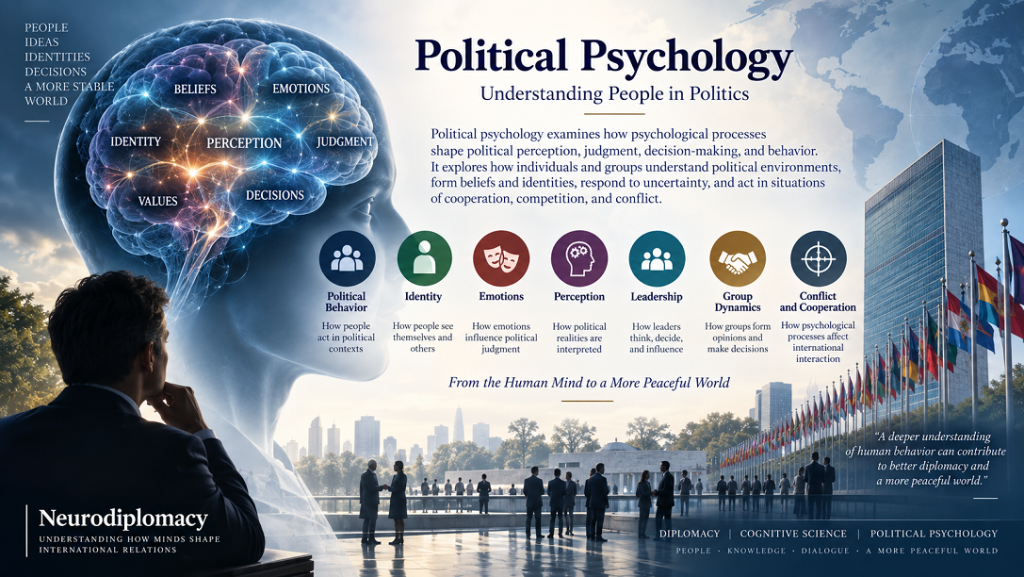
Neurodiplomacy is an emerging interdisciplinary approach that integrates insights from:
Political psychology.
Cognitive science.
Neuroscience.
Communication theory.
NLP (Neuro-Linguistic Programming).
Constructivism.
Foreign policy analysis.
Neurodiplomacy examines how:
Perceptions.
Beliefs.
Emotions.
Values.
Identity.
Cognitive processes.
shape diplomatic behavior and foreign policy decisions.
Its primary focus is not merely communication but understanding the psychological mechanisms underlying international interactions.
Similarities Between Neurodiplomacy and Public Diplomacy
Both Emphasize Perception
Both approaches recognize that perceptions influence international outcomes.
Public Diplomacy
Focuses on shaping how foreign publics perceive a country.
Neurodiplomacy
Focuses on understanding how perceptions are formed and how they influence decisions.
Both acknowledge that perception often matters as much as objective reality.
Both Recognize the Importance of Communication
Communication is central to both approaches.
Public Diplomacy
Uses communication to influence external audiences.
Neurodiplomacy
Studies how communication affects cognition, emotions, and behavior.
Both view communication as a strategic resource.
Both Support Soft Power
Public diplomacy is often considered a tool of soft power, a concept developed by Joseph Nye.
Neurodiplomacy also contributes to soft power by improving:
Persuasion.
Relationship-building.
Trust formation.
Narrative construction.
Both Focus on Relationships
Neither approach relies primarily on coercion.
Instead, both emphasize:
Cooperation.
Trust.
Mutual understanding.
Long-term engagement.
Both Are Important in the Digital Age
Social media, artificial intelligence, and digital communication have increased the importance of both fields.
Both seek to understand how information shapes international perceptions and behavior.
Differences Between Neurodiplomacy and Public Diplomacy
Primary Focus
Public Diplomacy focuses on external audiences.
Main question:
How can we influence foreign public opinion?
Neurodiplomacy focuses on internal cognitive and psychological processes.
Main question:
How do people perceive, interpret, and respond to international events?
This is perhaps the most fundamental difference.
Unit of Analysis
Public Diplomacy examines:
Foreign populations.
Media audiences.
International communities.
Neurodiplomacy examines:
Leaders.
Diplomats.
Negotiators.
Decision-makers.
Groups and societies.
Neurodiplomacy often operates at a deeper psychological level.
Theoretical Foundations
Public Diplomacy rooted in:
Communication studies.
Public relations.
Soft power theory.
International communication.
Neurodiplomacy rooted in:
Political psychology.
Cognitive science.
Neuroscience.
Constructivism.
Decision-making theory.
NLP.
Its theoretical scope is broader and more interdisciplinary.
Objective
Public Diplomacy seeks to influence public attitudes.
Neurodiplomacy seeks to understand and influence:
Thinking patterns.
Decision-making processes.
Perceptual frameworks.
Emotional responses.
The objective is deeper than image management.
Role of Identity
Public Diplomacy identity is often presented as part of national branding.
Neurodiplomacy identity is treated as a central variable influencing:
Foreign policy.
Threat perception.
Negotiation behavior.
International cooperation.
Role of Decision-Making
Public Diplomacy
Decision-making is not usually its primary concern.
Neurodiplomacy
Decision-making is one of its core areas of analysis.
Neurodiplomacy investigates:
Cognitive biases.
Belief systems.
Perceptual filters.
Strategic choices.
Conflict Resolution
Public Diplomacy may support peacebuilding indirectly through communication.
Neurodiplomacy directly addresses:
Conflict dynamics.
Perception gaps.
Identity conflicts.
Negotiation psychology.
Conflict resolution is a central concern.
Neurodiplomacy as an Extension of Public Diplomacy
One way to understand the relationship between the two concepts is to view Neurodiplomacy as an extension or deepening of public diplomacy.
Public diplomacy asks:
How can we influence perceptions?
Neurodiplomacy asks:
How are perceptions created, maintained, and transformed?
Public diplomacy focuses on messages.
Neurodiplomacy focuses on the psychological processes through which messages acquire meaning.
Example: Climate Change Communication
Public Diplomacy Approach
A government launches an international campaign promoting environmental cooperation.
Focus:
Public awareness.
International reputation.
Global engagement.
Neurodiplomatic Approach
Focus:
How different audiences perceive climate risks.
How identity influences environmental attitudes.
Which frames and narratives generate cooperation.
How cognitive biases affect policy responses.
Both approaches complement one another.
The Future Relationship
As international politics becomes increasingly influenced by:
Social media.
Artificial intelligence.
Information warfare.
Identity politics.
Behavioral insights.
the relationship between public diplomacy and Neurodiplomacy is likely to become stronger.
Future diplomats may need expertise in both:
Communicating effectively with publics.
Understanding the cognitive processes that shape those publics.
Conclusion
Public diplomacy and Neurodiplomacy share a common recognition that perceptions and communication play crucial roles in international relations. Both seek to influence attitudes, build relationships, and enhance cooperation through non-coercive means. However, they differ in their primary focus and level of analysis. Public diplomacy concentrates on influencing external audiences and shaping national image, while Neurodiplomacy investigates the deeper cognitive, emotional, and perceptual mechanisms that shape diplomatic behavior and foreign policy decisions.
In this sense, Neurodiplomacy can be viewed as complementing and expanding public diplomacy. While public diplomacy focuses on the messages sent to the world, Neurodiplomacy focuses on how those messages are interpreted within the human mind. Together, they provide a more comprehensive understanding of diplomacy in an age increasingly shaped by communication, perception, and human cognition.