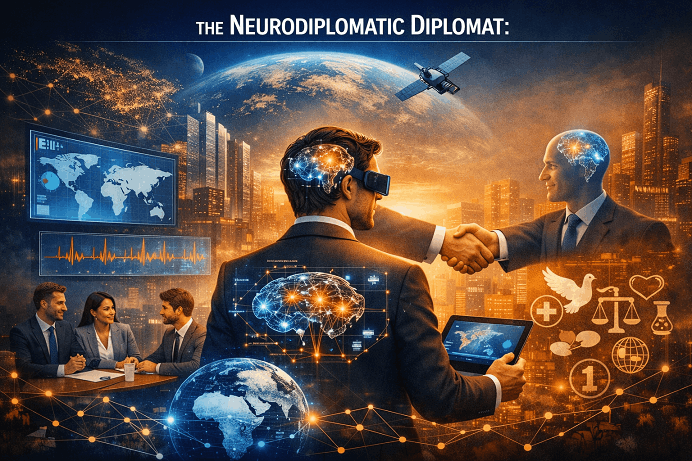
From the perspective of Neurodiplomacy, a diplomat is not merely a representative of the state or a negotiator of national interests. Rather, the diplomat becomes a cognitive actor who understands that international relations are shaped as much by human perception, emotions, beliefs, identity, and decision-making as by material power. Neurodiplomacy therefore expands the diplomat’s role from managing interstate relations to influencing the cognitive and emotional processes that underlie those relations.
The Diplomat as a Cognitive Actor
Traditional diplomacy emphasizes power, interests, and institutions. Neurodiplomacy adds another dimension: the human brain. Every diplomatic interaction passes through cognitive filters before it becomes a political decision. Diplomatic success therefore depends on understanding how leaders, negotiators, and societies perceive and interpret reality.
The neurodiplomatic diplomat recognizes that international conflicts often arise not simply because interests conflict, but because perceptions differ. Consequently, diplomacy becomes an exercise in managing cognition as much as managing policy.
A Neurodiplomatic Diplomat Should:
Manage Perceptions Rather Than Only Positions
Successful diplomacy begins by understanding how counterparts perceive reality.
Instead of asking only:
“What does the other country want?”
the diplomat also asks:
“How does the other country interpret the situation?”
Perception frequently determines political behaviour more than objective reality.
Reduce Cognitive Biases
Every diplomat possesses unconscious cognitive biases, including:
Confirmation bias
Attribution bias
Stereotyping
Availability heuristic
Anchoring
Groupthink
A neurodiplomatic diplomat consciously reflects on these biases before making judgments.
Self-awareness becomes a diplomatic competency.
Develop Emotional Intelligence
Emotions strongly influence foreign policy decisions.
Fear may increase confrontation.
Humiliation may intensify nationalism.
Empathy may facilitate cooperation.
A neurodiplomatic diplomat learns to regulate emotions while also recognizing the emotional states of counterparts.
Build Trust Through Human Connection
Trust is not simply a political resource.
It is also a neurobiological process involving social cognition and emotional regulation.
Face-to-face meetings, active listening, respectful language, and consistency create neural conditions that facilitate cooperation.
Trust becomes an instrument of diplomacy.
Master Strategic Communication
Language does more than transmit information.
Language shapes perception.
The neurodiplomatic diplomat carefully considers:
framing
wording
metaphors
narratives
timing
tone
The same proposal can produce different political outcomes depending upon how it is communicated.
Understand the Role of Identity
National identity influences diplomatic behaviour.
People defend identities as strongly as interests.
A neurodiplomatic diplomat therefore respects:
historical memory
cultural narratives
national pride
collective identity
Negotiations become more productive when identity is acknowledged rather than ignored.
Improve Decision-Making
Neurodiplomacy encourages evidence-based decision-making.
Before reaching conclusions, diplomats ask:
Have we considered alternative explanations?
Are emotions influencing our judgment?
Are we interpreting signals accurately?
What assumptions are we making?
This reflective approach reduces miscalculation.
Prevent Conflict Through Better Understanding
Many international crises result from misunderstanding rather than deliberate aggression.
A neurodiplomatic diplomat actively works to:
clarify intentions
reduce ambiguity
prevent misperception
improve communication
Conflict prevention begins with cognitive understanding.
Become a Continuous Learner
Modern diplomacy requires knowledge from multiple disciplines.
The neurodiplomatic diplomat studies:
international relations
political psychology
neuroscience
behavioural economics
communication science
negotiation theory
artificial intelligence
Diplomacy becomes an interdisciplinary profession.
Influence Rather Than Coerce
Power in the twenty-first century increasingly depends upon influence.
Influence is achieved by shaping:
perceptions
beliefs
expectations
narratives
trust
Rather than relying solely on military or economic pressure, neurodiplomatic diplomats seek durable influence through understanding the human mind.
The Neurodiplomatic Diplomat Model
A diplomat inspired by Neurodiplomacy gradually evolves into five complementary roles:
Traditional Role Neurodiplomatic Role
Representative Cognitive leader
Negotiator Perception manager
Communicator Strategic narrative architect
Analyst Decision scientist
Policy adviser Human behaviour expert
This broader conception reflects the increasing importance of psychology, cognition, and communication in contemporary international relations.
Conclusion
Neurodiplomacy redefines the diplomat as more than a state representative. It envisions the diplomat as a cognitive strategist who understands that foreign policy is ultimately made by human beings whose decisions are shaped by perception, memory, emotion, identity, and social interaction. By integrating insights from neuroscience, cognitive psychology, behavioural science, and diplomacy, the neurodiplomatic approach equips diplomats to reduce misperceptions, build trust, communicate more effectively, and make better-informed decisions.
In an era of geopolitical competition, information overload, artificial intelligence, and global interdependence, the most effective diplomat is not only an expert in international law and statecraft but also an expert in how the human mind thinks, feels, learns, and decides. This is the distinctive contribution of Neurodiplomacy to the future of international relations.