Applying the NLP Communication Model to the Neurodiplomacy Model: How Diplomats Process Information, Construct Meaning, and Make Decisions
Introduction
Diplomacy has traditionally been understood as the art of representing national interests through negotiation, communication, and peaceful interaction. Classical diplomatic theories have largely emphasized power, strategy, institutions, and international law. However, advances in cognitive science, political psychology, neuroscience, and communication studies increasingly demonstrate that diplomatic behavior is fundamentally shaped by how human beings perceive, interpret, evaluate, and respond to information.
The NLP communication model—often summarized as “how the mind processes information”—provides a useful conceptual framework for understanding these cognitive processes. According to the model, individuals do not respond directly to objective reality. Rather, information from the external world is filtered through neurological, psychological, linguistic, cultural, and experiential processes before it becomes perception, judgment, and ultimately behavior.
The Neurodiplomacy Model extends this understanding into international relations by explaining how diplomats, political leaders, negotiators, and societies construct diplomatic reality. Rather than viewing diplomacy solely as an interaction between states, Neurodiplomacy argues that diplomacy is fundamentally an interaction between human minds. Every diplomatic decision begins with perception, is shaped by cognition and emotion, and ends in communication and action.
The NLP model therefore serves as an excellent cognitive foundation for Neurodiplomacy.
Understanding the NLP Communication Model
The NLP model describes information processing as a sequence of interconnected stages.
The process begins with:
The External World
↓
Information enters through the five senses (visual, auditory, kinesthetic, olfactory, and gustatory).
↓
The brain applies neurological filters.
↓
Past experiences, memories, beliefs, and values influence interpretation.
↓
Language organizes these internal experiences into a linguistic map.
↓
The individual evaluates and judges the situation.
↓
Behavioral programs determine responses.
↓
The final output becomes:
- Communication
- Decisions
- Attitudes
- Actions
Although originally developed as a communication framework, this model has profound implications for diplomacy.
Stage One: International Reality
Within Neurodiplomacy, the external world corresponds to international reality.
This includes:
- Wars
- Elections
- Diplomatic negotiations
- Economic sanctions
- Terrorist attacks
- Climate change
- Military exercises
- International treaties
Importantly, these events exist independently of the observer.
However, diplomats never interact directly with objective reality.
They interact with their perception of reality.
This distinction lies at the heart of Neurodiplomacy.
Stage Two: Diplomatic Inputs
The NLP model emphasizes that reality enters through sensory experience.
For diplomats, sensory input is replaced by diplomatic information.
Sources include:
- Intelligence reports
- Embassy communications
- Satellite imagery
- News media
- Social media
- Diplomatic cables
- Personal meetings
- Public speeches
- Economic indicators
The quantity of available information is enormous. No diplomat can process all available information objectively. Selection becomes inevitable.
Stage Three: Neurological Filters—Deletion, Distortion, and Generalization
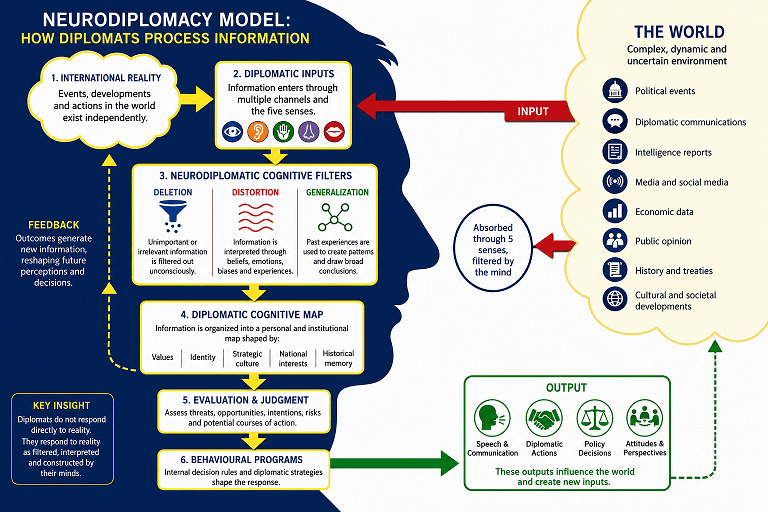
One of the central assumptions of Neuro-Linguistic Programming (NLP) is that the human brain cannot consciously process every piece of information available in the external environment. At any given moment, individuals are exposed to an enormous amount of sensory and informational input. To function efficiently, the brain automatically simplifies reality through three fundamental cognitive processes: deletion, distortion, and generalization.
From a Neurodiplomatic perspective, these processes are highly relevant because diplomats and foreign policy decision-makers operate in environments characterized by uncertainty, complexity, and information overload. Every day, diplomats receive intelligence reports, diplomatic cables, media coverage, satellite imagery, social media content, economic indicators, policy briefs, and communications from multiple governmental and non-governmental actors. No individual, regardless of experience or expertise, can consciously process all this information objectively and simultaneously.
Deletion
Deletion refers to the unconscious filtering out of information that the brain considers less relevant.
In diplomacy, deletion is inevitable. A diplomat cannot pay equal attention to every report, speech, intelligence assessment, or diplomatic signal. Instead, attention is directed toward information that appears most significant according to existing priorities, experiences, and expectations.
For example, during an international crisis, a diplomat may concentrate primarily on military developments while giving less attention to cultural, humanitarian, or economic factors. Another diplomat facing the same situation may prioritize public opinion or regional political dynamics. Both individuals are observing the same international event, yet each deletes different aspects of reality.
Deletion is therefore not a weakness but a necessary cognitive mechanism. However, excessive or selective deletion may result in incomplete situational awareness and policy blind spots.
Distortion
Distortion occurs when the mind interprets information in ways that differ from objective reality.
Diplomatic interpretation is rarely neutral. Information is often influenced by previous experiences, political assumptions, ideological beliefs, emotional states, institutional culture, and historical memory.
For example, a military exercise conducted by one state may be interpreted by another as preparation for aggression, while the initiating state considers it a routine defensive activity. The factual event remains the same, but its meaning is cognitively transformed through distortion.
Distortion also occurs through diplomatic narratives, metaphors, and political framing. Describing an operation as a “peacekeeping mission,” “strategic deterrence,” or “military aggression” creates different psychological interpretations of the same event.
Generalization
Generalization enables individuals to draw broader conclusions from previous experiences.
This process allows diplomats to recognize patterns and make rapid decisions under uncertainty. Historical analogies such as the Munich Agreement, the Cold War, or the Cuban Missile Crisis often become cognitive reference points for interpreting contemporary events.
While generalization can improve efficiency, it may also produce inaccurate conclusions when current situations differ significantly from historical precedents. Assuming that every geopolitical rivalry resembles the Cold War, or that every territorial dispute will inevitably escalate into armed conflict, may lead to inappropriate policy responses.
The Neurodiplomatic Implications
Deletion, distortion, and generalization explain why diplomats do not respond directly to objective international reality. Instead, they respond to internally constructed representations of reality. Consequently, two diplomats observing the same negotiation, military development, or international crisis may arrive at entirely different assessments and policy recommendations because they have filtered the available information differently.
Stage Four: Internal Representation
According to the NLP model, external information becomes internal subjective experience.
Neurodiplomacy describes this as the construction of diplomatic reality.
Diplomats ask themselves:
- Is this threatening?
- Is cooperation possible?
- What does this action mean?
- What are the hidden intentions?
Notice that these are interpretations rather than objective facts.
Two countries may interpret exactly the same event completely differently.
Stage Five: Linguistic Filters
Language is central to diplomacy.
The image correctly identifies linguistic filters as organizing thought.
Neurodiplomacy argues that language does not merely describe reality.
Language constructs diplomatic reality.
Consider the difference between describing an action as:
- Military aggression
- Defensive operation
- Peace enforcement
- Humanitarian intervention
Each description activates different cognitive and emotional responses despite referring to similar events.
Diplomatic language therefore becomes a strategic instrument.
Stage Six: The Diplomatic Map
The NLP model refers to the “linguistic map.”
Neurodiplomacy expands this concept into the Diplomatic Cognitive Map.
This map contains:
- National interests
- Identity
- Values
- Strategic culture
- Political ideology
- Historical memory
- International norms
Every diplomat possesses a unique diplomatic map.
Consequently, identical information often produces different policy recommendations.
Stage Seven: Evaluation and Judgment
The image shows evaluation occurring after linguistic processing.
Within Neurodiplomacy this stage includes:
Risk Assessment
How dangerous is the situation?
Opportunity Assessment
Can cooperation be achieved?
Trust Evaluation
Can the other side be trusted?
Intention Attribution
Why did the other actor behave this way?
Each judgment influences subsequent diplomatic behavior.
Stage Eight: Behavioural Programs
Behavioural programs determine diplomatic action.
Possible outputs include:
- Negotiation
- Dialogue
- Mediation
- Economic sanctions
- Military deterrence
- Alliance formation
- Public diplomacy
These actions represent the final expression of underlying cognitive processes.
Diplomatic Output
The NLP image concludes with output. In Neurodiplomacy, diplomatic outputs include:
- Official statements
- Foreign policy decisions
- Treaty negotiations
- Voting behavior
- Crisis management
- Peace agreements
- Strategic communication
Thus, diplomacy itself becomes the visible consequence of invisible cognitive processes.
Feedback Loops
One limitation of the original NLP model is that it appears linear. Neurodiplomacy introduces continuous feedback. Diplomatic actions generate responses. These responses become new inputs, and the cycle repeats. International relations therefore become a continuous cognitive feedback system.
Applying the Model to International Negotiations:
Imagine two states entering negotiations.
Both observe identical facts.
Yet each side processes those facts through:
- Different histories
- Different identities
- Different emotions
- Different political cultures
- Different strategic priorities
Consequently:
Different perceptions
↓
Different judgments
↓
Different policies
↓
Different diplomatic behavior
Conflict often arises not because reality differs, but because cognitive maps differ.
Practical Implications for Diplomats
The Neurodiplomacy Model suggests that effective diplomats should develop competencies beyond traditional negotiation skills. These include:
Cognitive awareness
Recognizing one’s own assumptions and biases.
Emotional regulation
Managing emotional responses during crises.
Perception management
Understanding how messages are interpreted by different audiences.
Strategic communication
Selecting language that promotes understanding rather than escalation.
Empathy
Understanding how adversaries perceive the same situation.
Cognitive flexibility
Revising mental models when new evidence emerges.
These competencies improve diplomatic judgment and increase the likelihood of successful negotiations.
The Neurodiplomatic Model of Information Processing
The figure can therefore be expanded into the following Neurodiplomatic sequence:
International Reality
↓
Diplomatic Information
↓
Sensory and Information Inputs
↓
Neurological Filters
- Attention
- Emotion
- Memory
- Cognitive Biases
↓
Psychological Filters
- Beliefs
- Values
- Identity
- Strategic Culture
↓
Linguistic Filters
- Framing
- Metaphors
- Narratives
- Diplomatic Language
↓
Diplomatic Cognitive Map
↓
Decision-Making
↓
Diplomatic Behaviour
↓
International Outcomes
↓
Feedback and Learning
This expanded model better reflects the complexity of contemporary diplomacy.
Conclusion
The NLP communication model provides an important foundation for understanding how individuals process information, but the Neurodiplomacy Model extends this framework into the realm of international relations. It demonstrates that diplomatic decisions are not determined solely by objective events but are constructed through cognitive, emotional, linguistic, and cultural filters. Diplomats do not negotiate reality itself; they negotiate their interpretations of reality.
By integrating insights from neuroscience, political psychology, cognitive science, and communication theory, Neurodiplomacy transforms the traditional understanding of diplomacy into a model of human cognition in action. It highlights that successful diplomacy depends not only on knowledge of international politics but also on an awareness of how perceptions are formed, how language shapes meaning, how emotions influence judgment, and how cognitive biases affect decision-making. In an era of digital communication, geopolitical competition, and complex global challenges, this integrated approach offers diplomats a more comprehensive framework for understanding international behavior and for conducting more effective, adaptive, and psychologically informed diplomacy.