Introduction
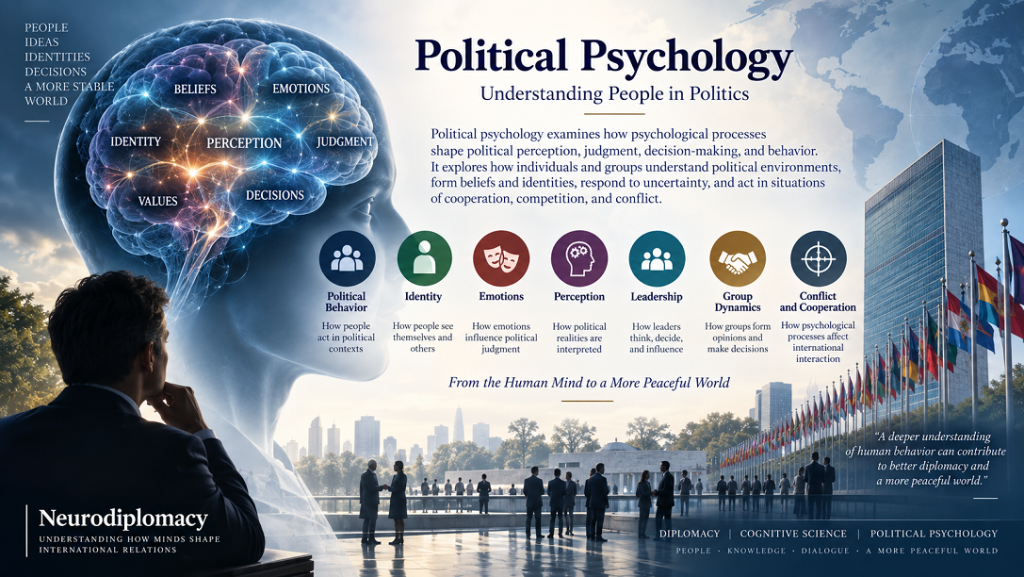
The emergence of Artificial Intelligence (AI) represents one of the most transformative developments in twenty-first-century international relations. AI is rapidly reshaping economic systems, military capabilities, governance structures, diplomatic practices, and global power dynamics. Simultaneously, growing recognition of the importance of human cognition, perception, emotions, and decision-making in international affairs has contributed to the development of Neurodiplomacy, an interdisciplinary approach that integrates diplomacy, cognitive science, neuroscience, political psychology, and communication studies.
While AI provides unprecedented capabilities for data processing, prediction, and strategic analysis, Neurodiplomacy focuses on understanding the human cognitive and emotional processes that shape diplomatic behavior. Together, AI and Neurodiplomacy represent complementary forces that are transforming how states manage international cooperation, conflict resolution, negotiation, and global governance.
The relationship between AI and Neurodiplomacy raises important questions: Can artificial intelligence improve diplomatic decision-making? How can cognitive science help diplomats navigate an increasingly technological world? What are the opportunities and risks of integrating AI into diplomatic practice? Addressing these questions is essential for understanding the future of international relations.
Artificial Intelligence and Diplomacy
AI as a Diplomatic Tool
Artificial intelligence offers powerful tools for diplomats and policymakers.
AI systems can assist in:
Data analysis
Conflict forecasting
Crisis monitoring
Intelligence assessment
Strategic planning
Policy simulation
Multilingual communication
Through machine learning and predictive analytics, AI can process vast quantities of information that exceed human cognitive capacities.
For example, AI can identify:
Emerging political crises
Patterns of conflict escalation
Economic vulnerabilities
Environmental risks
Public opinion trends
Such capabilities can improve situational awareness and support diplomatic decision-making.
AI and Digital Diplomacy
Digital diplomacy has become increasingly important in global politics.
Governments now utilize AI-enhanced technologies to:
Monitor international developments
Conduct public diplomacy
Analyze social media discourse
Counter misinformation
Enhance strategic communication
AI enables diplomatic institutions to engage global audiences more efficiently while responding rapidly to international events.
The Complementarity of AI and Neurodiplomacy
Although AI and Neurodiplomacy originate from different intellectual traditions, they share a common objective: improving decision-making under conditions of complexity and uncertainty.
Artificial Intelligence focuses on:
Computational intelligence
Data processing
Pattern recognition
Predictive analysis
Neurodiplomacy focuses on:
Human cognition
Emotional intelligence
Trust-building
Perception
Social interaction
Together, they create a more comprehensive approach to diplomacy.
AI provides analytical power, while Neurodiplomacy provides insight into the human dimensions of political behavior.
AI and Cognitive Decision-Making
Overcoming Cognitive Biases
Research in cognitive science demonstrates that decision-makers are vulnerable to biases such as:
Confirmation bias
Availability bias
Anchoring effects
Overconfidence
Groupthink
These biases can distort diplomatic judgments and foreign policy decisions.
AI systems may help mitigate some of these limitations by:
Identifying alternative scenarios
Detecting inconsistencies
Highlighting overlooked information
Providing evidence-based assessments
However, Neurodiplomacy reminds us that AI itself is designed and interpreted by humans, meaning cognitive biases can still influence how AI-generated information is used.
Human-AI Collaboration
The future of diplomacy will likely depend on effective collaboration between human and artificial intelligence.
AI can answer:
“What is happening?”
and
“What might happen next?”
Neurodiplomacy helps answer:
“How will people interpret these developments?”
and
“How can diplomatic actors build trust and cooperation?”
This complementary relationship illustrates why human judgment remains indispensable.
Trust, Empathy, and AI
The Limits of Artificial Intelligence
One of the central insights of Neurodiplomacy is that diplomacy is fundamentally relational.
Successful diplomatic engagement depends upon:
Trust
Empathy
Emotional understanding
Cultural sensitivity
Personal relationships
While AI can analyze language and predict behavior, it cannot fully replicate human emotional intelligence.
Diplomatic negotiations often require:
Reading subtle emotional cues
Understanding historical grievances
Building interpersonal rapport
Demonstrating sincerity
These functions remain largely human.
Neurodiplomacy and Trust Formation
Trust is a cornerstone of international cooperation.
Neurodiplomatic research suggests that trust emerges through:
Repeated interactions
Communication
Shared experiences
Social understanding
AI may facilitate communication and information sharing, but trust itself remains a human psychological process.
Therefore, AI should be viewed as a diplomatic support tool rather than a replacement for human diplomacy.
AI, Conflict Prevention, and Peacebuilding
Early Warning Systems
AI can contribute to conflict prevention through predictive modeling.
By analyzing:
Political indicators
Economic trends
Social unrest
Environmental stress
AI systems can identify regions at risk of instability.
Such tools may enable:
Preventive diplomacy
Early intervention
Crisis management
before conflicts escalate.
Neurodiplomatic Insights into Conflict
Neurodiplomacy complements these capabilities by examining:
Misperception
Identity conflicts
Emotional escalation
Collective trauma
Many conflicts persist not because of insufficient information but because of psychological barriers to cooperation.
Combining AI forecasting with neurodiplomatic analysis may improve conflict prevention strategies.
AI, Climate Diplomacy, and Global Governance
Global challenges such as climate change require unprecedented international cooperation.
AI can support climate diplomacy by:
Modeling environmental scenarios
Predicting climate impacts
Monitoring emissions
Supporting resource management
However, environmental negotiations are also shaped by:
Risk perception
Political values
Trust
Public attitudes
Neurodiplomacy helps explain why scientific evidence alone is often insufficient to generate political action.
Understanding how leaders and societies cognitively process environmental risks is essential for successful climate governance.
Ethical Challenges
Algorithmic Bias
AI systems can inherit biases from the data on which they are trained.
These biases may affect:
Risk assessments
Intelligence analysis
Diplomatic recommendations
Neurodiplomacy emphasizes the importance of critical evaluation and human oversight.
Manipulation and Information Warfare
AI technologies can be used to:
Spread disinformation
Manipulate public opinion
Influence elections
Conduct psychological operations
These developments create significant challenges for international security.
Neurodiplomacy contributes by examining how information influences perception, cognition, and political behavior.
Preserving Human Agency
As AI becomes more influential in policymaking, an important question emerges:
Should machines influence diplomatic decisions?
Neurodiplomacy argues that diplomatic judgment involves ethical reasoning, empathy, and contextual understanding that cannot be fully automated.
Human agency must remain central to international decision-making.
Toward an AI-Enhanced Neurodiplomacy
The future of diplomacy may involve the integration of AI and Neurodiplomacy into a unified framework.
Such a framework would combine:
AI Capabilities
Data analysis
Predictive modeling
Scenario simulation
Information management
Neurodiplomatic Capabilities
Emotional intelligence
Trust-building
Perspective-taking
Cognitive awareness
Strategic communication
This integration could improve:
Negotiation outcomes
Conflict prevention
Crisis management
Global governance
International cooperation
Conclusion
Artificial Intelligence and Neurodiplomacy represent two of the most important innovations shaping the future of international relations. AI provides unprecedented analytical capabilities that can enhance diplomatic decision-making, conflict forecasting, and global governance. Neurodiplomacy, meanwhile, highlights the cognitive, emotional, and psychological dimensions of diplomacy that remain fundamentally human.
Rather than competing approaches, AI and Neurodiplomacy are complementary. AI helps policymakers understand complex global environments, while Neurodiplomacy explains how human beings perceive, interpret, and respond to those environments. Together, they offer a more comprehensive understanding of world politics in an era characterized by technological transformation, geopolitical uncertainty, and growing global interdependence.
Ultimately, the future of diplomacy will depend not on replacing human judgment with artificial intelligence but on creating a productive partnership between technological innovation and human cognitive wisdom. Such a partnership may become one of the defining features of international relations in the twenty-first century.