Bibliographic Information
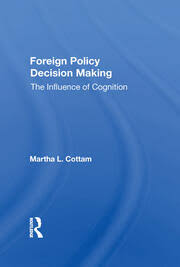
Cottam, Martha L. Foreign Policy Decision Making: The Influence of Cognition. New York: Routledge, 2019 (reprint of the original 1986 edition). 278 pages.
Introduction
Foreign Policy Decision Making: The Influence of Cognition is one of the pioneering works in political psychology and foreign policy analysis. Originally published in 1986 and reissued by Routledge in 2019, Martha Cottam’s influential study remains highly relevant to scholars seeking to understand the cognitive foundations of international politics. At a time when rational actor models dominated much of international relations theory, Cottam argued that foreign policy decisions cannot be adequately explained solely through objective calculations of national interests or material power. Instead, policymakers interpret international events through cognitive structures that shape how they perceive allies, adversaries, opportunities, and threats.
The book represents an important bridge between cognitive psychology and international relations. Drawing upon developments in cognitive science and political psychology, Cottam develops a systematic framework for analysing how political leaders organize information, categorize political actors, and construct images of the international environment. These cognitive processes, she argues, fundamentally influence diplomatic negotiation, foreign policy adaptation, and international conflict.
More than three decades after its original publication, the book remains one of the foundational texts in foreign policy analysis and continues to influence research on perception, political cognition, leadership psychology, and decision-making.
Overview of the Book
The central thesis of the book is that foreign policy decisions are profoundly influenced by cognition.
Rather than responding directly to objective international realities, policymakers respond to their political worldviews—organized systems of cognitive categories through which they interpret external events.
Cottam argues that decision-makers simplify the complexity of international politics by constructing cognitive frameworks that classify states, leaders, and political situations into meaningful categories. These mental structures help policymakers process enormous quantities of information efficiently, but they also create biases, stereotypes, and perceptual distortions that may reduce diplomatic flexibility.
To demonstrate her argument, the book develops a political-psychological model and applies it to the case of United States–Mexico natural gas negotiations, illustrating how policymakers’ cognitive images influenced diplomatic behaviour.
Major Themes
Cognition and Political Worldviews
The central contribution of the book is its concept of the political worldview.
According to Cottam, policymakers organize political information through cognitive categories that simplify complex international realities.
These categories shape:
-
Threat perception
-
Alliance formation
-
Strategic judgment
-
Diplomatic expectations
-
Policy preferences
Because these cognitive structures influence how information is interpreted, two policymakers may reach entirely different conclusions despite receiving identical information.
This insight fundamentally challenges purely rational models of foreign policy.
Images in International Politics
A recurring theme throughout the volume is the importance of political images.
Governments develop relatively stable images of foreign states that influence future diplomatic interactions.
These images affect:
-
Trust
-
Risk assessment
-
Negotiation strategies
-
Policy flexibility
-
Conflict escalation
Once established, political images often become resistant to contradictory information, contributing to persistent diplomatic misunderstandings.
Cognitive Categories and Information Processing
The book emphasizes that cognition functions through categorization.
Political leaders cannot process every detail of international affairs individually.
Instead, they rely upon mental categories that simplify information processing.
Although these categories increase efficiency, they may also generate:
-
Stereotyping
-
Oversimplification
-
Confirmation bias
-
Selective attention
-
Misperception
Consequently, cognitive organization becomes both a strength and a limitation of diplomatic decision-making.
Foreign Policy Adaptation
One of the most important practical implications concerns adaptation.
Cottam demonstrates that policymakers often struggle to adjust foreign policy when international conditions change because existing cognitive structures resist revision.
Diplomatic failures therefore frequently result not from insufficient information but from difficulties in changing deeply embedded political perceptions.
Theoretical Contributions
Integrating Psychology and International Relations
One of the book’s greatest achievements is its successful integration of cognitive psychology into foreign policy analysis.
Rather than treating cognition as a peripheral variable, Cottam places psychological processes at the centre of diplomatic decision-making.
This interdisciplinary approach significantly broadened the study of international relations.
Beyond Rational Actor Models
The book offers a persuasive critique of traditional rational actor assumptions.
While acknowledging that policymakers seek rational outcomes, Cottam demonstrates that rationality is constrained by perception, categorization, and cognitive limitations.
Decision-makers therefore operate under conditions of bounded rationality rather than perfect rationality.
Political Cognition as an Analytical Framework
The book provides one of the earliest systematic attempts to develop political cognition as an analytical framework for explaining foreign policy behaviour.
Its emphasis on information processing anticipated later developments in behavioural economics, cognitive science, and political psychology.
Relevance to Neurodiplomacy
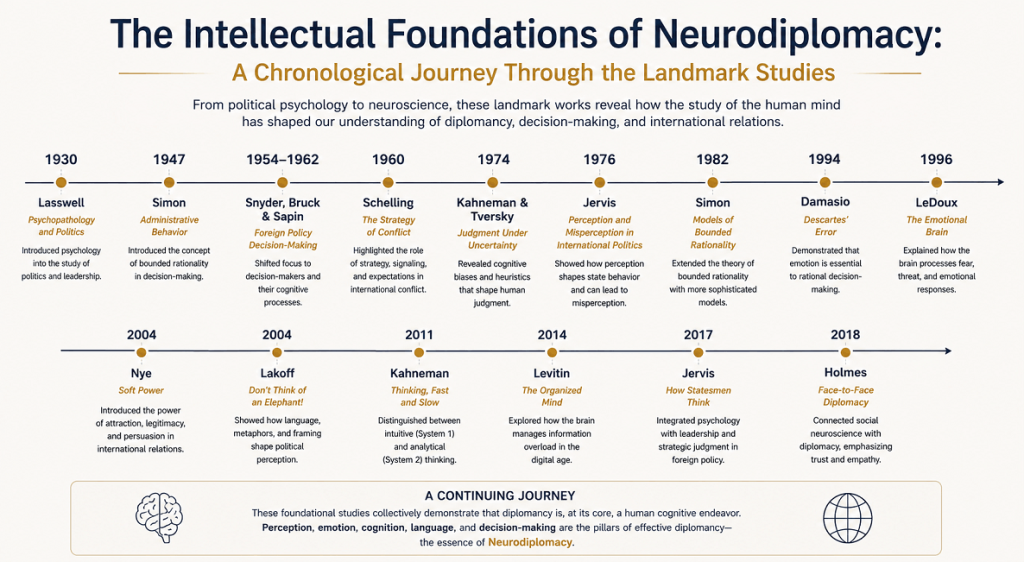
From the perspective of Neurodiplomacy, Foreign Policy Decision Making: The Influence of Cognition is one of the most important foundational works.
Although written before advances in contemporary neuroscience, many of Cottam’s central arguments closely parallel modern neurocognitive research.
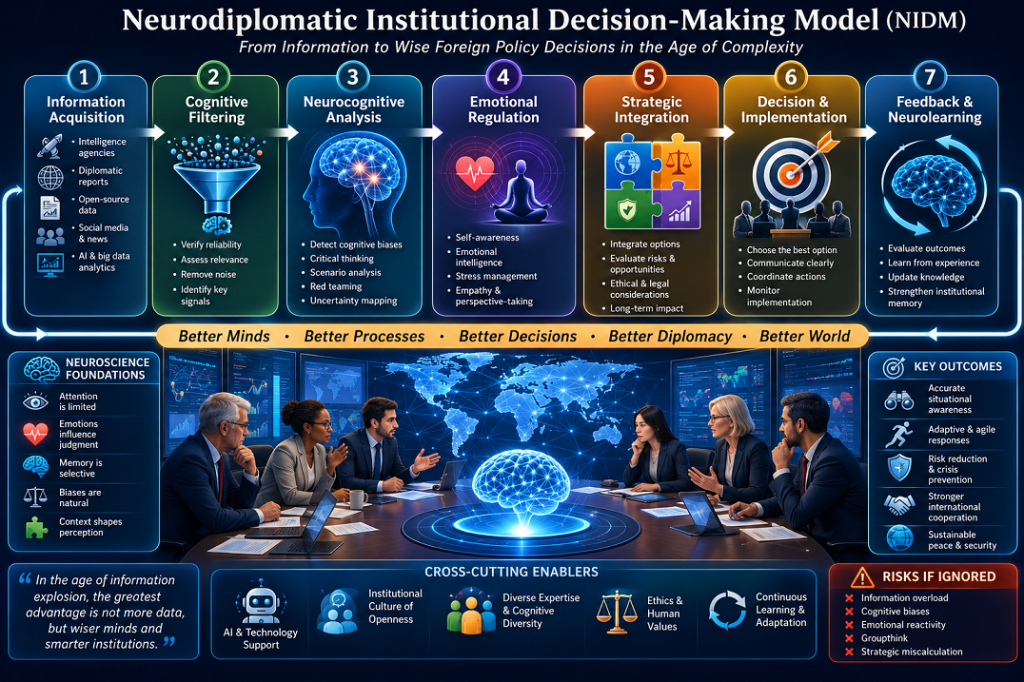
Neurodiplomacy argues that diplomats do not perceive objective reality directly. Instead, every diplomatic message passes through neurocognitive filters before being interpreted.
These filters include:
-
Attention
-
Perception
-
Memory
-
Belief systems
-
Emotional evaluation
-
Cultural identity
-
Previous experience
-
Cognitive biases
Cottam’s concept of political worldviews corresponds closely with Neurodiplomacy’s understanding of mental models.
Both perspectives recognize that diplomatic decisions emerge not from objective facts alone but from how those facts are cognitively interpreted.
Neurodiplomacy extends Cottam’s framework by incorporating findings from neuroscience concerning how brain networks regulate attention, emotional processing, threat perception, empathy, trust, and decision-making.
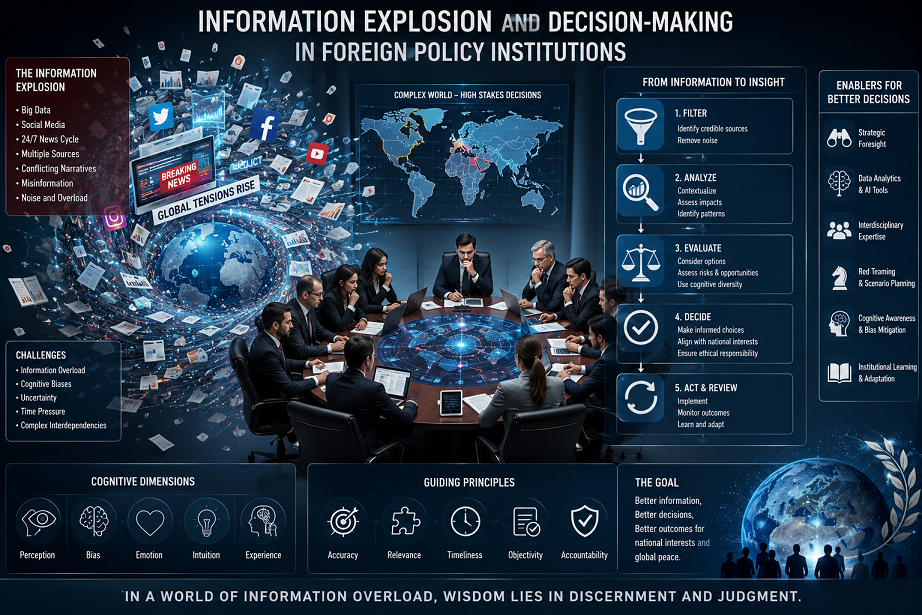
From a neurodiplomatic perspective, diplomats continuously receive enormous amounts of information through diplomatic cables, intelligence reports, media coverage, public opinion, and interpersonal communication. The brain cannot process all of this information equally.
Instead, the nervous system automatically filters information through processes that involve selection, interpretation, and meaning construction.
Consequently, diplomatic behaviour reflects not only political interests but also the neurocognitive architecture through which international reality is understood.
This interpretation makes Cottam’s work remarkably compatible with contemporary Neurodiplomacy.
Relevance to Diplomacy
The book provides important lessons for diplomats and foreign policy practitioners.
Successful diplomacy requires awareness of one’s own cognitive assumptions as well as those of negotiating counterparts.
Understanding cognitive structures enables diplomats to:
-
Recognize misperceptions.
-
Improve negotiation strategies.
-
Increase diplomatic flexibility.
-
Reduce conflict escalation.
-
Adapt more effectively to changing international environments.
These practical implications remain highly relevant for contemporary diplomacy.
Strengths of the Book
Conceptual Originality
Cottam was among the first scholars to systematically integrate cognitive psychology into foreign policy analysis.
Her political worldview model remains intellectually influential.
Interdisciplinary Approach
The book successfully combines international relations, political psychology, and cognitive science into a coherent analytical framework.
This interdisciplinary perspective significantly enriched foreign policy analysis.
Empirical Illustration
The detailed examination of United States–Mexico natural gas negotiations demonstrates how cognitive theory can be applied to real diplomatic cases.
This empirical application strengthens the theoretical argument.
Enduring Relevance
Although originally published nearly four decades ago, the book anticipated many developments that now characterize behavioural international relations and political psychology.
Limitations
Limited Neuroscientific Evidence
Because the original edition preceded modern neuroscience, the book relies primarily upon cognitive psychology rather than neurobiological evidence.
Future research integrating brain imaging, social neuroscience, and decision neuroscience would strengthen the theoretical framework.
Limited Cross-Cultural Analysis
Most empirical illustrations focus upon American foreign policy.
Comparative studies across different political cultures would broaden the model’s applicability.
Changing Information Environment
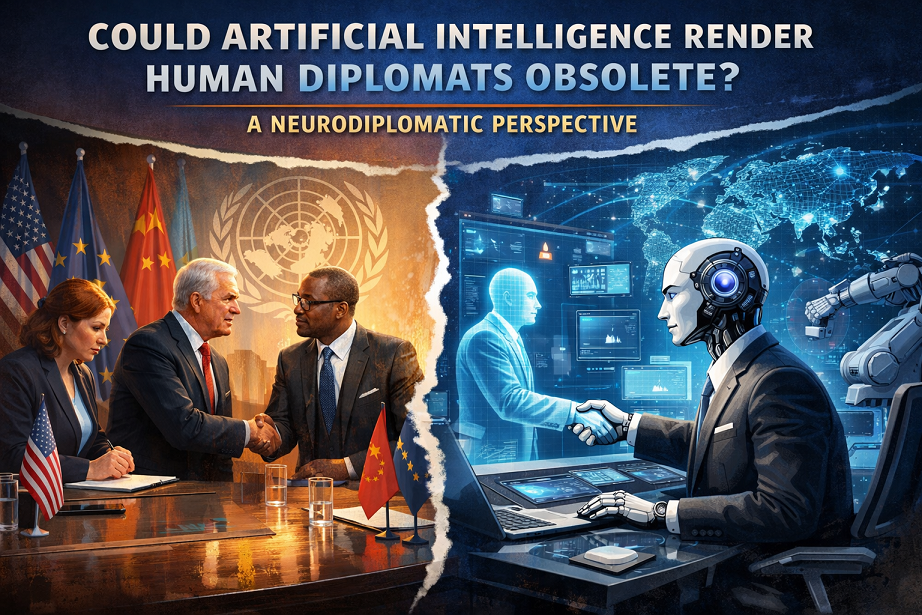
The rise of artificial intelligence, digital diplomacy, social media, and algorithmic information systems has transformed diplomatic decision-making since the book’s original publication.
These developments require extensions of Cottam’s cognitive framework.
Conclusion
Foreign Policy Decision Making: The Influence of Cognition remains one of the foundational works in political psychology and foreign policy analysis. Martha Cottam successfully demonstrated that diplomatic behaviour cannot be understood solely through objective national interests or rational calculations. Instead, policymakers interpret international events through cognitive structures that shape perception, judgment, and decision-making.
The book’s emphasis on political worldviews, cognitive categorization, and information processing has exercised lasting influence on scholarship in international relations and diplomatic studies. Its interdisciplinary approach anticipated many later developments in behavioural international relations and cognitive science.
From the perspective of Neurodiplomacy, Cottam’s work assumes even greater significance. Neurodiplomacy extends her cognitive framework by incorporating advances in neuroscience that explain how diplomats perceive information, regulate emotions, evaluate risks, build trust, and make foreign policy decisions. In many respects, Foreign Policy Decision Making may be regarded as one of the intellectual foundations upon which Neurodiplomacy can further develop.
For scholars and practitioners of diplomacy, international relations, political psychology, cognitive science, and Neurodiplomacy, this book remains essential reading and continues to provide profound insights into the human dimensions of foreign policy decision-making.