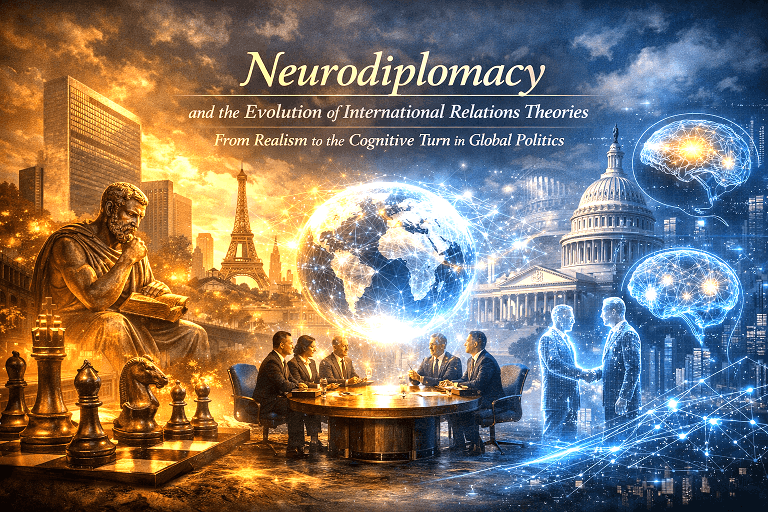
From Realism to the Cognitive Turn in Global Politics (Part 1)
Abstract
The discipline of International Relations (IR) has evolved through a series of theoretical developments aimed at explaining the causes of conflict, cooperation, and political order in the international system. From realism’s emphasis on power and security to liberalism’s focus on institutions, constructivism’s attention to identities and norms, and contemporary approaches centered on cognition, emotions, and human behavior, IR theory has progressively expanded its understanding of global politics.
This article examines the chronological evolution of major IR theories and explores how the emerging concept of neurodiplomacy represents a new cognitive and neuroscientific turn in the study of international affairs. Neurodiplomacy does not replace established theories; rather, it complements them by examining the human mind as a fundamental element in diplomatic practice, foreign policy decision-making, negotiation, and international cooperation. By integrating insights from neuroscience, cognitive science, psychology, and diplomacy studies, neurodiplomacy contributes to a more comprehensive understanding of how perceptions, emotions, communication, and decision-making processes shape world politics.
Keywords: Neurodiplomacy, Realism, Liberalism, Constructivism, International Relations Theory, Cognitive Science, Neuroscience, Diplomacy
1. Introduction: The Evolution of Understanding International Politics
International Relations as an academic discipline has continuously developed in response to changing global realities. Each theoretical approach has attempted to answer fundamental questions:
- Why do wars occur?
- Why do states cooperate?
- How do international institutions function?
- How do identities and ideas influence political behavior?
- How do leaders make decisions under uncertainty?
The history of IR theory can be understood as a gradual movement from explanations based primarily on external structures and material power toward approaches increasingly interested in human perception, cognition, emotions, and communication.
Early theories focused on the international system and state behavior. Later approaches introduced institutions, norms, culture, identity, and individual decision-making. The emergence of neurodiplomacy represents the latest stage of this intellectual evolution: the attempt to understand how the human brain and cognitive processes influence international relations.
2. Classical Realism: Power, Human Nature, and the Origins of IR Theory
The modern study of International Relations emerged after the First World War, particularly through debates between idealists and realists. The devastating consequences of global conflict challenged optimistic assumptions that international law and institutions alone could prevent war.
Realism became the dominant theoretical tradition, emphasizing power, national interest, and survival.
One of the foundational thinkers of realism, Hans Morgenthau, argued that international politics is fundamentally shaped by human nature and the pursuit of power. In his view, states behave according to national interests defined in terms of power because international politics exists in a competitive environment.
Classical realism introduced an important psychological dimension. Unlike later structural realism, classical realism recognized that leaders’ ambitions, fears, and judgments influence political outcomes.
From a neurodiplomatic perspective, classical realism contains an early recognition that international politics is connected to human motivations. The desire for security, status, recognition, and influence reflects psychological processes that influence political behavior.
However, realism primarily explained international politics through the struggle for power among states rather than through detailed analysis of how human minds perceive and interpret international events.
3. Neorealism: The International System and Structural Constraints
During the Cold War, realism evolved into neorealism or structural realism. Kenneth Waltz argued that international behavior is shaped less by human nature and more by the structure of the international system.
Because the international system is anarchic—meaning there is no central authority above states—states must prioritize survival and security.
Neorealism contributed significantly by explaining patterns of international competition, balance of power, and strategic behavior.
However, from the perspective of neurodiplomacy, structural realism leaves important questions open:
Why do different leaders facing similar structural conditions make different choices?
Why do some states perceive another state as a threat while others do not?
Why do historical experiences and emotions influence strategic decisions?
Neurodiplomacy addresses these questions by examining the cognitive processes through which international structures are interpreted by human decision-makers.
4. Liberalism: Cooperation, Institutions, and Human Possibilities
Liberal theories developed as an alternative to realism by emphasizing cooperation, institutions, democracy, economic interdependence, and international organizations.
Liberal thinkers argued that international politics is not only a competition for power but also a space for collaboration.
Institutions reduce uncertainty, create expectations, and facilitate cooperation among states. International organizations provide mechanisms for dialogue and collective problem-solving.
From the perspective of neurodiplomacy, liberalism highlights an important human capacity: the ability to cooperate.
Cooperation requires:
- trust,
- empathy,
- communication,
- recognition of shared interests.
Neurodiplomacy extends liberal insights by exploring the cognitive and emotional foundations that allow cooperation to emerge.
Diplomatic relationships are not created only through institutions; they are also created through human interactions, communication patterns, and psychological understanding.
5. The English School: Diplomacy and International Society
The English School introduced a middle position between realism and liberalism by arguing that states exist within an international society governed by shared rules, norms, and institutions.
Hedley Bull emphasized diplomacy as one of the fundamental institutions maintaining international order.
This perspective is especially relevant for neurodiplomacy because diplomacy is fundamentally a human activity.
Diplomats must:
- interpret intentions,
- manage emotions,
- build trust,
- communicate across cultures,
- negotiate meaning.
The English School therefore provides an important bridge between traditional IR theory and cognitive approaches.
6. Constructivism: Ideas, Identity, and the Social Construction of Reality
The end of the Cold War encouraged new theoretical developments in IR. Constructivism emerged as one of the most influential approaches, emphasizing that international politics is shaped by ideas, identities, norms, and social meanings.
Alexander Wendt famously argued that international realities are socially constructed through interaction among actors.
Constructivism transformed IR by demonstrating that states do not simply respond to objective conditions; they interpret the world through shared beliefs and identities.
This approach strongly connects with neurodiplomacy.
Human beings construct political reality through cognitive processes:
- perception,
- memory,
- categorization,
- narratives,
- emotional associations.
For example, whether another country is perceived as a partner or enemy depends not only on material capabilities but also on historical memories, cultural narratives, and psychological interpretations.
Neurodiplomacy adds a cognitive explanation for how social realities become meaningful in human minds.
7. Foreign Policy Analysis and the Return of the Individual
While many IR theories focused on states and systems, Foreign Policy Analysis (FPA) returned attention to individuals and decision-makers.
Researchers examined:
- leadership personality,
- belief systems,
- political psychology,
- group decision-making.
Scholars such as Robert Jervis demonstrated that perceptions and misperceptions significantly influence foreign policy.
This development created the strongest foundation for neurodiplomacy.
Foreign policy decisions occur through human cognitive processes. Leaders must interpret incomplete information, assess risks, and make choices under pressure.
Neurodiplomacy builds upon FPA by incorporating knowledge from neuroscience and cognitive science.
8. The Cognitive Revolution and the Study of Decision-Making
The cognitive revolution in psychology transformed understanding of human behavior by focusing on mental processes.
Researchers demonstrated that humans do not process information objectively. Instead, decision-making is influenced by:
- cognitive biases,
- emotions,
- memory,
- attention,
- previous experiences.
Daniel Kahneman demonstrated that human judgment involves both rapid intuitive thinking and slower analytical reasoning.
These findings have important implications for diplomacy.
Diplomats and political leaders frequently operate under:
- uncertainty,
- time pressure,
- emotional stress,
- incomplete information.
Understanding cognition therefore becomes essential for understanding international decision-making.
9. Neuroscience and the Emotional Foundations of Politics
Modern neuroscience has challenged the traditional idea that rationality and emotion are separate.
Research by Antonio Damasio demonstrated that emotions are essential components of decision-making.
International politics contains powerful emotional dimensions:
- fear of threats,
- desire for recognition,
- national pride,
- humiliation,
- empathy.
Diplomatic conflicts often involve emotional perceptions as much as strategic interests.
Neurodiplomacy incorporates these findings by examining how emotional and neural processes influence negotiation, leadership, and international communication.
10. The Emergence of Neurodiplomacy: A New Interdisciplinary Perspective
Neurodiplomacy represents the convergence of:
- international relations theory,
- diplomacy studies,
- neuroscience,
- cognitive science,
- psychology,
- linguistics.
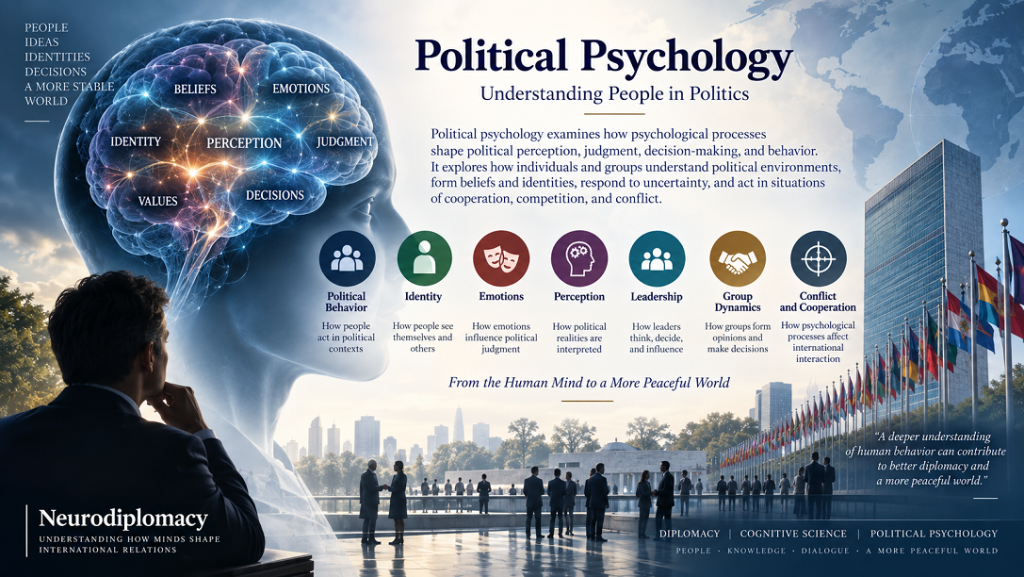
It explores how the human mind shapes international affairs.
Its central argument is that global politics is not conducted by abstract states alone; it is conducted by human beings whose perceptions, emotions, memories, and cognitive frameworks influence political outcomes.
Neurodiplomacy examines:
Diplomatic perception
How leaders interpret intentions and threats.
Cognitive biases
How mental shortcuts influence judgment.
Emotional intelligence
How empathy and emotional awareness affect negotiations.
Language and communication
How framing and narratives influence diplomatic outcomes.
Decision-making under uncertainty
How minds respond to complex international environments.
11. Neurodiplomacy and the Future of International Relations Theory
The development of neurodiplomacy reflects a broader transformation in IR theory: the movement toward integrating different levels of analysis.
Traditional theories often examined:
- systems,
- states,
- institutions,
- norms.
Neurodiplomacy adds:
- brains,
- minds,
- perceptions,
- emotions.
The future of IR may therefore require combining structural, institutional, social, and cognitive explanations.
A comprehensive understanding of international politics requires both:
- analysis of global systems, and
- understanding of the human minds operating within those systems.
Conclusion of Part 1
The history of International Relations theory demonstrates a gradual expansion of analytical focus. Realism emphasized power and security; liberalism highlighted cooperation and institutions; the English School examined international society; constructivism revealed the importance of identity and norms; Foreign Policy Analysis returned attention to decision-makers; and cognitive approaches explored perception and judgment.
Neurodiplomacy represents the next stage in this intellectual journey. It does not replace previous theories but complements them by addressing a fundamental question:
How do human minds create, interpret, and transform international reality?
By bringing neuroscience and cognitive science into dialogue with IR theory, neurodiplomacy offers a more complete understanding of diplomacy as not only a strategic practice but also a cognitive, emotional, and human process.
International relations is ultimately a relationship between states—but states act through minds. Understanding those minds is essential for understanding world politics.