Abstract
The rapid advancement of artificial intelligence (AI) has generated fundamental questions about the future of diplomacy. AI systems are increasingly capable of processing vast quantities of information, predicting geopolitical trends, translating languages, generating policy analyses, and supporting diplomatic decision-making. These developments have led some scholars and technologists to ask whether AI could eventually replace human diplomats. This article argues that although AI will profoundly transform diplomatic practice, it is unlikely to render human diplomats obsolete. From the perspective of Neurodiplomacy, diplomacy is fundamentally a human cognitive and social activity grounded in perception, emotional intelligence, trust, ethical judgment, creativity, cultural understanding, and strategic adaptation. AI can significantly augment these processes but cannot fully replicate the conscious, relational, and moral dimensions of diplomacy. The future of diplomacy will therefore be characterized not by competition between humans and machines but by collaboration between human cognitive intelligence and artificial intelligence.
Keywords: Artificial Intelligence, Neurodiplomacy, Diplomacy, Digital Diplomacy, Decision-Making, Cognitive Science, Foreign Policy, International Relations.
Introduction
Artificial intelligence is reshaping every sector of society, including diplomacy. Governments now employ AI to analyze geopolitical developments, monitor crises, translate documents, detect misinformation, forecast political instability, and assist policymakers in evaluating strategic options.
These developments naturally raise a provocative question:
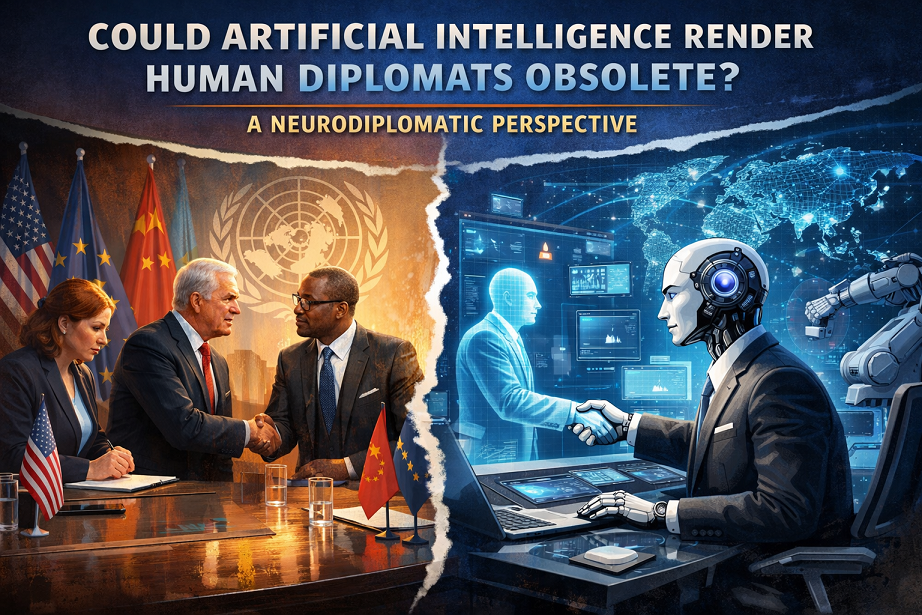
Could artificial intelligence eventually replace diplomats?
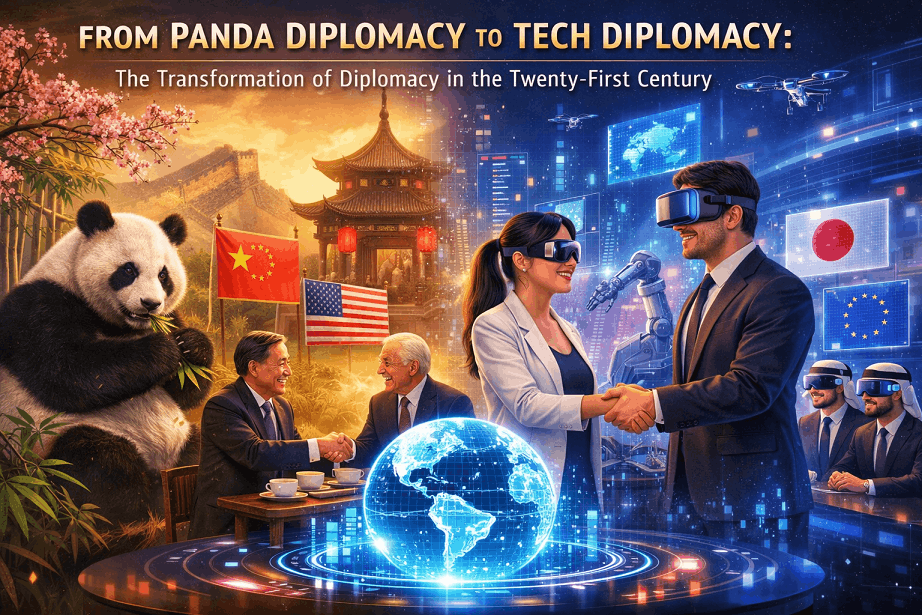
Historically, diplomacy has always adapted to technological change. The telegraph accelerated diplomatic communication. The telephone reduced delays in negotiations. The internet enabled digital diplomacy. Social media transformed public diplomacy. Today, AI represents the next major technological revolution.
However, diplomacy differs fundamentally from many other professions. Diplomacy is not merely the transmission of information. It is a complex human process involving judgment, empathy, persuasion, trust, negotiation, and the management of uncertainty.
From a Neurodiplomatic perspective, these capacities arise from the cognitive and emotional architecture of the human mind. Consequently, while AI will dramatically change how diplomacy is conducted, it is unlikely to replace the uniquely human dimensions of diplomatic practice.
The Expanding Role of Artificial Intelligence in Diplomacy
Artificial intelligence already contributes to diplomacy in numerous ways.
Governments increasingly employ AI for:
- geopolitical data analysis,
- multilingual translation,
- policy simulation,
- crisis monitoring,
- early warning systems,
- cyber threat detection,
- economic forecasting,
- information verification.
Machine learning algorithms can identify patterns within datasets far beyond human capacity.
Generative AI can rapidly summarize reports, draft speeches, prepare briefing notes, and support diplomatic research.
These capabilities improve efficiency and reduce routine administrative work.
Why Diplomacy Is Different
Despite these remarkable advances, diplomacy differs from many other professions.
Diplomatic practice requires continuous interaction among human beings with different:
- cultures,
- values,
- emotions,
- identities,
- historical memories,
- political interests.
Negotiations often depend upon subtle interpersonal dynamics that extend beyond explicit language.
Diplomacy therefore operates simultaneously at political, psychological, cultural, and emotional levels.
Neurodiplomacy: Diplomacy Begins in the Human Mind
Neurodiplomacy begins from a simple principle:
Diplomatic decisions are products of human cognition.
Before diplomats negotiate, they must:
- perceive,
- interpret,
- evaluate,
- imagine,
- communicate,
- trust,
- decide.
These mental processes involve complex interactions among cognition, emotion, memory, attention, and social understanding.
While AI processes information, human diplomats construct meaning.
This distinction remains fundamental.
What AI Does Better Than Humans
Artificial intelligence possesses extraordinary strengths.
Speed
AI analyzes information within seconds.
Human analysts may require days.
Pattern Recognition
Machine learning identifies hidden relationships across enormous datasets.
Diplomats benefit from these insights.
Data Integration
AI simultaneously processes:
- economic indicators,
- satellite imagery,
- media reports,
- intelligence assessments,
- social media.
Humans cannot match this scale.
Consistency
AI does not experience fatigue.
Its analytical performance remains stable.
Multilingual Communication
Advanced language models facilitate real-time translation across numerous languages.
This significantly improves diplomatic communication.
What Human Diplomats Do Better
Despite AI’s analytical strengths, diplomacy depends upon uniquely human capacities.
Emotional Intelligence
Successful diplomacy requires recognizing emotions as anger, hope, pride, humiliation, empathy, trust.
These emotional dynamics often determine negotiation outcomes.
Current AI models recognize emotional patterns but do not experience emotions.
Trust Building
Diplomatic trust develops through long-term interpersonal relationships.
Trust involves credibility, integrity, consistency, and shared experience.
Although AI may facilitate communication, genuine political trust remains fundamentally human.
Ethical Judgment
Foreign policy frequently requires moral choices.
Examples include:
- humanitarian intervention,
- refugee protection,
- conflict mediation,
- sanctions,
- human rights.
Ethical reasoning involves values that cannot be determined solely through algorithms.
Political responsibility remains human.
Creativity
Diplomatic breakthroughs often emerge through creative thinking.
Innovative agreements frequently result from reframing problems rather than optimizing existing solutions.
Human imagination remains essential for such innovation.
Cultural Understanding
Culture involves implicit meanings, historical memories, symbolism, humor, and identity.
Diplomats continuously interpret subtle cultural signals.
Although AI can analyze cultural information, lived cultural understanding remains uniquely human.
Negotiation Cannot Be Fully Automated
Negotiation is among diplomacy’s most important functions.
Negotiations require:
- empathy,
- persuasion,
- compromise,
- strategic ambiguity,
- relationship management,
- emotional regulation.
These activities extend beyond information processing.
From a Neurodiplomatic perspective, negotiations involve dynamic interactions among multiple human cognitive systems.
AI can support negotiations through analysis.
It cannot replace the interpersonal process itself.
Cognitive Biases: Can AI Improve Diplomacy?
Human diplomats are influenced by:
- confirmation bias,
- overconfidence,
- anchoring,
- emotional reasoning.
AI can assist by identifying alternative interpretations and highlighting overlooked information.
Consequently, AI may improve diplomatic judgment rather than replace it.
The optimal model combines human intuition with machine analysis.
Human-AI Collaboration
The future of diplomacy is likely to involve collaborative intelligence.
In this model:
AI contributes:
- analysis,
- prediction,
- data processing,
- simulation,
- translation.
Human diplomats contribute:
- judgment,
- empathy,
- ethics,
- creativity,
- leadership,
- responsibility.
Together they produce superior diplomatic outcomes.
Neurodiplomacy and Human Adaptation
Neurodiplomacy does not ask whether humans will compete against AI.
Instead, it asks:
How can diplomats adapt cognitively to work effectively with AI?
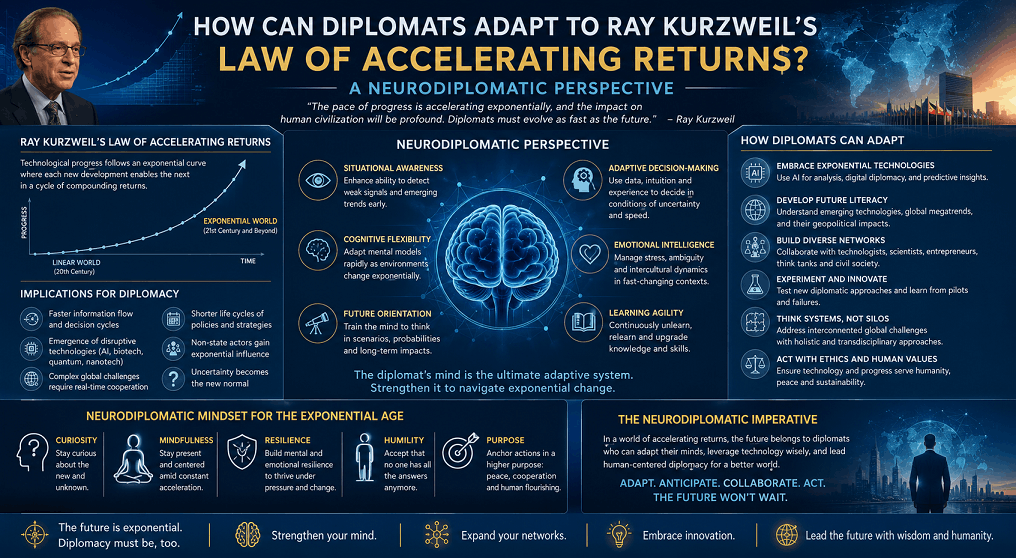
Future diplomats should develop competencies including:
- AI literacy,
- cognitive flexibility,
- systems thinking,
- emotional intelligence,
- interdisciplinary reasoning,
- strategic foresight.
The diplomat of the future becomes an intelligent integrator rather than merely an information processor.
Risks of AI-Driven Diplomacy
Although AI offers considerable advantages, several risks deserve attention.
Algorithmic Bias
AI reflects the quality of its training data.
Biased data may produce biased recommendations.
Overreliance
Diplomats may become excessively dependent upon algorithmic analysis.
Human critical thinking must remain central.
Cybersecurity
AI systems may become targets for cyber attacks and manipulation.
Protecting diplomatic information becomes increasingly important.
Accountability
When foreign policy decisions have serious consequences, responsibility cannot be delegated to algorithms.
Governments remain accountable.
The Future Diplomat
Rather than disappearing, diplomats will evolve.
Future diplomats will increasingly function as:
- strategic advisors,
- AI supervisors,
- intercultural communicators,
- ethical decision-makers,
- cognitive leaders.
Routine analytical tasks may become automated.
Human strategic judgment becomes more valuable.
The Neurodiplomatic Model of Human-AI Diplomacy
A Neurodiplomatic framework for future diplomacy consists of complementary roles.
Artificial Intelligence
- Data processing
- Predictive analytics
- Translation
- Pattern recognition
- Information management
Human Diplomats
- Ethical judgment
- Emotional intelligence
- Trust building
- Negotiation
- Creativity
- Strategic vision
- Cultural interpretation
- Political responsibility
The strength of future diplomacy lies in integrating both forms of intelligence.
Conclusion
Artificial intelligence will profoundly transform diplomacy, but transformation should not be confused with replacement. AI possesses extraordinary capabilities in information processing, prediction, translation, and analytical support, making it an indispensable tool for twenty-first-century foreign ministries. Nevertheless, diplomacy is fundamentally a human enterprise rooted in cognition, emotion, ethics, culture, and interpersonal relationships.
From a Neurodiplomatic perspective, the essential functions of diplomacy—building trust, negotiating peace, exercising moral judgment, interpreting cultural meaning, and adapting creatively to uncertainty—remain deeply human. These capacities arise from the cognitive and social architecture of the human mind and cannot be fully replicated by current or foreseeable artificial intelligence.
The future of diplomacy is therefore unlikely to be characterized by human obsolescence. Instead, it will be defined by the emergence of augmented diplomacy, in which artificial intelligence enhances analytical capability while human diplomats continue to provide wisdom, empathy, accountability, and strategic leadership. The most successful diplomatic institutions will not ask whether AI can replace diplomats; they will ask how diplomats can collaborate intelligently with AI to promote peace, cooperation, and global stability in an increasingly complex world.
Recommended Sources for Further Reading:
- Bostrom, N. (2014). Superintelligence: Paths, dangers, strategies. Oxford University Press.
- Ismail, S., Malone, M. S., & van Geest, Y. (2014). Exponential organizations: Why new organizations are ten times better, faster, and cheaper than yours (and what to do about it). Diversion Books.
- Kissinger, H., Schmidt, E., & Huttenlocher, D. (2021). The age of AI: And our human future. Little, Brown and Company.
- Russell, S. (2019). Human compatible: Artificial intelligence and the problem of control. Viking.
- Schwab, K. (2016). The fourth industrial revolution. Crown Business.