Abstract
Ray Kurzweil’s Law of Accelerating Returns argues that technological progress advances exponentially rather than linearly. As each generation of technology accelerates the development of the next, innovation occurs at increasingly shorter intervals, transforming economies, societies, and international politics. For diplomacy, this presents both unprecedented opportunities and significant challenges. Traditional diplomatic institutions, which often evolve gradually, must now respond to rapid technological disruption, artificial intelligence, quantum computing, biotechnology, autonomous systems, and digital governance. This article argues that Neurodiplomacy provides an adaptive framework for preparing diplomats to operate effectively in an era of exponential technological change by integrating neuroscience, cognitive science, psychology, and international relations.
Introduction
For centuries, diplomacy evolved at a relatively predictable pace. Diplomatic institutions, international law, and foreign policy strategies developed gradually as political and economic conditions changed.
Today, however, technological innovation is progressing at an unprecedented rate.
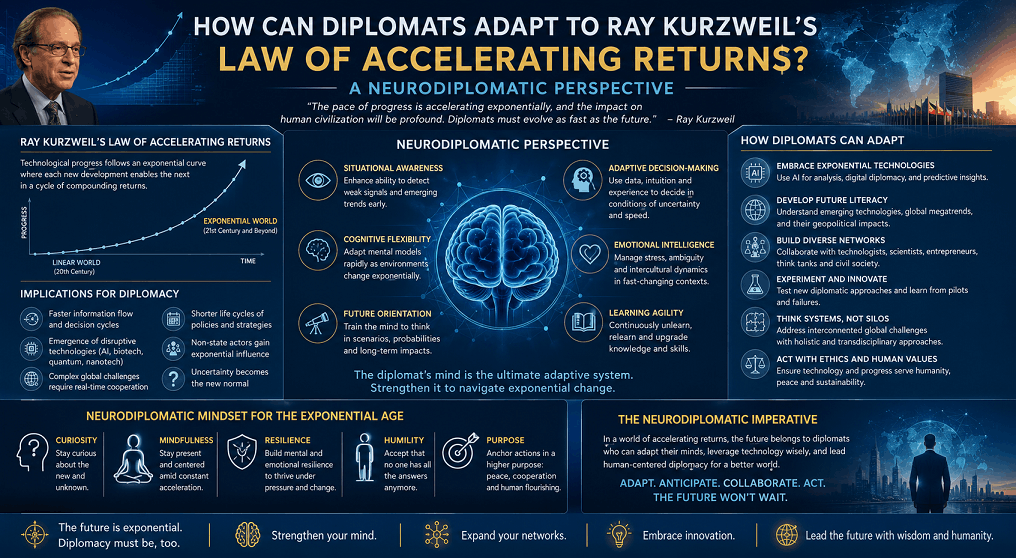
Ray Kurzweil’s Law of Accelerating Returns suggests that technological change follows an exponential rather than linear trajectory. According to this principle, advances in computing, artificial intelligence, biotechnology, robotics, and communication technologies reinforce one another, dramatically accelerating future innovation.
For diplomats, this means that the geopolitical environment may change more rapidly than traditional diplomatic systems are designed to accommodate.
The challenge is therefore no longer simply adapting to change—but adapting to accelerating change.
Understanding the Law of Accelerating Returns
Kurzweil argues that technological evolution is cumulative.
Each technological breakthrough increases the capacity to produce subsequent breakthroughs.
Examples include:
Artificial Intelligence
Quantum Computing
Robotics
Biotechnology
Brain–Computer Interfaces
Nanotechnology
Synthetic Biology
Space Technologies
These developments do not occur independently.
They interact, creating exponential technological transformation.
Diplomats must therefore anticipate multiple simultaneous technological revolutions rather than isolated innovations.
Why Traditional Diplomacy Faces Difficulties
Traditional diplomacy was developed for an industrial world characterized by:
relatively stable institutions
slower technological change
hierarchical decision-making
long policy cycles
The exponential age challenges these assumptions.
Diplomatic institutions often struggle because:
policy development is slow
bureaucratic procedures are rigid
negotiations require lengthy consensus-building
legal frameworks become outdated quickly
Consequently, diplomacy risks becoming reactive rather than proactive.
A Neurodiplomatic Response
Neurodiplomacy proposes that adaptation begins with the diplomat rather than the institution.
Instead of focusing solely on external technological developments, Neurodiplomacy asks:
How can diplomats develop minds capable of thriving in exponential environments?
This shifts attention toward human cognition.
-
Develop Exponential Thinking
Most people naturally think linearly.
The human brain evolved to predict gradual environmental change.
Exponential technological growth often exceeds intuitive human expectations.
Diplomats should therefore cultivate the ability to:
recognize exponential trends
anticipate second-order effects
identify technological convergence
think several innovation cycles ahead
Strategic foresight becomes an essential diplomatic competency.
-
Increase Cognitive Flexibility
Accelerating change requires continuous adaptation.
Neurodiplomacy identifies cognitive flexibility as one of the most valuable diplomatic skills.
Diplomats should regularly:
update assumptions
challenge existing beliefs
reconsider policies
embrace new information
adapt negotiation strategies
Flexible thinking enables diplomats to respond effectively to uncertainty.
-
Practice Continuous Learning
Knowledge now becomes obsolete more rapidly than ever before.
Rather than mastering a fixed body of information, diplomats must become lifelong learners.
Continuous learning includes:
emerging technologies
neuroscience
behavioural science
cyber governance
AI regulation
digital diplomacy
Learning itself becomes a strategic capability.
-
Combine Human and Artificial Intelligence
Future diplomacy will involve collaboration between human intelligence and AI.
Artificial intelligence excels at:
analysing large datasets
identifying patterns
generating scenarios
processing information
Humans remain superior in:
ethical judgment
empathy
creativity
intuition
trust-building
Neurodiplomacy promotes human-AI complementarity rather than competition.
-
Build Cognitive Resilience
Accelerating technological change increases uncertainty.
Information overload, misinformation, deepfakes, and algorithmic influence place growing pressure on diplomats.
Neurodiplomacy recommends strengthening:
attention control
emotional regulation
critical thinking
metacognition
psychological resilience
A resilient mind becomes a strategic diplomatic asset.
-
Strengthen Interdisciplinary Cooperation
Future diplomacy cannot operate within disciplinary boundaries.
Diplomats should collaborate with:
neuroscientists
AI engineers
psychologists
economists
ethicists
cybersecurity experts
climate scientists
International problems increasingly require interdisciplinary solutions.
-
Prepare for Ethical Governance
Accelerating technologies create ethical dilemmas concerning:
AI autonomy
surveillance
privacy
cognitive enhancement
genetic engineering
autonomous weapons
Diplomats will play a central role in negotiating international norms governing these technologies.
Human values must evolve alongside technological capabilities.
-
Improve Decision-Making Under Uncertainty
Rapid technological change reduces certainty.
Rather than seeking perfect information, diplomats should improve their ability to make high-quality decisions under uncertainty.
Neurodiplomacy emphasizes:
scenario planning
probabilistic reasoning
cognitive awareness
reflective judgment
These competencies reduce strategic miscalculation.
-
Cultivate Adaptive Leadership
Leadership in an exponential world differs from leadership in stable environments.
Adaptive diplomatic leaders:
encourage innovation
tolerate uncertainty
facilitate collaboration
communicate clearly
learn continuously
embrace complexity
Adaptive leadership becomes essential for future foreign ministries.
-
Maintain the Human Dimension
Perhaps the most important lesson of Neurodiplomacy is that technological acceleration does not diminish the importance of human relationships.
Trust…
Empathy…
Communication…
Identity…
Culture…
Perception…
These remain central to diplomacy regardless of technological sophistication.
Technology changes rapidly.
Human nature changes slowly.
Successful diplomacy requires understanding both.
The Neurodiplomatic Model for Exponential Diplomacy
Neurodiplomacy proposes that future diplomats integrate five complementary capacities:
Capacity Contribution
Technological Intelligence Understanding emerging technologies and their geopolitical implications.
Cognitive Intelligence Strategic thinking, adaptive learning, and complex problem-solving.
Emotional Intelligence Empathy, trust-building, intercultural communication, and negotiation.
Ethical Intelligence Responsible governance, legitimacy, and human-centered decision-making.
Adaptive Intelligence Continuous learning, flexibility, resilience, and innovation.
Together, these capacities enable diplomats to navigate exponential technological transformation while preserving human values.
Implications for Neurodiplomacy
Ray Kurzweil’s Law of Accelerating Returns reinforces one of Neurodiplomacy’s central principles:
The greatest challenge of the future is not technological acceleration itself—it is whether human cognition can adapt quickly enough to govern it wisely.
Neurodiplomacy therefore extends beyond diplomacy.
It becomes a framework for preparing leaders whose cognitive capabilities evolve alongside accelerating technologies.
Future diplomacy will increasingly depend upon:
adaptive thinking
lifelong learning
cognitive flexibility
interdisciplinary collaboration
emotional intelligence
ethical leadership
These are precisely the competencies Neurodiplomacy seeks to develop.
Conclusion
Ray Kurzweil’s Law of Accelerating Returns suggests that the pace of technological innovation will continue to increase, fundamentally reshaping international relations. Diplomats can no longer rely on static knowledge or incremental adaptation. Instead, they must cultivate the cognitive, emotional, ethical, and strategic capacities required to operate in an exponential world.
From a Neurodiplomatic perspective, the future diplomat is not simply a negotiator of treaties but an adaptive cognitive leader—someone capable of integrating neuroscience, artificial intelligence, behavioural science, and diplomacy into a coherent approach to global governance. In the age of accelerating technological change, the decisive advantage will belong not to those who merely understand technology, but to those who can continually adapt their thinking while preserving the human values that diplomacy exists to protect.
Main Source:
The Law of Accelerating Returns Kurzweil, R. (2001). The law of accelerating returns. KurzweilAI.net.
Recommended Sources for Further Reading:
- The Age of Intelligent Machines Kurzweil, R. (1990). The age of intelligent machines. MIT Press.
- The Age of Spiritual Machines Kurzweil, R. (1999). The age of spiritual machines: When computers exceed human intelligence. Viking.
- The Singularity Is Near Kurzweil, R. (2005). The singularity is near: When humans transcend biology. Viking.
- How to Create a Mind Kurzweil, R. (2012). How to create a mind: The secret of human thought revealed. Viking.
-
The Singularity Is Nearer Kurzweil, R. (2024). The singularity is nearer. Viking.