Abstract
Foreign policy is one of the principal instruments through which states pursue their national interests, protect their security, and shape the international order. At the heart of successful foreign policy lies strategic thinking—the capacity to anticipate future developments, evaluate complex environments, integrate multiple sources of information, and formulate long-term policies under conditions of uncertainty. While traditional foreign policy analysis has emphasized power, institutions, ideology, and national interests, recent advances in cognitive science, political psychology, and neuroscience suggest that strategic thinking is fundamentally a cognitive process. This article examines strategic thinking in foreign policy through the perspective of Neurodiplomacy, an emerging interdisciplinary field integrating diplomacy, neuroscience, cognitive psychology, communication studies, and international relations. It argues that effective foreign policy depends not only on geopolitical capabilities but also on the quality of perception, cognitive flexibility, emotional intelligence, strategic foresight, and adaptive decision-making. The article proposes a Neurodiplomatic Strategic Foreign Policy Model and discusses its implications for contemporary diplomacy in an era of artificial intelligence, technological disruption, and global complexity.
Keywords: Strategic Thinking, Foreign Policy, Neurodiplomacy, Decision-Making, Cognitive Science, International Relations, Strategic Foresight, Diplomacy.
Introduction
Foreign policy represents the external expression of a state’s national interests and strategic objectives. Through foreign policy, governments seek to protect national security, promote economic prosperity, maintain international influence, and contribute to regional or global stability.
The contemporary international system, however, differs fundamentally from that of previous centuries. Diplomats and policymakers must now address cyber conflict, artificial intelligence, climate change, biotechnology, information warfare, transnational terrorism, and rapidly shifting geopolitical alliances. In such an environment, foreign policy can no longer rely solely on historical precedent or traditional geopolitical calculations. It requires strategic thinking—the ability to anticipate change, interpret uncertainty, and formulate adaptive responses.
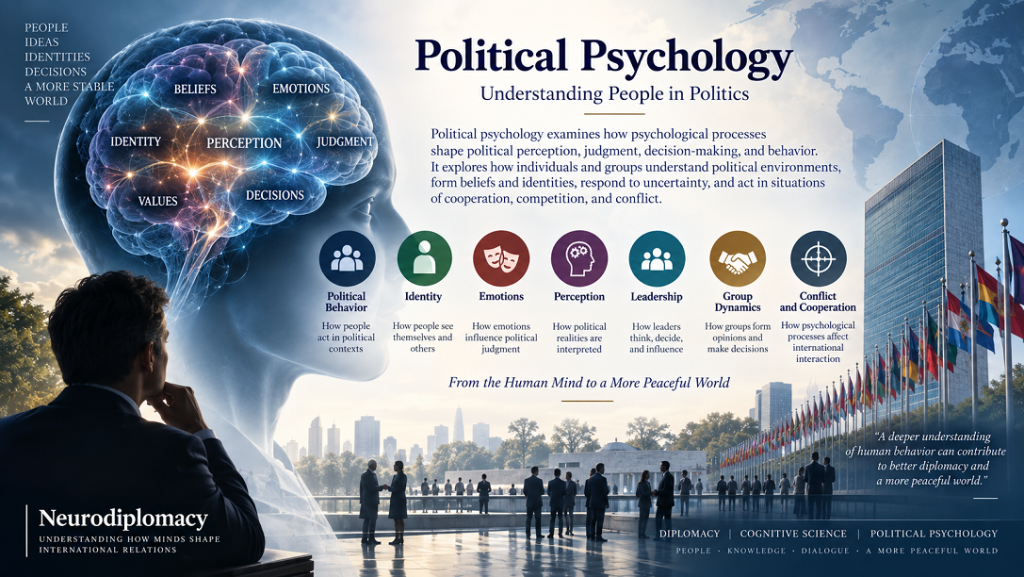
From the perspective of Neurodiplomacy, strategic thinking begins not with institutions or military capabilities but with the human mind. Every foreign policy decision originates in the cognitive processes of leaders and diplomats who perceive information, evaluate alternatives, regulate emotions, and construct strategic judgments. Understanding these mental processes is therefore essential for improving foreign policy decision-making.
Strategic Thinking in Foreign Policy
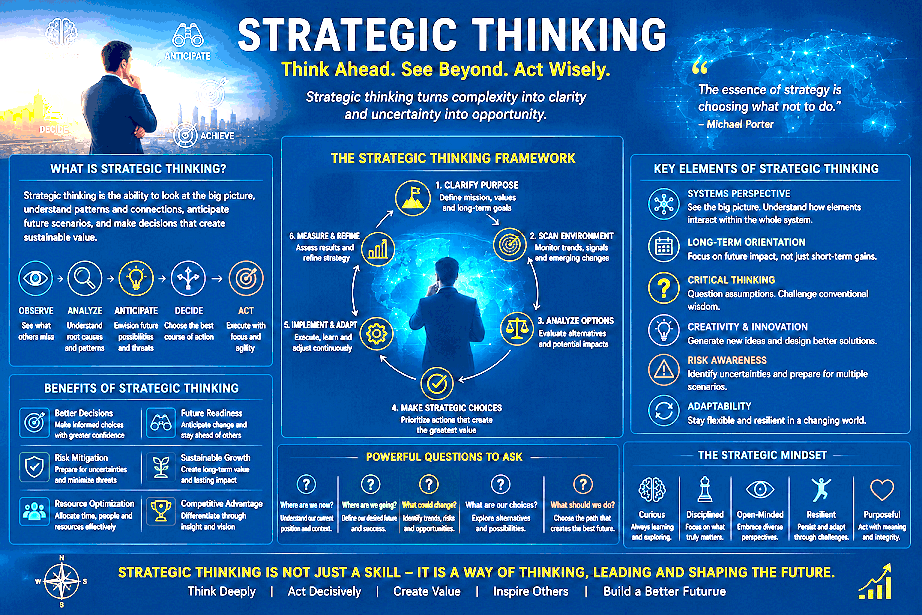
Strategic thinking is the intellectual process through which policymakers connect present decisions with long-term national objectives.
It involves the ability to:
- anticipate future developments,
- identify opportunities and threats,
- understand complex systems,
- integrate diverse information,
- formulate adaptive policies.
Unlike tactical thinking, which focuses on immediate problems, strategic thinking considers the broader and longer-term consequences of political decisions.
In foreign policy, strategy serves as the bridge between national interests and diplomatic action.
Traditional Approaches to Foreign Policy Strategy
Classical theories of international relations have emphasized several foundations of strategic thinking.
Realism
Realist scholars argue that foreign policy should primarily safeguard national survival, security, and power within an anarchic international system.
Liberalism
Liberal approaches emphasize international cooperation, institutions, diplomacy, and economic interdependence as strategic resources.
Constructivism
Constructivist scholars highlight the influence of identities, norms, beliefs, and ideas on strategic behavior.
Although these traditions provide valuable insights, they often pay less attention to the cognitive mechanisms through which leaders actually formulate strategy.
Neurodiplomacy and Strategic Thinking
Neurodiplomacy introduces a complementary perspective.
It begins with a simple proposition:
Foreign policy is ultimately made by human minds rather than abstract states.
Before any diplomatic action occurs, policymakers must:
- perceive information,
- interpret events,
- evaluate risks,
- imagine future scenarios,
- regulate emotions,
- make decisions.
These cognitive processes shape strategic outcomes.
Perception: The Foundation of Foreign Policy
Every foreign policy begins with perception.
Governments must interpret:
- allies,
- adversaries,
- opportunities,
- threats,
- global trends.
Robert Jervis demonstrated that leaders frequently respond to their perceptions rather than objective reality.
Consequently, inaccurate perception can produce serious strategic errors.
Neurodiplomacy therefore emphasizes improving perceptual accuracy through reflective thinking, multiple perspectives, and continuous learning.
Strategic Foresight
Foreign policy requires anticipation rather than prediction.
Strategic foresight involves exploring multiple plausible futures.
Diplomats should regularly examine:
- technological trends,
- demographic change,
- environmental developments,
- geopolitical shifts,
- emerging security risks.
Scenario planning enables governments to prepare for uncertainty rather than react to crises.
Systems Thinking
Modern international politics functions as a highly interconnected system.
Economic crises affect political stability.
Climate change influences migration.
Technological innovation reshapes security.
Strategic thinking therefore requires systems thinking—the ability to understand relationships among interconnected variables rather than viewing events in isolation.
Cognitive Flexibility
One of the defining characteristics of successful foreign policymakers is cognitive flexibility.
Rigid strategic assumptions often become obsolete as international conditions change.
Cognitive flexibility enables policymakers to:
- revise assumptions,
- integrate new evidence,
- generate alternative policies,
- adapt to uncertainty.
From a Neurodiplomatic perspective, flexibility is a strategic asset.
Emotional Intelligence
Foreign policy is frequently portrayed as a rational activity.
However, neuroscience demonstrates that emotion influences attention, memory, judgment, and risk perception.
Diplomatic leaders who regulate emotions effectively are more capable of:
- managing crises,
- negotiating agreements,
- building trust,
- avoiding escalation.
Emotional intelligence therefore strengthens strategic decision-making.
Cognitive Biases in Foreign Policy
Strategic failures often result from cognitive biases rather than insufficient information.
Common biases include:
- confirmation bias,
- overconfidence,
- anchoring,
- availability heuristic,
- groupthink.
Recognizing these biases allows policymakers to improve strategic judgment.
Neurodiplomacy encourages structured reflection and interdisciplinary consultation to reduce cognitive error.
Artificial Intelligence and Strategic Decision-Making
Artificial intelligence increasingly supports foreign policy through:
- geopolitical forecasting,
- data analysis,
- language translation,
- intelligence processing,
- crisis monitoring.
Nevertheless, AI cannot replace human qualities such as:
- ethical judgment,
- empathy,
- creativity,
- political wisdom.
The future of foreign policy will therefore depend upon effective collaboration between human cognition and intelligent technologies.
Strategic Communication
Foreign policy succeeds only when strategy is effectively communicated.
Diplomats must explain policies to:
- foreign governments,
- international organizations,
- domestic audiences,
- global public opinion.
Neurodiplomacy examines how communication influences perception through framing, narratives, metaphors, and emotional resonance.
Strategic Thinking in an Era of Exponential Change
Rapid technological acceleration has transformed the strategic environment.
Foreign policy now requires continuous adaptation to:
- artificial intelligence,
- quantum technologies,
- biotechnology,
- cyber security,
- digital diplomacy,
- cognitive warfare.
Traditional long-term planning must therefore be complemented by adaptive learning and organizational agility.
The Neurodiplomatic Strategic Foreign Policy Model
Strategic foreign policy can be understood as an eight-stage cognitive process.
Stage 1. Strategic Perception
Identifying relevant geopolitical information.
Stage 2. Interpretation
Constructing meaning through cognitive models.
Stage 3. Emotional Regulation
Managing emotional influences upon judgment.
Stage 4. Systems Analysis
Understanding relationships among global variables.
Stage 5. Strategic Foresight
Developing multiple future scenarios.
Stage 6. Policy Formulation
Designing adaptive diplomatic strategies.
Stage 7. Strategic Communication
Implementing policy through effective diplomatic engagement.
Stage 8. Evaluation and Learning
Assessing outcomes and updating strategic assumptions.
This model emphasizes continuous learning and adaptation rather than static planning.
Implications for Ministries of Foreign Affairs
Foreign ministries should cultivate strategic thinking by integrating:
- neuroscience,
- cognitive psychology,
- systems thinking,
- behavioral economics,
- artificial intelligence,
- strategic foresight,
- emotional intelligence,
- negotiation science.
Diplomatic training should prepare officials not only to understand international politics but also to think strategically within rapidly changing environments.
Conclusion
Strategic thinking is one of the most essential capabilities in foreign policy. While traditional theories of international relations have provided valuable explanations of state behavior, the accelerating complexity of global politics requires a deeper understanding of how strategies are actually formed. Neurodiplomacy contributes this missing dimension by demonstrating that foreign policy begins within the cognitive processes of diplomats and political leaders.
Effective foreign policy depends not only on material capabilities or institutional structures but also on perception, cognitive flexibility, emotional intelligence, systems thinking, strategic foresight, and adaptive learning. The Neurodiplomatic Strategic Foreign Policy Model proposed in this article illustrates how foreign policy emerges through interconnected stages of perception, interpretation, emotional regulation, analysis, foresight, communication, and continuous evaluation.
As the international system enters an era defined by artificial intelligence, exponential technological change, and global interdependence, strategic thinking will become increasingly important. Future foreign policy success will depend not merely on understanding world politics but on cultivating the cognitive capacities necessary to anticipate change, navigate uncertainty, and transform complexity into strategic opportunity. Neurodiplomacy therefore offers a valuable interdisciplinary framework for preparing diplomats and policymakers to lead effectively in the evolving international order.
Sources for Further Reading:
- Allison, G. T. (1971). Essence of decision: Explaining the Cuban Missile Crisis. Little, Brown.
- George, A. L. (1980). Presidential decisionmaking in foreign policy: The effective use of information and advice. Westview Press.
- Mintzberg, H., Ahlstrand, B., & Lampel, J. (2009). Strategy safari: Your complete guide through the wilds of strategic management (2nd ed.). Pearson.
- Paret, P., Craig, G. A., & Gilbert, F. (Eds.). (1986). Makers of modern strategy from Machiavelli to the nuclear age. Princeton University Press.)
- Tetlock, P. E., & Gardner, D. (2015). Superforecasting: The art and science of prediction. Crown Publishers.