Bibliographic Information
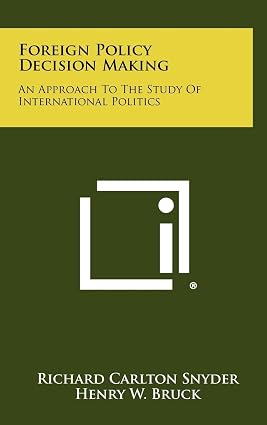
Snyder, Richard C., H. W. Bruck, and Burton Sapin (eds.). Foreign Policy Decision-Making: An Approach to the Study of International Politics. New York: The Free Press of Glencoe, 1962. vii + 274 pp.
Introduction
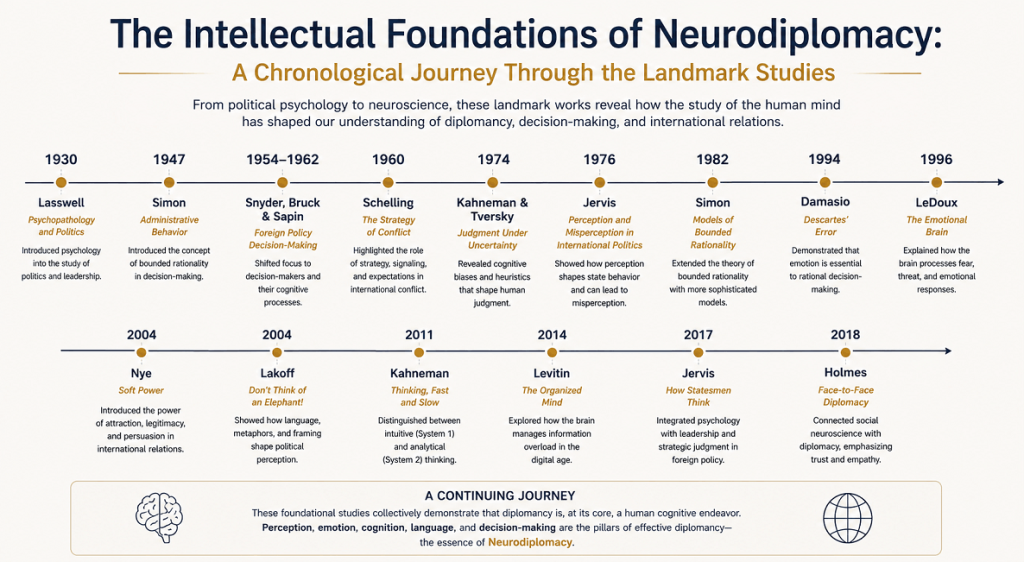
Foreign Policy Decision-Making: An Approach to the Study of International Politics represents one of the most influential works in the development of Foreign Policy Analysis (FPA). At a time when international relations scholarship was largely dominated by realist and systemic explanations of state behavior, Richard C. Snyder, H. W. Bruck, and Burton Sapin introduced a revolutionary proposition: foreign policy should be understood through the decisions of the individuals and organizations that formulate it rather than through the abstract behavior of states alone.
The book challenged the prevailing assumption that states behave as unitary rational actors. Instead, the authors argued that foreign policy emerges from complex decision-making processes shaped by psychological, organizational, bureaucratic, informational, and environmental factors. This perspective laid the intellectual foundations for what later became decision-making theory, comparative foreign policy, political psychology, and modern Foreign Policy Analysis.
More than six decades after its publication, the book remains a landmark contribution whose ideas continue to influence international relations scholarship.
Central Argument
The central thesis of the book is straightforward yet transformative:
States do not make decisions—people do.
According to Snyder, Bruck, and Sapin, foreign policy is the outcome of decisions taken by policymakers operating within organizational and political contexts. Consequently, explaining international politics requires understanding how leaders perceive situations, evaluate alternatives, process information, and select courses of action.
The authors therefore shift the unit of analysis from the state to the decision-making process.
Decision-Making as the Unit of Analysis
One of the book’s greatest contributions is its reconceptualization of international politics.
Rather than treating states as abstract actors, the authors examine the internal mechanisms through which governments formulate foreign policy.
These mechanisms include:
- decision-makers
- organizational structures
- communication systems
- information flows
- institutional constraints
- environmental influences
- political values
This multidimensional framework significantly expanded the analytical scope of international relations.
Major Theoretical Contributions
Humanizing International Politics
The book argues that international politics is fundamentally conducted by human beings rather than by impersonal state structures.
Foreign policy therefore reflects:
- perceptions
- judgments
- beliefs
- organizational routines
- political objectives
- individual choices
This insight anticipated later developments in political psychology and behavioral decision theory.
The Decision Environment
The authors introduce the concept of the decision environment, emphasizing that policymakers never operate under conditions of complete information.
Decision-makers face:
- uncertainty
- ambiguity
- incomplete intelligence
- conflicting objectives
- time pressure
- organizational constraints
Consequently, foreign policy decisions are rarely perfectly rational.
Organizational Context
Another significant contribution concerns the role of governmental organizations.
The book demonstrates that decisions emerge not only from leaders’ preferences but also from:
- bureaucratic procedures
- institutional rules
- communication networks
- organizational cultures
This insight later influenced Graham Allison’s bureaucratic politics model and organizational process theory.
Methodological Contributions
Rather than constructing a grand systemic theory, Snyder and his colleagues propose an analytical framework for empirical research.
Their approach encourages scholars to examine:
- who makes decisions
- what information is available
- how alternatives are evaluated
- what organizational structures influence policy
- how external events shape internal deliberations
This framework remains influential within Foreign Policy Analysis today.
Influence on International Relations
Few books have exercised greater influence on the study of foreign policy.
Its intellectual legacy can be observed in several research traditions:
Foreign Policy Analysis
The book is widely regarded as one of the founding texts of FPA.
Political Psychology
Its emphasis on individual decision-makers anticipated later research on perception, cognition, and leadership psychology.
Bureaucratic Politics
The recognition of organizational influences helped inspire subsequent bureaucratic models of decision-making.
Behavioral Decision Theory
Its rejection of perfectly rational decision-making foreshadowed later work on bounded rationality, heuristics, and cognitive biases.
Relevance to Cognitive Science
Although written before the emergence of modern cognitive neuroscience, the book contains ideas remarkably consistent with contemporary cognitive science.
Decision-makers must:
- interpret information
- allocate attention
- evaluate uncertainty
- construct mental models
- make judgments under limited information
These processes correspond closely with current research in:
- cognitive psychology
- decision science
- behavioral economics
- neuroscience
The book therefore anticipated what later became known as the cognitive turn in political science.
Relevance to Neurodiplomacy
From a Neurodiplomatic perspective, this book is foundational.
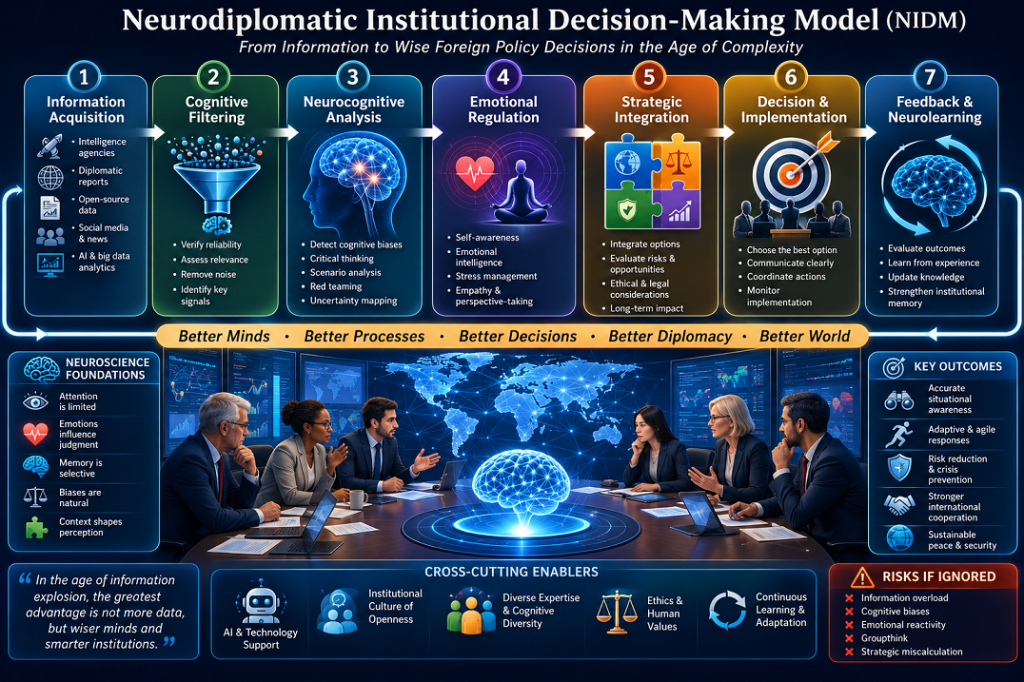
Neurodiplomacy extends Snyder, Bruck, and Sapin’s central insight by asking not only who makes foreign policy decisions but also how the human brain makes them.
Where Snyder and colleagues analyze decision-making at the organizational and political levels, Neurodiplomacy investigates the neurocognitive mechanisms underlying diplomatic judgment.
These include:
- perception
- attention
- emotional regulation
- cognitive biases
- memory
- belief systems
- empathy
- trust
- strategic communication
The decision-making framework proposed in 1962 therefore serves as an intellectual bridge between classical Foreign Policy Analysis and contemporary Neurodiplomacy.
One of the most significant extensions offered by Neurodiplomacy is the shift from explaining why decisions occur to understanding how diplomats can improve their decision-making through greater awareness of cognitive processes.
Strengths
The book possesses several enduring strengths.
Conceptual Innovation
Its greatest achievement lies in shifting attention from abstract states to concrete decision-makers.
This change fundamentally transformed international relations scholarship.
Interdisciplinary Vision
The authors drew upon psychology, sociology, organizational theory, and political science, making the book remarkably interdisciplinary for its time.
Practical Relevance
The analytical framework remains useful for diplomats, policymakers, intelligence analysts, and foreign policy practitioners.
Lasting Influence
More than sixty years after publication, its concepts continue to shape research on leadership, cognition, and foreign policy.
Limitations
Despite its importance, the book has certain limitations.
Limited Cognitive Neuroscience
Published decades before advances in neuroscience, the book could not incorporate contemporary understanding of neural mechanisms, emotional regulation, or cognitive bias.
Limited Empirical Testing
Many propositions are presented as conceptual frameworks rather than systematically tested empirical hypotheses.
Less Attention to International Structures
Structural realists may argue that the book underestimates the influence of systemic power distributions and geopolitical constraints.
Nevertheless, these limitations largely reflect the historical context in which the work was written rather than conceptual weaknesses.
Contemporary Relevance
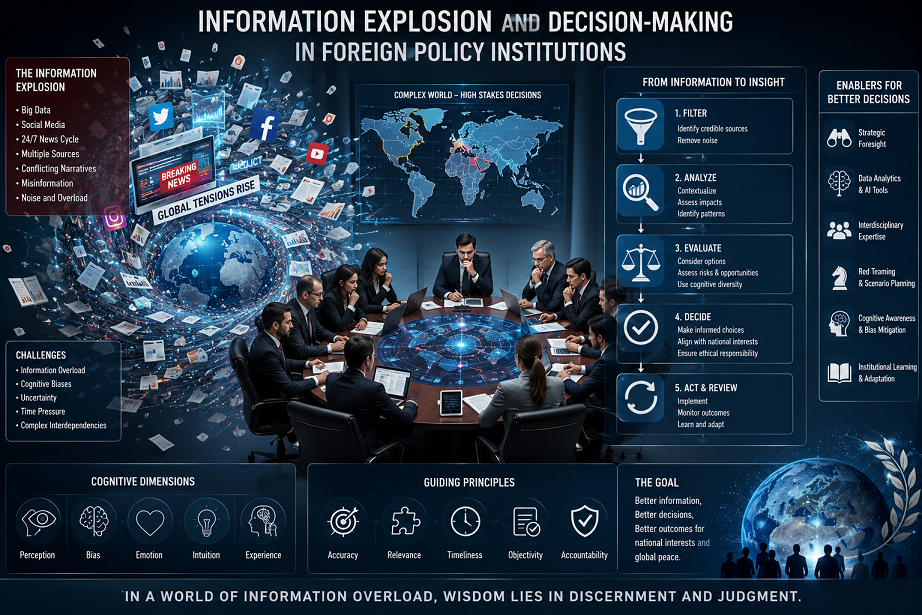
The accelerating complexity of international politics—including artificial intelligence, cyber diplomacy, information warfare, and technological convergence—makes the book more relevant than ever.
Today’s diplomats confront environments characterized by uncertainty, rapid information flows, and cognitive overload.
Understanding decision-making processes has therefore become increasingly important.
The book’s emphasis on human judgment provides a valuable foundation for integrating neuroscience and cognitive science into diplomatic practice.
Conclusion
Foreign Policy Decision-Making: An Approach to the Study of International Politics is a classic work that fundamentally transformed the study of international relations. By shifting analytical attention from the state as an abstract actor to the individuals and organizations responsible for foreign policy decisions, Snyder, Bruck, and Sapin established a new research agenda that gave rise to Foreign Policy Analysis and influenced generations of scholars in political psychology, organizational theory, and decision science.
From the perspective of Neurodiplomacy, the book’s enduring importance lies in its recognition that diplomacy is ultimately a human cognitive activity. While the authors explored the political and organizational dimensions of decision-making, contemporary Neurodiplomacy extends their framework by incorporating neuroscience, cognitive science, and psychology to better understand how diplomats perceive, interpret, and respond to international challenges.
More than sixty years after its publication, this landmark work remains essential reading for scholars of international relations, diplomacy, foreign policy analysis, political psychology, cognitive science, and Neurodiplomacy.