Bibliographic Information
Singer, Eric, and Valerie M. Hudson, eds. Political Psychology and Foreign Policy. Boulder, CO: Westview Press, 1992.
Introduction
Political Psychology and Foreign Policy, edited by Eric Singer and Valerie M. Hudson, is a seminal contribution to the interdisciplinary study of international relations and foreign policy decision-making. Bringing together leading scholars in political psychology and foreign policy analysis, the volume examines how psychological factors influence the behavior of political leaders, governments, and states in the international arena.
Published during a period when rational choice and structural theories dominated international relations scholarship, the book challenges the assumption that foreign policy can be adequately explained through systemic pressures, material capabilities, or objective national interests alone. Instead, the contributors argue that political behavior is fundamentally shaped by human cognition, perception, personality, emotions, beliefs, and decision-making processes.
The volume occupies an important place in the development of political psychology as a subfield of international relations. It demonstrates that understanding foreign policy requires examining the psychological characteristics of decision-makers and the cognitive mechanisms through which they interpret and respond to international events.
More than three decades after its publication, the book remains an influential resource for scholars interested in foreign policy analysis, leadership studies, political psychology, cognitive science, and diplomacy.
Purpose and Central Argument
The primary objective of the volume is to explore how psychological variables affect foreign policy behavior.
The central argument is that foreign policy decisions cannot be understood solely through structural or rationalist models because policymakers operate within cognitive and emotional constraints. Decision-makers do not respond directly to objective reality; rather, they respond to their perceptions and interpretations of reality.
The contributors emphasize that foreign policy outcomes are influenced by:
-
Individual beliefs
-
Cognitive biases
-
Personality characteristics
-
Emotional responses
-
Political learning
-
Perceptions of threat
-
Group dynamics
-
Leadership styles
Consequently, foreign policy analysis must incorporate insights from psychology if it is to provide a realistic understanding of international political behavior.
Major Themes
Cognition and Decision-Making
One of the book’s most significant themes is the role of cognition in foreign policy decision-making.
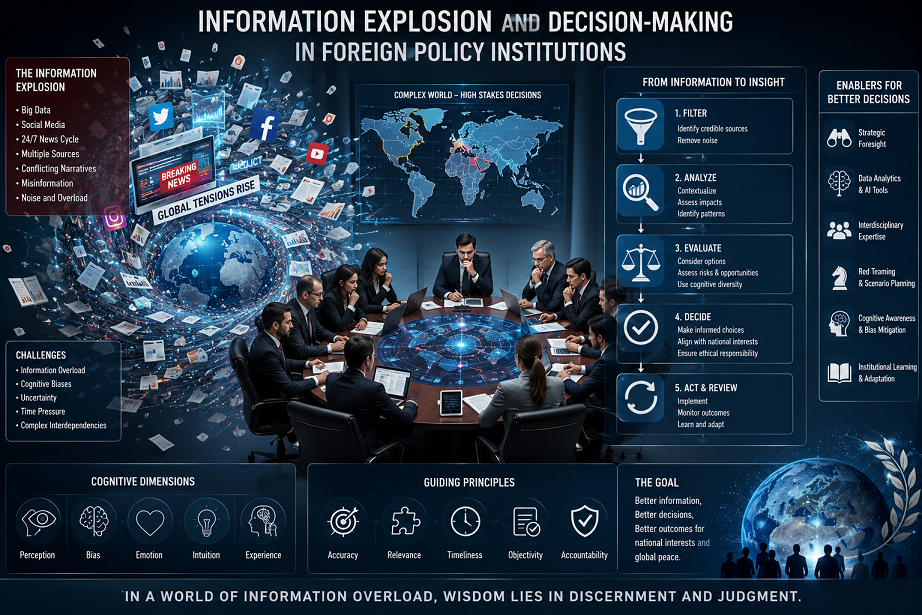
The contributors argue that leaders face environments characterized by:
-
Uncertainty
-
Complexity
-
Incomplete information
-
Time constraints
Under such conditions, policymakers rely on cognitive shortcuts, mental models, and interpretive frameworks to simplify reality.
The volume demonstrates how these cognitive processes influence:
-
Threat assessment
-
Strategic judgment
-
Policy formulation
-
Crisis management
-
Diplomatic behavior
This focus reflects a broader movement within political psychology that views decision-making as a process of information interpretation rather than purely rational calculation.
Perception and Misperception
Building upon earlier work by scholars such as Robert Jervis, the book highlights the importance of perception in international politics.
Political leaders often act on the basis of subjective interpretations rather than objective facts.
The contributors examine how:
-
Stereotypes
-
Prior beliefs
-
Historical experiences
-
Expectations
shape perceptions of adversaries and allies.
Misperceptions can contribute to:
-
Diplomatic failures
-
Escalation of conflict
-
Strategic miscalculations
-
Policy errors
The volume demonstrates that understanding perception is essential for explaining both cooperation and conflict in international relations.
Personality and Leadership
Another major theme concerns the role of individual leaders.
The book challenges the notion that states can be treated as unitary actors and argues that foreign policy often reflects the psychological characteristics of decision-makers.
Several chapters explore how leadership traits influence:
-
Risk-taking behavior
-
Foreign policy preferences
-
Negotiation strategies
-
Crisis responses
-
Political judgment
The contributors show that individual differences can have significant consequences for international outcomes.
This focus on leadership represents a major contribution to foreign policy analysis.
Emotions and Political Behavior
The volume also emphasizes the importance of emotions in international politics.
Contrary to traditional assumptions that emotions are irrational disruptions of political reasoning, the contributors argue that emotions are integral components of decision-making.
The motions can influence how leaders evaluate information and respond to international events.
This perspective anticipated later developments in affective psychology and neuroscience, which increasingly recognize the close relationship between emotion and cognition.
Group Processes and Organizational Behavior
The book extends its analysis beyond individual psychology by examining how group dynamics affect foreign policy.
Decision-making often occurs within organizations and advisory groups rather than at the individual level alone.
The contributors discuss phenomena such as:
-
Groupthink
-
Bureaucratic politics
-
Organizational culture
-
Collective decision-making
These processes shape the formulation and implementation of foreign policy decisions.
Theoretical Contributions
Bridging Psychology and International Relations
Perhaps the book’s most important contribution is its successful integration of psychological insights into the study of foreign policy.
The volume demonstrates that political behavior cannot be fully understood through systemic theories alone.
Psychological variables provide essential explanations for:
-
Variations in policy choices
-
Differences among leaders
-
Strategic miscalculations
-
Diplomatic successes and failures
This interdisciplinary framework enriches both political psychology and international relations.
Advancing Foreign Policy Analysis
The book played a significant role in advancing the Foreign Policy Analysis (FPA) tradition.
Rather than focusing exclusively on state behavior, FPA emphasizes the individuals and institutions responsible for policy decisions.
The contributors provide powerful arguments for examining:
-
Human agency
-
Cognitive processes
-
Leadership characteristics
as central components of international politics.
Challenging Rational Actor Models
The volume offers a sustained critique of purely rationalist approaches to foreign policy.
While acknowledging that leaders often behave strategically, the contributors argue that decision-making is constrained by:
-
Cognitive limitations
-
Emotional influences
-
Informational uncertainty
This perspective aligns with Herbert Simon’s concept of bounded rationality and later developments in behavioral decision theory.
Relevance to Diplomacy
The book has significant implications for diplomatic studies.
Diplomacy involves continuous interaction among individuals seeking to:
-
Communicate intentions
-
Resolve disputes
-
Build trust
-
Negotiate agreements
Many of these processes are fundamentally psychological.
The volume demonstrates how:
-
Perceptions influence negotiations.
-
Cognitive biases affect diplomatic communication.
-
Emotions shape conflict resolution.
-
Leadership styles influence international cooperation.
The book therefore provides valuable insights for both diplomatic theory and practice.
Relevance to Cognitive Science
Although written primarily within political psychology, the volume addresses several topics central to cognitive science.
These include:
-
Information processing
-
Mental representation
-
Attention
-
Memory
-
Learning
-
Decision-making under uncertainty
The contributors show that foreign policy decisions emerge from cognitive processes through which individuals interpret and organize complex information.
This cognitive perspective helps explain why leaders facing similar circumstances may adopt different policies.
Consequently, the volume can be viewed as an important precursor to contemporary applications of cognitive science in international relations.
Relevance to Neurodiplomacy
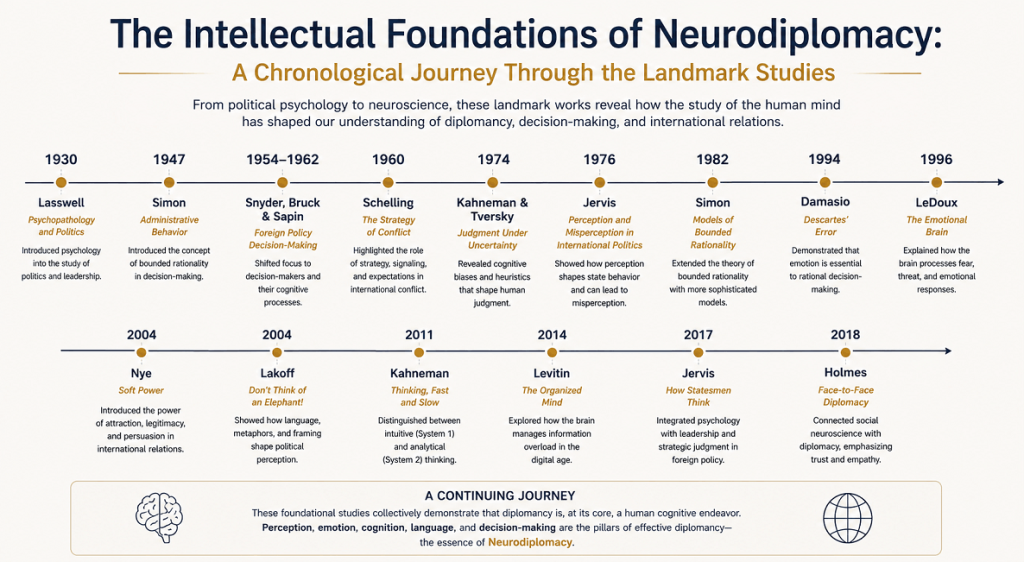
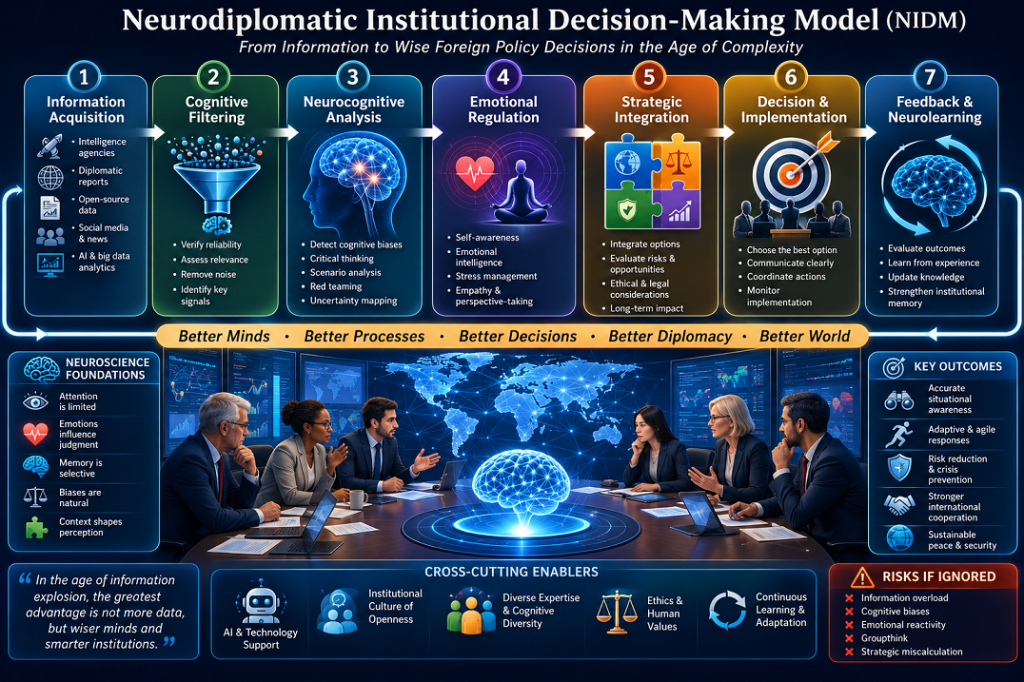
The book is particularly relevant to the emerging field of Neurodiplomacy, which seeks to integrate diplomacy, cognitive science, neuroscience, and political psychology.
Many themes explored in the volume directly support neurodiplomatic research.
Perception and Social Cognition
Neurodiplomacy emphasizes the importance of understanding how decision-makers perceive and interpret international events.
The book’s discussions of perception and misperception provide a strong theoretical foundation for this perspective.
Emotional Influences
Contemporary neuroscience demonstrates that emotions play a central role in judgment and decision-making.
The contributors anticipated this insight by highlighting the importance of emotional processes in foreign policy behavior.
Leadership Psychology
Neurodiplomatic research frequently examines the cognitive and emotional characteristics of political leaders.
The volume’s analysis of leadership traits and decision-making remains highly relevant in this regard.
Trust and Communication
Diplomatic success often depends on the ability to establish trust and communicate effectively.
The psychological mechanisms underlying these processes are central concerns of both political psychology and neurodiplomacy.
As a result, Political Psychology and Foreign Policy can be regarded as one of the intellectual foundations upon which contemporary neurodiplomatic scholarship is built.
Strengths
Interdisciplinary Innovation
The volume successfully combines psychology and international relations, creating a richer understanding of foreign policy behavior.
Scholarly Diversity
The collection brings together multiple perspectives, offering a comprehensive overview of political psychological approaches.
Lasting Influence
Many themes explored in the book continue to shape contemporary research in political psychology and foreign policy analysis.
Practical Relevance
The insights provided are directly applicable to diplomacy, negotiation, conflict management, and foreign policy decision-making.
Limitations
Limited Neuroscientific Perspective
Because the volume was published before the rapid growth of cognitive neuroscience, it contains relatively little discussion of biological mechanisms underlying cognition and emotion.
Methodological Diversity
As an edited collection, the chapters vary in theoretical orientation and methodological approach, which occasionally reduces conceptual coherence.
Historical Context
Some empirical examples reflect Cold War and post–Cold War concerns that may require reinterpretation in light of contemporary international developments.
Nevertheless, these limitations are largely a consequence of the book’s historical context and do not diminish its scholarly significance.
Conclusion
Political Psychology and Foreign Policy remains one of the most important contributions to the study of foreign policy decision-making and international political behavior. By demonstrating that psychological processes profoundly influence how leaders perceive, interpret, and respond to world events, the volume broadens traditional approaches to international relations and foreign policy analysis.
The book successfully integrates cognition, perception, emotion, personality, and leadership into the study of international politics, providing a more realistic and human-centered understanding of foreign policy behavior. Its interdisciplinary insights continue to inform research in political psychology, diplomacy, cognitive science, and international relations.
For scholars interested in diplomacy, leadership, political psychology, foreign policy analysis, cognitive science, and neurodiplomacy, this volume remains essential reading and a foundational text in the study of the psychological dimensions of international affairs.