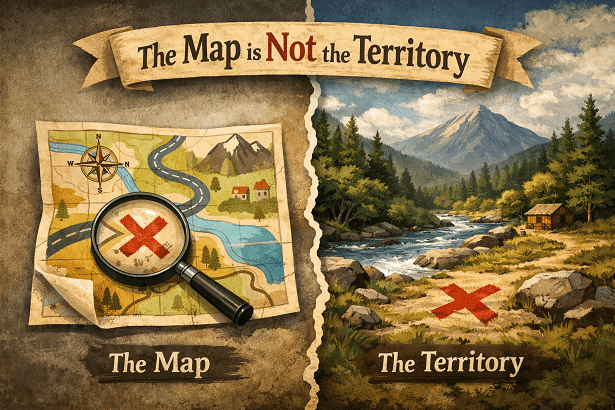
One of the most profound concepts for understanding Neurodiplomacy is the famous statement:
“The map is not the territory.”
This principle was introduced by the Polish-American philosopher and scientist Alfred Korzybski in his work on General Semantics. The phrase means that our mental representations of reality (“maps”) are not reality itself (“the territory”). Human beings do not experience the world directly; rather, they experience interpretations, perceptions, and cognitive constructions of the world.
From a neurodiplomatic perspective, this principle provides a powerful framework for understanding diplomacy, international conflict, negotiation, and foreign policy decision-making.
The Meaning of the Concept
The “territory” refers to objective reality:
Political events
Military capabilities
Diplomatic actions
Economic conditions
International crises
The “map” refers to how individuals perceive and interpret these realities:
Beliefs
Assumptions
Mental models
Strategic narratives
Historical memories
Cultural understandings
In other words, there is always a distinction between:
Reality
and
Perception of Reality
Neurodiplomacy is fundamentally concerned with understanding this distinction.
Neurodiplomacy and Cognitive Maps
At the heart of Neurodiplomacy lies the assumption that leaders do not react directly to objective reality.
Instead, they react to their cognitive maps of reality.
These cognitive maps are shaped by:
Personal experiences
Education
Ideology
Culture
Historical memory
Emotions
Identity
Consequently, two leaders can observe the same event and reach entirely different conclusions.
For example:
A military exercise may be perceived as:
A defensive precaution by one state.
A signal of aggression by another state.
The territory remains unchanged.
The maps differ.
This difference often determines political outcomes.
Diplomacy as the Management of Maps
Traditional diplomacy seeks to manage relations between states.
Neurodiplomacy suggests that diplomacy is also a process of managing perceptions.
In many international disputes, the principal problem is not objective reality itself but competing cognitive maps of reality.
Diplomats therefore attempt to:
Clarify intentions
Reduce misunderstandings
Correct misperceptions
Build mutual understanding
Align perceptions
Successful diplomacy frequently occurs when actors begin to revise their cognitive maps.
The Neuroscience of Mapping Reality
Modern cognitive neuroscience demonstrates that the human brain does not passively record reality.
Instead, it actively constructs interpretations.
The brain continuously:
Selects information
Filters stimuli
Organizes experiences
Creates meaning
As a result, perception is not a mirror of reality but a mental construction.
Neurodiplomacy applies this insight to international relations.
Political leaders do not see the world exactly as it is; they see it through cognitive filters.
These filters become the “maps” that guide foreign policy behavior.
Perception, Misperception, and Conflict
One of the central lessons of Neurodiplomacy is that many international conflicts emerge from confusion between maps and territories.
States often assume that:
“Our perception is reality.”
However, other actors may possess entirely different perceptions.
This phenomenon is visible in:
Security dilemmas
Diplomatic crises
Interstate conflicts
Peace negotiations
For example:
One state may perceive its actions as defensive.
Another state may perceive those same actions as offensive.
Because both sides believe their maps accurately represent reality, misunderstandings emerge.
This is precisely the type of perceptual problem that Neurodiplomacy seeks to address.
Robert Jervis and Cognitive Maps
The work of Robert Jervis strongly reflects the principle that the map is not the territory.
In his influential book Perception and Misperception in International Politics, Jervis demonstrated that foreign policy decisions are often based on perceptions rather than objective conditions.
Decision-makers:
Interpret information selectively.
Fit new evidence into existing beliefs.
Construct simplified images of adversaries.
These cognitive maps influence diplomatic behavior far more than objective reality alone.
Neurodiplomacy builds directly upon these insights.
Neuro-Linguistic Programming and Mental Maps
The principle “the map is not the territory” also occupies a central place in Neuro-Linguistic Programming (NLP).
According to NLP, individuals construct internal maps through:
Language
Experience
Perception
Communication
People do not respond directly to reality; they respond to their internal representations of reality.
Applied to diplomacy, this suggests that international actors negotiate not only material interests but also competing mental maps.
Neurodiplomacy can therefore draw upon this insight by examining how diplomatic language shapes political perceptions.
Strategic Narratives as Maps
States construct strategic narratives that help explain international events.
Examples include narratives about:
Security
National identity
Historical victimhood
Sovereignty
Justice
Power
These narratives function as collective maps.
They help societies interpret international developments.
However, competing narratives often generate conflicting perceptions.
Neurodiplomacy examines how these narrative maps influence political behavior and diplomatic outcomes.
Trust and the Revision of Maps
Trust-building can be understood as a process of revising cognitive maps.
When states distrust one another, their maps often include assumptions such as:
“The other side is hostile.”
“The other side is deceptive.”
“The other side cannot be trusted.”
Diplomatic engagement may gradually alter these perceptions.
As trust develops, cognitive maps become more flexible and less adversarial.
Thus, successful diplomacy often involves changing mental maps rather than changing objective conditions.
Neurodiplomatic Applications
The principle “the map is not the territory” has important implications for Neurodiplomacy.
Conflict Resolution
Understanding that perceptions are not identical to reality helps negotiators identify sources of misunderstanding.
Cross-Cultural Diplomacy
Different cultures construct different cognitive maps of international events.
Recognizing these differences improves communication.
Crisis Management
During crises, leaders often rely on incomplete information.
Awareness of perceptual limitations can reduce escalation risks.
Peacebuilding
Peace processes frequently require the transformation of entrenched perceptions and narratives.
Neurodiplomatic Principle
A central proposition of Neurodiplomacy can be formulated as follows:
International conflicts often arise not because actors inhabit different territories, but because they inhabit different maps of the same territory.
The task of diplomacy is therefore not merely to negotiate interests but to understand, compare, and sometimes transform the cognitive maps through which political actors interpret reality.
Conclusion
The phrase “the map is not the territory” offers one of the most powerful conceptual foundations for Neurodiplomacy. It reminds us that diplomatic actors do not respond directly to objective reality but to cognitive representations of that reality. These representations are shaped by perception, emotion, memory, identity, culture, and communication. Consequently, understanding international politics requires examining not only the external world but also the mental maps through which leaders and societies interpret that world.
From a neurodiplomatic perspective, diplomacy is fundamentally a process of navigating competing perceptions, reducing misperceptions, and creating shared understandings of reality. In this sense, the success of diplomacy often depends less on changing the territory than on transforming the maps through which that territory is perceived.