Introduction
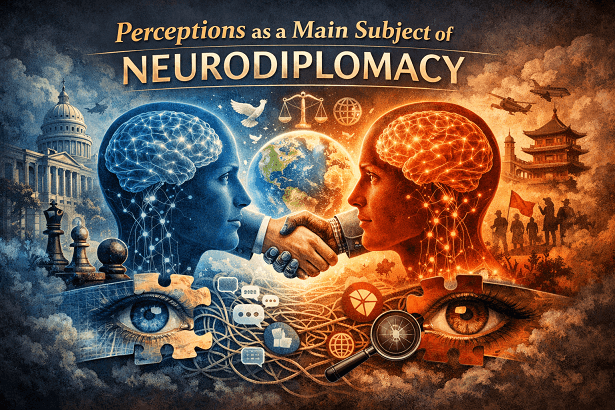
Among the various concepts that constitute the intellectual foundation of Neurodiplomacy, perception occupies a central and arguably the most important position. While traditional diplomacy often focuses on material capabilities, strategic interests, military power, and institutional arrangements, Neurodiplomacy emphasizes that international political behavior is fundamentally shaped by how individuals, leaders, and societies perceive reality.
States do not react directly to objective events; rather, they respond to their interpretations of those events. Diplomatic decisions, foreign policy choices, conflict escalation, alliance formation, and peace negotiations are all influenced by perceptions of intentions, threats, opportunities, risks, and identities. Consequently, understanding perception is essential for understanding diplomacy itself.
Neurodiplomacy integrates insights from cognitive science, neuroscience, political psychology, and international relations to examine how perceptions are formed, maintained, distorted, and transformed in diplomatic contexts. Within this framework, perception becomes the critical link between objective reality and political action.
The Concept of Perception
Perception refers to the process through which individuals receive, interpret, organize, and assign meaning to information from their environment.
In diplomatic and political contexts, perception involves how actors understand:
International events
Foreign governments
Allies and adversaries
Threats and opportunities
Political intentions
Diplomatic signals
Strategic environments
Perception is not a passive reflection of reality. Rather, it is an active cognitive process shaped by:
Prior beliefs
Historical experiences
Cultural values
Emotions
Expectations
Social identities
As a result, different actors may interpret the same event in fundamentally different ways.
Why Perception is Central to Neurodiplomacy
Neurodiplomacy starts from a fundamental premise:
Political actors respond not to objective reality itself, but to their perceptions of reality.
This proposition has profound implications for international relations.
For example:
A military exercise conducted by one state may be perceived as:
Defensive by the initiating state.
Offensive by neighboring states.
Preparatory for aggression by adversaries.
The objective action remains the same, but perceptions differ.
These perceptual differences often determine diplomatic and political outcomes.
Therefore, Neurodiplomacy considers perception the primary cognitive mechanism through which international reality is interpreted and acted upon.
Cognitive Foundations of Perception
Information Processing
Human beings constantly process vast amounts of information.
The brain cannot analyze every piece of information equally. Therefore, individuals rely on cognitive shortcuts that simplify complex environments.
Diplomats and policymakers must often make decisions under conditions characterized by:
Ambiguity
Uncertainty
Time pressure
Incomplete information
Perception serves as a mechanism for organizing this complexity.
However, simplification can also produce errors.
Mental Models
Perceptions are influenced by mental models—internal representations of how the world works.
Political leaders develop mental models based on:
Education
Historical experiences
Political ideology
Cultural background
Professional training
These mental models influence how new information is interpreted.
For example, leaders who perceive international politics as inherently conflictual may interpret diplomatic actions differently from leaders who emphasize cooperation.
Perception and Threat Assessment
One of the most important functions of perception in international relations is the assessment of threats.
Threats are not purely objective phenomena.
Their significance depends upon how they are perceived.
Factors influencing threat perception include:
Historical experiences
Strategic culture
Collective memory
Leadership beliefs
Emotional responses
Two states facing identical circumstances may perceive different levels of danger.
Neurodiplomacy therefore argues that threat perception is often more politically consequential than objective threats themselves.
Perception and Misperception
A major theme in Neurodiplomacy is the distinction between perception and misperception.
Misperception occurs when actors incorrectly interpret:
Intentions
Capabilities
Motivations
Signals
Actions
Many international conflicts have been linked to perceptual errors.
Political leaders may:
Overestimate threats.
Underestimate adversaries.
Misread diplomatic signals.
Misinterpret strategic intentions.
These distortions can contribute to:
Escalation of tensions.
Diplomatic failures.
Military conflicts.
Negotiation breakdowns.
Neurodiplomacy seeks to identify and reduce such perceptual distortions.
Robert Jervis and Perception in International Politics
No discussion of perception in international relations is complete without reference to Robert Jervis.
His influential work, Perception and Misperception in International Politics, demonstrated that foreign policy decisions are often based on subjective interpretations rather than objective realities.
Jervis argued that decision-makers:
Filter information through existing beliefs.
Interpret evidence selectively.
Construct simplified images of adversaries.
His work laid much of the intellectual foundation upon which contemporary Neurodiplomacy is built.
Emotions and Perception
Neurodiplomacy recognizes that perception is not purely cognitive.
It is also emotional.
Emotions influence:
Attention
Memory
Judgment
Risk assessment
Several emotions play particularly important roles in diplomatic perception.
Fear
Fear tends to increase perceptions of threat.
Leaders experiencing fear may:
Overestimate risks.
Interpret ambiguous actions as hostile.
Support defensive or aggressive policies.
Anger
Anger can reduce sensitivity to risk and increase support for confrontation.
Hope
Hope encourages openness to cooperation and compromise.
Empathy
Empathy facilitates understanding of other perspectives and intentions.
These emotional influences demonstrate that diplomatic perception involves both rational and affective processes.
Perception, Identity, and Collective Memory
Perceptions are strongly influenced by social identity.
States and societies develop collective understandings of:
Who they are.
Who their allies are.
Who their adversaries are.
These identities shape political perceptions.
Collective memories of:
Wars
Occupations
Colonial experiences
Historical injustices
often influence contemporary diplomatic attitudes.
Consequently, Neurodiplomacy examines how historical narratives and identity-based perceptions affect international relations.
Perception and Trust
Trust is one of the most important diplomatic resources.
However, trust depends largely upon perception.
States cooperate when they perceive others as:
Credible
Reliable
Predictable
Benevolent
Conversely, distrust emerges when actors perceive:
Hidden intentions
Deception
Aggression
Uncertainty
Neurodiplomacy views trust-building as a process of transforming perceptions through communication, interaction, and relationship development.
Perception in Negotiation and Conflict Resolution
Diplomatic negotiations are fundamentally exercises in perception management.
Negotiators seek to:
Understand the perspectives of others.
Communicate intentions.
Reduce misunderstandings.
Build confidence.
Successful negotiations often depend upon changing perceptions rather than changing material conditions.
For example:
Peace agreements frequently become possible when parties begin to perceive one another differently.
Thus, perception constitutes a central mechanism of conflict transformation.
Perception in the Digital Age
Digital technologies have dramatically altered the informational environment in which perceptions are formed.
Social media, artificial intelligence, and digital communication influence:
Public opinion
Diplomatic narratives
International images
Political attitudes
However, digital environments can also amplify:
Misinformation
Cognitive biases
Polarization
Misperceptions
Neurodiplomacy therefore increasingly examines how digital communication affects diplomatic perception and international behavior.
Perception as the Foundation of Neurodiplomacy
From a neurodiplomatic perspective, perception serves as the bridge between the external world and diplomatic action.
It influences:
Threat assessment
Trust formation
Negotiation behavior
Strategic communication
Conflict escalation
Peacebuilding
Virtually every diplomatic interaction begins with perception and ends with decisions based upon those perceptions.
For this reason, perception can be regarded as the foundational concept of Neurodiplomacy.
Conclusion
Perception is arguably the central subject of Neurodiplomacy because it shapes how political leaders, diplomats, and societies understand and respond to international reality. Rather than reacting directly to objective events, actors interpret those events through cognitive, emotional, cultural, and historical filters. These interpretations influence diplomatic behavior, foreign policy decisions, conflict dynamics, and international cooperation.
By integrating insights from cognitive science, neuroscience, political psychology, and diplomacy, Neurodiplomacy provides a sophisticated framework for understanding how perceptions are formed, how misperceptions emerge, and how diplomatic processes can transform perceptions to promote cooperation and peace. In this sense, perception is not merely one topic within Neurodiplomacy—it is the intellectual core around which the entire field revolves.
Key Neurodiplomatic Proposition:
The success or failure of diplomacy often depends less on objective reality than on how that reality is perceived by the human mind.