Introduction
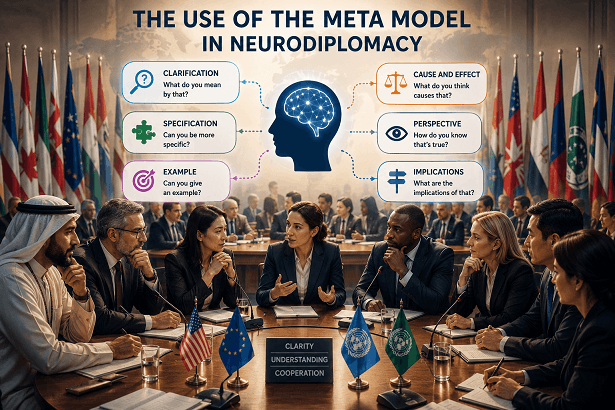
The Meta Model is one of the most important communication frameworks in Neuro-Linguistic Programming (NLP). Developed by Richard Bandler and John Grinder, it consists of a series of questioning techniques designed to clarify language, challenge assumptions, uncover hidden meanings, and reduce misunderstandings.
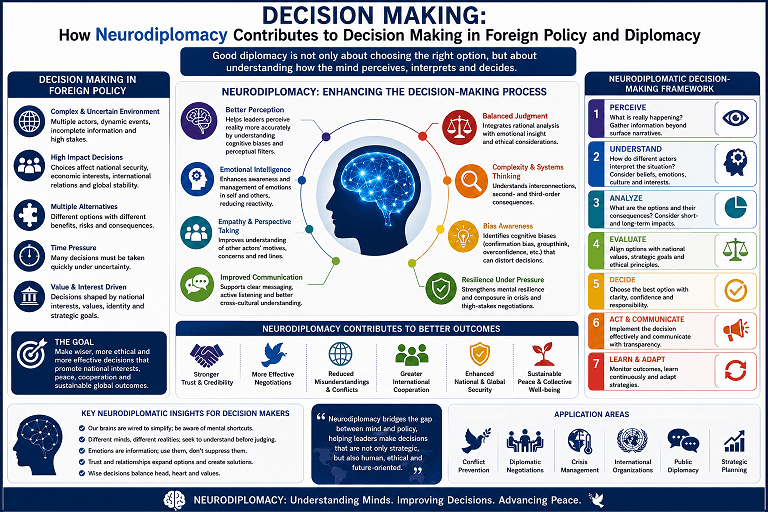
From the perspective of Neurodiplomacy, the Meta Model is particularly valuable because diplomacy is fundamentally a process of interpreting and communicating meanings. International conflicts, failed negotiations, and foreign policy mistakes often arise not from objective reality itself, but from distortions, misperceptions, generalizations, and assumptions about reality.
The Meta Model provides diplomats with a systematic method for exploring how political actors construct their perceptions and for improving the quality of diplomatic communication.
Neurodiplomacy and Perception
One of the central principles of Neurodiplomacy is:
People respond to their perception of reality rather than reality itself.
Governments, leaders, diplomats, and societies interpret international events through cognitive filters shaped by:
- History.
- Culture.
- Identity.
- Ideology.
- Emotions.
- Previous experiences.
As a result, the same event may be interpreted very differently by different actors.
The Meta Model helps diplomats uncover these interpretive processes.
Why the Meta Model Matters in Diplomacy
Diplomatic communication often contains:
- Ambiguity.
- Generalizations.
- Emotional language.
- Assumptions.
- Political narratives.
Without clarification, these patterns can produce misunderstanding and conflict.
The Meta Model helps diplomats move from:
Surface Structure
What people say.
to
Deep Structure
What people actually mean.
This distinction is highly relevant to Neurodiplomacy because diplomatic success often depends on understanding meanings beneath official statements.
The Three Major Meta Model Categories
The Meta Model focuses on three linguistic processes:
- Deletion
- Generalization
- Distortion
Each has important diplomatic applications.
- Deletion
Deletion occurs when information is omitted.
Diplomatic Statement
“We have serious concerns.”
Questions:
- What concerns specifically?
- About whom?
- Under what circumstances?
The original statement lacks important information.
Neurodiplomatic Importance
Clarification reduces uncertainty and prevents inaccurate assumptions.
Example in International Negotiation
A delegation says:
“The proposal is unacceptable.”
Meta Model Questions:
- Unacceptable to whom?
- Which part of the proposal?
- Under what conditions might it become acceptable?
Such questions often reveal hidden opportunities for compromise.
- Generalization
Generalization occurs when specific experiences become universal conclusions.
Diplomatic Statement
“They never cooperate.”
Meta Model Questions:
- Never?
- Can you identify situations where cooperation occurred?
- Under what circumstances did cooperation happen?
Neurodiplomatic Value
Generalizations often reinforce hostility and stereotypes.
Clarification helps restore cognitive flexibility.
Example in Conflict Resolution
One side states:
“Negotiations always fail.”
A mediator may ask:
“Have there been occasions when negotiations produced progress?”
The question shifts attention from failure to exceptions and possibilities.
- Distortion
Distortion occurs when assumptions are presented as facts.
Diplomatic Statement
“Their military exercise proves hostile intentions.”
Meta Model Questions:
- How specifically does it prove hostility?
- What alternative explanations exist?
- What evidence supports that conclusion?
Neurodiplomatic Relevance
Many international crises emerge from distorted interpretations of intentions.
The Meta Model encourages evidence-based analysis.
Meta Model and Misperception
Political psychologist Robert Jervis demonstrated that international conflict often results from misperception.
States frequently:
- Misread intentions.
- Misinterpret signals.
- Overestimate threats.
- Assume hostile motives.
The Meta Model functions as a practical tool for reducing such errors.
Example
Instead of accepting:
“They are preparing for war.”
A Neurodiplomatic diplomat asks:
“What specific evidence supports this conclusion?”
This promotes more accurate assessments.
Meta Model and Diplomatic Negotiation
Negotiators often become trapped by vague language.
Example
“We need stronger guarantees.”
Meta Model Questions:
- What kind of guarantees?
- How would they function?
- How would you know they are sufficient?
These questions transform abstract demands into negotiable issues.
Benefits
- Clarifies interests.
- Reveals underlying concerns.
- Identifies common ground.
- Improves problem solving.
Meta Model and Identity-Based Conflicts
Many conflicts involve identity narratives.
Example
“They do not respect our people.”
Meta Model Questions:
- Who specifically?
- What actions indicate disrespect?
- How is respect being defined?
These questions help separate emotional narratives from observable behavior.
Neurodiplomatic Benefit
Reducing identity-based distortions can lower emotional intensity and support dialogue.
Meta Model and Foreign Policy Decision-Making
Foreign policy decisions are often based on assumptions that go unchallenged.
A Neurodiplomatic decision-maker can use Meta Model questions to test these assumptions.
Example
Assumption:
“Sanctions are the only option.”
Questions:
- According to whom?
- What alternatives exist?
- What outcomes are expected?
- Under what conditions would another option be considered?
This expands the range of strategic choices.
Meta Model and Public Diplomacy
Public diplomacy seeks to influence international audiences.
The Meta Model helps diplomats understand how foreign publics interpret messages.
Questions such as:
- What meaning are audiences assigning to this message?
- Which assumptions are shaping their reactions?
- What information is missing?
can improve communication strategies.
Meta Model and Conflict Resolution
In mediation, the Meta Model can:
Reduce Emotional Escalation
By focusing on specifics rather than accusations.
Clarify Interests
By distinguishing positions from needs.
Challenge Stereotypes
By questioning overgeneralizations.
Promote Understanding
By uncovering hidden assumptions.
Thus, it becomes a powerful instrument of peacebuilding.
The Neurodiplomatic Meta Model Process
A Neurodiplomatic diplomat may use the following sequence:
Step 1: Listen
Identify vague or emotionally charged language.
Step 2: Detect
Recognize deletions, distortions, and generalizations.
Step 3: Question
Use Meta Model questions to clarify meaning.
Step 4: Reframe
Transform rigid perceptions into broader perspectives.
Step 5: Negotiate
Build solutions based on clarified understanding.
Advantages of the Meta Model in Neurodiplomacy
Improves Perception Accuracy
Reduces cognitive distortions.
Enhances Communication
Clarifies ambiguous language.
Supports Better Decisions
Challenges hidden assumptions.
Strengthens Negotiation
Reveals underlying interests.
Reduces Conflict
Corrects misperceptions before they escalate.
Limitations
The Meta Model also has limitations.
- Excessive questioning may appear confrontational.
- Cultural differences influence responses.
- Political leaders may deliberately use ambiguity.
- Not all diplomatic situations allow detailed clarification.
Therefore, skilled diplomats must balance inquiry with rapport and sensitivity.
Conclusion
From a Neurodiplomatic perspective, the Meta Model is far more than a linguistic tool. It is a method for uncovering the cognitive structures that shape international behavior. By identifying deletions, generalizations, and distortions in diplomatic communication, diplomats can better understand how leaders, governments, and societies construct political reality.
In a world where international conflicts are often driven by misperceptions, stereotypes, and communication failures, the Meta Model offers a practical framework for improving dialogue, enhancing decision-making, and facilitating conflict resolution. As Neurodiplomacy continues to evolve, the Meta Model may become one of its most valuable tools for transforming communication into understanding and understanding into cooperation.