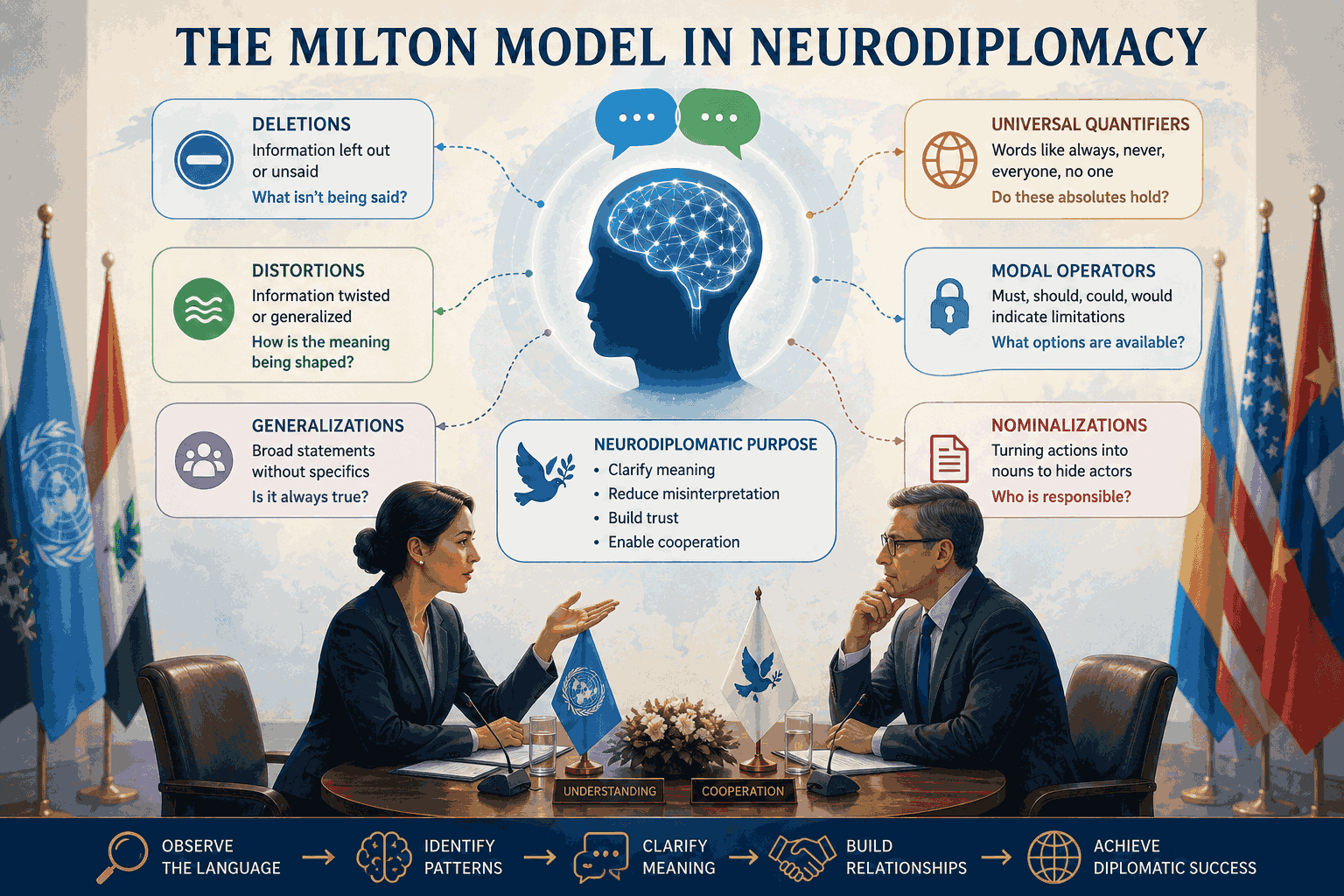
The Milton Model, developed by Richard Bandler and John Grinder through their study of the communication patterns of Milton H. Erickson, consists of language patterns designed to influence thinking through indirect suggestion, ambiguity, metaphor, presupposition, and permissive communication.
From a Neurodiplomatic perspective, the Milton Model offers a valuable framework for understanding how diplomats can influence perceptions, reduce resistance, build trust, and facilitate cooperation without direct confrontation. While traditional diplomacy often relies on formal statements and explicit bargaining, Neurodiplomacy recognizes that much of diplomatic influence occurs through subtle psychological and communicative processes.
The Milton Model therefore provides practical tools for managing perceptions, shaping narratives, and encouraging constructive diplomatic behavior.
Neurodiplomacy and Indirect Communication
One of the central assumptions of Neurodiplomacy is that individuals do not respond directly to reality but to their interpretation of reality.
Direct arguments often trigger:
- Resistance.
- Defensive reactions.
- Identity protection.
- Political polarization.
The Milton Model works differently.
Instead of telling people what to think, it creates linguistic environments that encourage individuals to generate their own conclusions.
For diplomats, this approach can be particularly valuable because international negotiations often involve sensitive issues where direct pressure may provoke opposition.
Core Milton Model Patterns in Neurodiplomacy
1. Presuppositions
Presuppositions embed assumptions within language.
Diplomatic Example
Instead of:
“Can peace be achieved?”
A diplomat might say:
“As the parties continue moving toward peace…”
This statement presupposes:
- Peace is possible.
- Progress is occurring.
- Cooperation is continuing.
Neurodiplomatic Effect
The brain tends to process the underlying assumption before evaluating the statement itself.
This can subtly encourage more constructive thinking.
2. Open-Ended Possibilities
The Milton Model frequently avoids rigid conclusions.
Example
“Many new opportunities may emerge from future dialogue.”
The statement remains intentionally broad.
Each listener fills in the meaning according to their own expectations and interests.
Diplomatic Benefit
Different parties can interpret the same statement positively without feeling pressured.
3. Utilization
Milton Erickson emphasized utilizing existing realities rather than fighting them.
Diplomatic Example
Instead of denying fears:
“We recognize the concerns expressed by all parties and believe these concerns can contribute to a more comprehensive solution.”
The concern itself becomes a resource.
Neurodiplomatic Application
This reduces resistance and increases psychological acceptance.
4. Strategic Ambiguity
Diplomacy has historically relied upon constructive ambiguity.
Example
“Both sides remain committed to pursuing mutually acceptable arrangements.”
The statement deliberately avoids rigid definitions.
Different parties may interpret the language in ways compatible with their interests.
Neurodiplomatic Value
Ambiguity can maintain negotiations when precise language would produce disagreement.
5. Embedded Suggestions
Embedded suggestions place desired ideas within broader statements.
Example
“As discussions continue, parties often discover unexpected areas of cooperation.”
The embedded message is:
“Discover cooperation.”
Diplomatic Use
- Peace negotiations.
- Mediation.
- Confidence-building measures.
- Public diplomacy.
6. Universal Possibility Statements
The Milton Model frequently uses possibility language.
Examples
“Solutions can emerge.”
“Progress is possible.”
“New perspectives may develop.”
These statements avoid imposing outcomes while encouraging optimism.
Neurodiplomatic Effect
They increase cognitive flexibility and reduce psychological rigidity.
7. Metaphors
Metaphors are among the most powerful Milton Model tools.
Diplomatic examples include:
“Building bridges.”
“Opening doors.”
“A shared journey.”
“A common path forward.”
Metaphors simplify complex political realities and create emotional resonance.
Neurodiplomatic Perspective
Metaphors activate broader cognitive associations than purely analytical language.
Milton Model and Negotiation
Negotiations often fail when participants become attached to fixed positions.
Milton-style language can encourage flexibility.
Direct Approach
“You must compromise.”
Milton Approach
“As discussions continue, both sides may discover options that were not previously visible.”
The second statement invites exploration rather than demanding compliance.
Milton Model and Conflict Resolution
In conflict situations, direct confrontation often strengthens resistance.
Milton language patterns can:
- Reduce defensiveness.
- Encourage reflection.
- Preserve face.
- Promote dialogue.
Example
Instead of:
“You are responsible for escalation.”
A mediator might say:
“Many conflicts evolve through patterns that neither side originally intended.”
The focus shifts from blame to understanding.
Milton Model and Public Diplomacy
Public diplomacy increasingly involves influencing perceptions rather than merely transmitting information.
Milton-style communication is particularly useful because it:
- Appeals to diverse audiences.
- Avoids polarization.
- Encourages positive interpretation.
- Supports narrative construction.
Example
“Together, nations can create a future characterized by stability, prosperity, and mutual respect.”
Different audiences may interpret this vision in ways consistent with their own values.
The Diplomat as a Neurodiplomatic Communicator
In a Neurodiplomatic framework, diplomats function not only as representatives of states but also as architects of perception.
The Milton Model helps diplomats:
- Shape narratives.
- Build rapport.
- Reduce resistance.
- Influence emotional states.
- Encourage cooperation.
- Create psychological space for agreement.
Thus, diplomatic communication becomes a process of guiding perceptions rather than imposing conclusions.
Strengths of the Milton Model in Neurodiplomacy
Encourages Cooperation
Indirect language often reduces opposition.
Preserves Relationships
Participants feel respected rather than pressured.
Enhances Flexibility
Multiple interpretations remain possible.
Supports Trust Building
Non-confrontational communication promotes rapport.
Facilitates Complex Negotiations
Constructive ambiguity can keep dialogue moving forward.
Limitations
Several limitations should be recognized.
- Ambiguous language may create misunderstandings.
- Excessive indirectness can reduce clarity.
- Cultural differences affect interpretation.
- Diplomatic agreements ultimately require precise language for implementation.
Therefore, the Milton Model should complement rather than replace traditional diplomatic communication.
Conclusion
From a Neurodiplomatic perspective, the Milton Model provides a sophisticated framework for understanding how language influences perception, cognition, emotion, and behavior in international relations. Through presuppositions, metaphors, embedded suggestions, strategic ambiguity, and possibility-oriented language, diplomats can create communicative environments that encourage cooperation and reduce resistance.
In an era where diplomacy increasingly involves managing perceptions, narratives, and relationships, the Milton Model offers valuable tools for influencing how political actors interpret reality. Neurodiplomacy thus views Milton Model language patterns not merely as communication techniques but as instruments for shaping the cognitive and emotional dimensions of international relations, negotiation, and conflict resolution.