Introduction
Power has always been a central concept in international relations. Traditionally, power was understood primarily in terms of military strength, territorial control, economic resources, and political influence. Great powers were often defined by their ability to compel others through force, coercion, or material superiority.
However, the twenty-first century has witnessed a profound transformation in the nature of power. Globalization, digital communication, artificial intelligence, social media, information networks, and growing interdependence have altered how power is acquired, exercised, and sustained. Increasingly, the ability to shape perceptions, influence narratives, build trust, and affect decision-making has become as important as traditional military and economic capabilities.
In this changing environment, Neurodiplomacy offers a new perspective on power by emphasizing the cognitive, emotional, and perceptual dimensions of international relations. It suggests that power is not merely the ability to control resources but also the ability to influence how individuals, societies, and states perceive reality and make decisions.
The Traditional Concept of Power
Classical international relations theories, particularly realism, view power as the ability of one actor to influence the behavior of another.
Traditional sources of power include:
Military capabilities.
Economic strength.
Population size.
Geographic position.
Natural resources.
Technological superiority.
From this perspective, states pursue power to ensure security and survival in an anarchic international system.
While these factors remain important, they no longer fully explain influence in contemporary world politics.
The Emergence of New Forms of Power
The modern international environment has produced additional forms of power.
Soft Power
Developed by Joseph Nye, soft power refers to the ability to attract and persuade rather than coerce.
Sources include:
Culture.
Values.
Institutions.
International reputation.
Countries increasingly compete for influence through attraction rather than force alone.
Information Power
Information has become a strategic resource.
States seek influence through:
Media networks.
Digital platforms.
Strategic communication.
Public diplomacy.
The ability to shape narratives often influences outcomes more effectively than traditional coercion.
Network Power
Influence increasingly depends on participation in global networks.
Power now derives from:
Connectivity.
Partnerships.
Alliances.
Knowledge exchange.
States that occupy central positions within international networks often possess disproportionate influence.
The Cognitive Dimension of Power
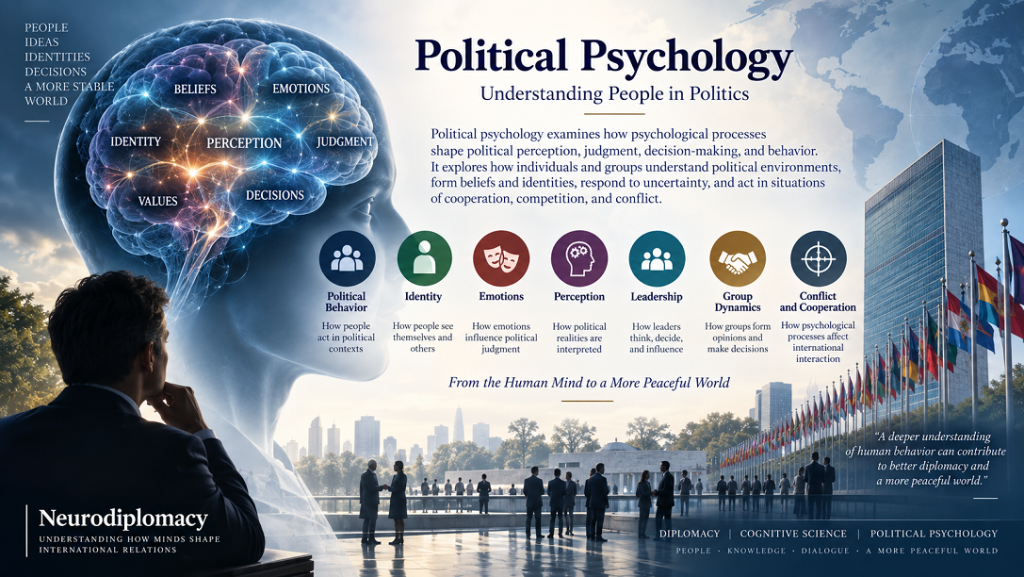
One of the most significant developments in world politics is the growing importance of cognition.
People act according to:
Perceptions.
Beliefs.
Values.
Emotions.
Identities.
As a result, power increasingly involves the ability to influence how others:
Interpret events.
Define interests.
Perceive threats.
Construct reality.
This shift creates space for Neurodiplomacy.
Neurodiplomacy and the New Understanding of Power
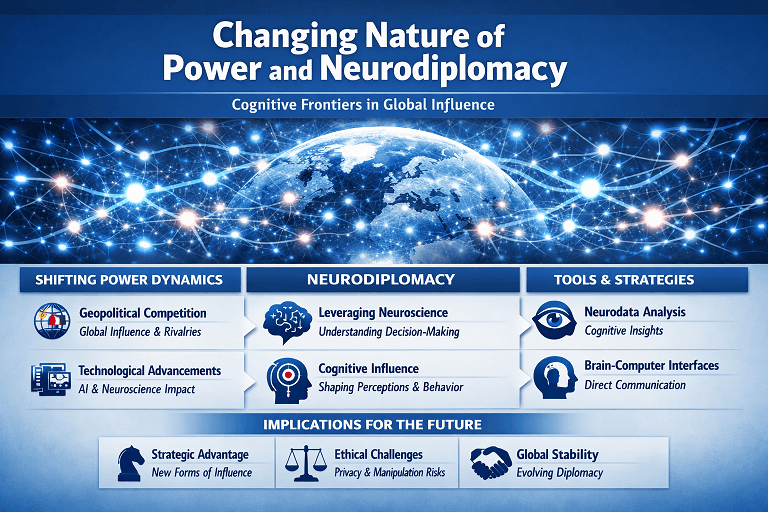
Neurodiplomacy views power as the capacity to influence the cognitive and emotional processes that shape international behavior.
The central question becomes:
How do states influence the way others think, feel, and decide?
Rather than focusing exclusively on material capabilities, Neurodiplomacy examines:
Perception management.
Strategic communication.
Narrative construction.
Identity formation.
Decision-making processes.
Power therefore becomes both material and psychological.
From Control to Influence
Traditional power often emphasized control.
Neurodiplomatic power emphasizes influence.
Traditional Approach
Change behavior through coercion.
Neurodiplomatic Approach
Change perceptions that shape behavior.
The second approach is often less costly and more sustainable.
Perception as a Source of Power
In many international situations, perceptions matter as much as objective realities.
For example:
A military capability influences behavior only if others perceive it as credible.
A threat influences decisions only if it is believed.
A diplomatic initiative succeeds only if it is viewed as trustworthy.
Thus, perceptions become strategic assets.
Narratives and Power
Modern international competition increasingly involves competing narratives.
States seek to shape narratives regarding:
Security.
Development.
Democracy.
Human rights.
Global leadership.
Neurodiplomacy studies how narratives influence:
Public opinion.
Elite decision-making.
International legitimacy.
The ability to define the narrative often determines political influence.
Identity and Power
Identity has become a major factor in contemporary politics.
Individuals and societies often make decisions based on:
National identity.
Cultural identity.
Religious identity.
Historical memory.
Neurodiplomacy recognizes that influence frequently depends on engaging identity rather than merely presenting facts.
Countries that understand identity dynamics can communicate more effectively and reduce conflict.
Digital Technology and Cognitive Power
Social media and digital communication have transformed international relations.
Information now spreads rapidly across borders.
This creates opportunities for:
Public diplomacy.
Digital diplomacy.
Strategic influence.
At the same time, it creates challenges:
Misinformation.
Information overload.
Polarization.
Neurodiplomacy seeks to understand how these information environments affect perception and behavior.
Emotional Power
Traditional theories often emphasize rational decision-making.
Neurodiplomacy recognizes that emotions influence:
Risk perception.
Trust.
Cooperation.
Conflict escalation.
States increasingly use emotional appeals to:
Mobilize support.
Build legitimacy.
Strengthen national identity.
Emotional intelligence therefore becomes a diplomatic asset.
The Diplomat in the Age of Cognitive Power
As power changes, the role of diplomats also changes.
Future diplomats require skills in:
Strategic communication.
Perception management.
Narrative construction.
Cultural intelligence.
Emotional intelligence.
Cognitive flexibility.
The diplomat becomes not only a negotiator of interests but also a manager of perceptions and relationships.
Neurodiplomacy as Smart Power
Neurodiplomacy does not replace military or economic power.
Instead, it complements them.
A state’s effectiveness increasingly depends on integrating:
Hard power.
Soft power.
Cognitive power.
This integrated approach may be described as smart power, where influence results from combining material capabilities with psychological understanding.
Challenges and Ethical Considerations
The growing importance of cognitive influence raises ethical questions.
These include:
Manipulation versus persuasion.
Transparency versus psychological influence.
Information integrity.
Protection of public trust.
Neurodiplomacy should therefore emphasize:
Mutual understanding.
Ethical communication.
Trust-building.
Sustainable cooperation.
Its objective should be influence through understanding rather than manipulation.
Conclusion
The nature of power in international relations is undergoing significant transformation. While military and economic capabilities remain important, influence increasingly depends on the ability to shape perceptions, narratives, identities, and decision-making processes. In this changing environment, Neurodiplomacy provides a valuable framework for understanding power as a cognitive and psychological phenomenon.
By focusing on perception, communication, emotion, identity, and decision-making, Neurodiplomacy expands traditional conceptions of power and offers new tools for diplomacy in the twenty-first century. As world politics becomes more interconnected, information-driven, and psychologically complex, the ability to influence minds may become as important as the ability to influence territory. In this sense, Neurodiplomacy represents not merely a new diplomatic approach but a new understanding of power itself.