Introduction
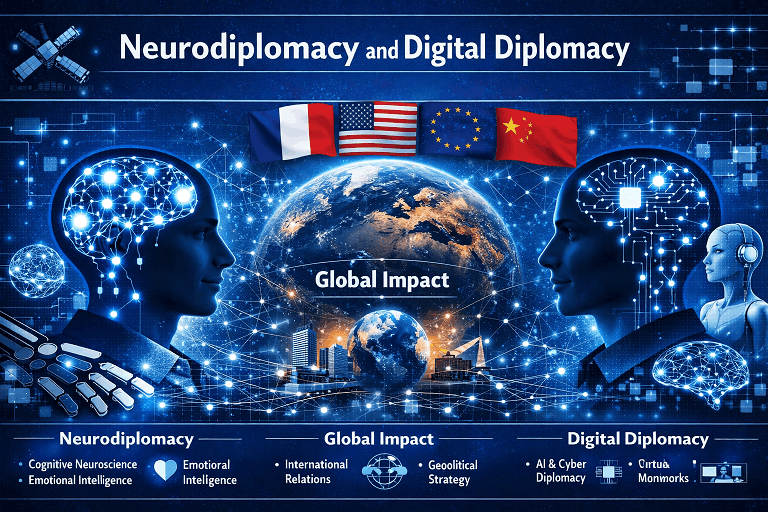
The rapid advancement of digital technologies has fundamentally transformed the practice of diplomacy and international relations. The emergence of social media, artificial intelligence, big data, digital communication platforms, cyber technologies, and virtual diplomatic engagement has given rise to what scholars describe as Digital Diplomacy. At the same time, growing recognition of the importance of cognition, emotion, perception, and decision-making in international politics has contributed to the emergence of Neurodiplomacy, an interdisciplinary framework that integrates diplomacy, cognitive science, neuroscience, political psychology, and communication studies.
Although Digital Diplomacy and Neurodiplomacy originate from different intellectual traditions, they are increasingly interconnected. Digital Diplomacy focuses on how technological innovations transform diplomatic communication and international engagement, while Neurodiplomacy seeks to understand the cognitive and emotional processes that shape diplomatic behavior. Together, these approaches provide a comprehensive framework for understanding diplomacy in an era characterized by technological innovation, information abundance, and complex global challenges.
The intersection of Neurodiplomacy and Digital Diplomacy offers important insights into how states communicate, negotiate, build trust, manage conflicts, and influence international audiences in the digital age.
Understanding Digital Diplomacy
Definition
Digital Diplomacy refers to the use of digital technologies and online communication tools to achieve diplomatic objectives and conduct foreign policy.
It involves the use of:
Social media platforms
Artificial intelligence
Big data analytics
Virtual communication systems
Digital public diplomacy
Cyber diplomacy
Online negotiation platforms
Digital Diplomacy expands traditional diplomatic practices beyond embassies and official meetings, allowing governments to engage directly with foreign publics, international organizations, and global audiences.
Evolution of Diplomacy in the Digital Age
Historically, diplomacy relied on:
Face-to-face negotiations
Official correspondence
Diplomatic missions
Confidential communication channels
The digital revolution has transformed these practices.
Modern diplomats increasingly operate within an environment characterized by:
Instant communication
Global connectivity
Continuous information flows
Public transparency
Social media engagement
As a result, diplomatic communication has become faster, broader, and more interactive.
Understanding Neurodiplomacy
Definition
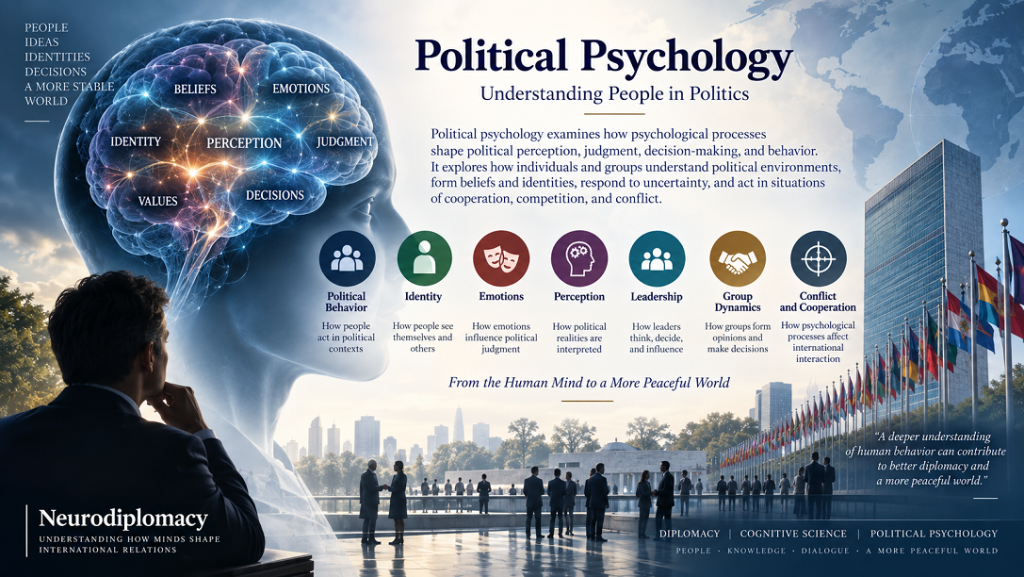
Neurodiplomacy is an emerging interdisciplinary field that explores how cognitive and emotional processes influence diplomacy and international relations.
It combines insights from:
Cognitive Science
Neuroscience
Political Psychology
Behavioral Economics
Communication Studies
International Relations
Neurodiplomacy seeks to understand how leaders, diplomats, and societies:
Perceive international events
Process information
Form judgments
Build trust
Experience emotions
Make decisions under uncertainty
The field recognizes that diplomatic behavior is shaped not only by strategic interests but also by human cognitive and emotional mechanisms.
The Intersection of Neurodiplomacy and Digital Diplomacy
Diplomacy as Information Processing
Both Digital Diplomacy and Neurodiplomacy view diplomacy as a process of information exchange and interpretation.
Digital technologies have dramatically increased the volume of information available to diplomats.
However, the human brain possesses limited cognitive capacities.
Decision-makers must continuously:
Filter information
Prioritize signals
Assess credibility
Manage uncertainty
Neurodiplomacy helps explain how diplomats cognitively process digital information and how psychological factors influence their interpretations.
Information Overload and Cognitive Challenges
One of the defining features of the digital era is information overload.
Diplomats are exposed to:
Continuous news cycles
Social media content
Intelligence reports
Public opinion data
Real-time crisis updates
This environment creates cognitive challenges.
Research in cognitive science demonstrates that excessive information can lead to:
Decision fatigue
Reduced attention
Cognitive shortcuts
Increased susceptibility to bias
Neurodiplomacy provides tools for understanding how diplomats navigate these cognitive constraints in digital environments.
Social Media and Diplomatic Communication
Digital Platforms as Diplomatic Arenas
Social media has become a major instrument of contemporary diplomacy.
Governments increasingly use platforms such as:
X (formerly Twitter)
YouTube
to communicate foreign policy positions and engage international audiences.
Digital diplomacy enables:
Public engagement
Rapid messaging
Crisis communication
International image-building
However, the effectiveness of these efforts depends on how audiences cognitively and emotionally respond to messages.
This is where Neurodiplomacy becomes particularly relevant.
Emotional Dynamics of Digital Communication
Neuroscience and political psychology demonstrate that emotional content often receives greater attention than neutral information. Digital communication frequently relies on emotions. Neurodiplomacy helps explain how the emotional responses influence:
Public opinion
Political attitudes
Diplomatic perceptions
International narratives
Understanding emotional engagement is therefore essential for effective digital diplomacy.
Trust in the Digital Age
The Challenge of Building Trust Online
Trust has always been central to diplomacy.
However, digital communication presents new challenges for trust-building.
Traditional diplomacy benefits from:
Personal interaction
Nonverbal communication
Relationship development
Face-to-face engagement
Digital communication often lacks these elements.
As a result, misunderstandings and misperceptions may increase.
Neurodiplomatic Perspectives on Trust
Research in social neuroscience suggests that trust emerges through:
Repeated interaction
Social understanding
Emotional connection
Perceived credibility
Digital diplomacy must therefore develop strategies that enhance trust despite physical distance.
This requires:
Consistent communication
Transparency
Authenticity
Cultural sensitivity
Neurodiplomacy provides valuable insights into the psychological foundations of trust in virtual environments.
Digital Diplomacy, Perception, and Narrative Competition
Strategic Narratives
International politics increasingly involves competition over narratives.
States seek to influence how global audiences interpret:
Conflicts
Crises
Alliances
International norms
Digital platforms amplify these struggles.
Neurodiplomacy explains why narratives matter.
Human cognition naturally organizes information into stories that provide:
Meaning
Identity
Emotional resonance
Consequently, effective digital diplomacy depends on the ability to construct persuasive narratives that resonate with target audiences.
Perceptual Distortions
The digital environment can intensify perceptual distortions.
Factors contributing to misperception include:
Information manipulation
Echo chambers
Algorithmic filtering
Selective exposure
Neurodiplomacy highlights how cognitive biases influence the interpretation of digital information.
These biases may contribute to diplomatic misunderstandings and international tensions.
Artificial Intelligence, Neurodiplomacy, and Digital Diplomacy
AI-Assisted Diplomacy
Artificial intelligence increasingly supports diplomatic activities.
AI can assist in:
Monitoring public sentiment
Translating languages
Analyzing political trends
Predicting crises
Supporting negotiations
These capabilities enhance digital diplomacy by improving information management.
Human Judgment and Cognitive Intelligence
Despite technological advances, Neurodiplomacy emphasizes that diplomacy remains fundamentally human.
AI cannot fully replicate:
Empathy
Trust-building
Moral judgment
Emotional intelligence
Cultural understanding
Therefore, successful diplomacy requires a partnership between technological tools and human cognitive capacities.
Cybersecurity and Cognitive Security
The New Diplomatic Frontier
Digital diplomacy operates within a complex cyber environment.
Threats include:
Cyberattacks
Disinformation campaigns
Deepfakes
Information warfare
These threats target not only technological systems but also human cognition.
Cognitive Security
Neurodiplomacy introduces the concept of cognitive security, which refers to protecting individuals and societies from manipulation of perception, attention, and decision-making.
Cognitive security has become increasingly important in an era where digital technologies can influence:
Public opinion
Electoral behavior
International perceptions
Political trust
Future diplomacy must therefore address both cybersecurity and cognitive security.
Neurodiplomacy and the Future of Digital Diplomacy
The future of diplomacy will likely involve the integration of digital technologies with insights from cognitive science and neuroscience.
This emerging model may be characterized by:
Technological Capabilities
Artificial Intelligence
Big Data Analytics
Digital Communication
Predictive Modeling
Neurodiplomatic Capabilities
Emotional Intelligence
Trust Building
Cognitive Awareness
Perspective-Taking
Strategic Communication
Together, these capabilities can improve:
International negotiations
Crisis management
Conflict prevention
Public diplomacy
Global cooperation
Conclusion
The convergence of Neurodiplomacy and Digital Diplomacy represents one of the most significant developments in contemporary international relations. While Digital Diplomacy transforms how states communicate and engage in global affairs, Neurodiplomacy explains how human cognition, emotions, perceptions, and social interactions shape the effectiveness of those communications.
In an era of artificial intelligence, social media, cyber threats, and information overload, understanding the human mind has become as important as understanding technology itself. Digital tools can facilitate communication, but successful diplomacy ultimately depends on trust, empathy, credibility, and cognitive understanding.
The future of diplomacy will therefore require not only technological sophistication but also a deep appreciation of the psychological and neurocognitive foundations of human interaction. Neurodiplomacy and Digital Diplomacy together offer a powerful interdisciplinary framework for navigating the complexities of twenty-first-century world politics and global governance.