Introduction
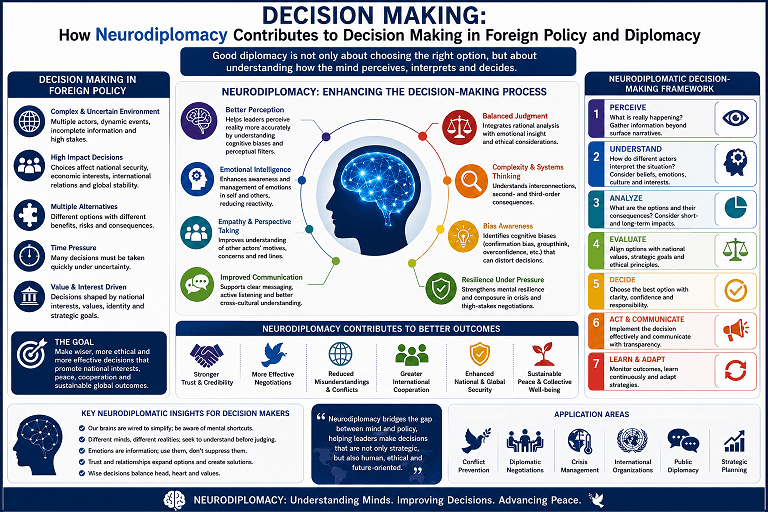
Decision-making lies at the heart of foreign policy and diplomacy. Governments, political leaders, diplomats, and international organizations constantly make decisions concerning war and peace, alliances, negotiations, sanctions, trade agreements, crisis management, and international cooperation. Traditional approaches to international relations often assume that decision-makers act rationally by objectively assessing costs, benefits, and strategic interests. However, research in cognitive science, neuroscience, and political psychology demonstrates that decision-making is rarely purely rational. Instead, it is influenced by perceptions, emotions, cognitive biases, identities, memories, and social interactions.
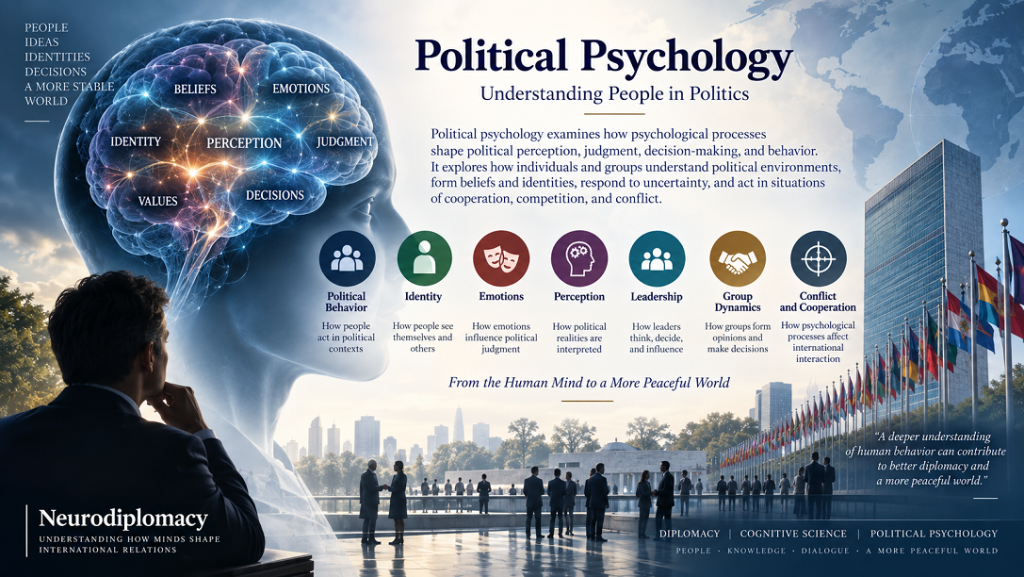
Neurodiplomacy emerges as an innovative interdisciplinary framework that integrates diplomacy, cognitive science, political psychology, and communication studies to better understand how human cognition shapes international behavior. Its central contribution is the recognition that foreign policy decisions are made not by abstract states but by human beings whose perceptions and mental processes influence political outcomes.
By examining how leaders perceive threats, process information, regulate emotions, build trust, and communicate with others, Neurodiplomacy offers valuable insights into improving diplomatic judgment and foreign policy decision-making.
The Human Dimension of Foreign Policy
Traditional realist theories often portray states as rational actors pursuing national interests. Neurodiplomacy challenges this assumption by emphasizing that states act through human decision-makers.
Foreign policy decisions are made by:
Presidents
Prime ministers
Foreign ministers
Diplomats
Military leaders
Policy advisors
These individuals possess:
Beliefs
Emotions
Cognitive limitations
Personal experiences
Cultural backgrounds
Therefore, understanding foreign policy requires understanding the human mind.
Neurodiplomacy shifts the focus from the state as an abstract entity to the cognitive processes of those who make decisions on behalf of the state.
Improving Perception and Situational Awareness
One of the central assumptions of Neurodiplomacy is:
Decision-makers respond to their perceptions of reality rather than to reality itself.
Before leaders make decisions, they must first interpret the international environment.
They assess:
Threats
Opportunities
Intentions
Risks
Strategic signals
However, perceptions are often imperfect.
Neurodiplomacy helps policymakers understand how perceptions are formed and how they influence decisions.
This awareness can improve situational assessment and reduce errors in judgment.
Reducing Misperception
Many foreign policy failures result from misperception.
Leaders may:
Misjudge adversaries’ intentions.
Overestimate threats.
Underestimate risks.
Misinterpret diplomatic signals.
Neurodiplomacy provides tools for identifying and correcting such perceptual distortions.
By encouraging awareness of cognitive limitations, decision-makers can develop more accurate assessments of international situations.
Addressing Cognitive Biases
Research in cognitive science demonstrates that human judgment is affected by systematic biases.
Common biases include:
Confirmation Bias
The tendency to seek information that confirms existing beliefs.
Availability Bias
The tendency to overemphasize recent or highly visible events.
Anchoring Bias
The tendency to rely excessively on initial information.
Overconfidence Bias
The tendency to overestimate one’s knowledge or capabilities.
Groupthink
The tendency of decision-making groups to suppress dissenting opinions.
These biases can distort foreign policy decisions and contribute to diplomatic failures.
Neurodiplomacy promotes awareness of these biases and encourages decision-making processes that incorporate multiple perspectives and critical evaluation.
Enhancing Strategic Thinking
Cognitive Flexibility
One of Neurodiplomacy’s most important contributions is promoting cognitive flexibility.
Cognitive flexibility refers to the ability to:
Consider alternative viewpoints.
Revise assumptions.
Adapt to new information.
Generate multiple policy options.
In international politics, rigid thinking often leads to escalation and diplomatic deadlock.
Flexible decision-makers are more capable of:
Exploring creative solutions.
Identifying opportunities for compromise.
Adapting to changing circumstances.
Thus, Neurodiplomacy enhances strategic adaptability.
Scenario-Based Thinking
Neurodiplomacy encourages policymakers to move beyond single explanations and consider multiple possible futures.
This approach helps decision-makers:
Anticipate uncertainty.
Prepare for unexpected developments.
Avoid strategic surprises.
Such thinking improves long-term foreign policy planning.
Emotional Intelligence in Diplomacy
The Role of Emotions
For many years, emotions were viewed as obstacles to rational decision-making.
Neurodiplomacy challenges this assumption.
Research demonstrates that emotions play essential roles in:
Attention
Judgment
Risk assessment
Motivation
Social interaction
Diplomatic decisions are often influenced by emotions such as: anger, hope, empathy and so on.
Understanding these emotional dynamics can improve decision quality.
Emotional Regulation
Leaders frequently operate under intense pressure.
During crises, emotional reactions may lead to:
Escalation
Miscalculation
Impulsive decisions
Neurodiplomacy emphasizes emotional regulation as a critical diplomatic skill.
Leaders who can manage emotions effectively are more likely to:
Maintain strategic clarity.
Evaluate options objectively.
Avoid unnecessary conflicts.
Strengthening Trust and Cooperation
Trust as a Decision Variable
Trust significantly influences foreign policy choices.
States are more likely to cooperate when they perceive others as:
Reliable
Predictable
Credible
Conversely, distrust often leads to:
Defensive behavior.
Strategic competition.
Conflict escalation.
Neurodiplomacy examines the psychological foundations of trust and provides insights into how trust can be built and maintained.
Empathy and Perspective-Taking
Empathy is often misunderstood as sympathy.
In diplomacy, empathy refers to the ability to understand how others perceive a situation.
Neurodiplomacy encourages leaders to ask:
How does the other side view this issue?
What are their concerns?
What historical experiences shape their perceptions?
Such perspective-taking improves negotiation outcomes and reduces misunderstandings.
Improving Diplomatic Communication
Communication is central to foreign policy.
Diplomatic messages are effective only when they are understood as intended.
Neurodiplomacy contributes by examining:
Message framing
Perception management
Emotional resonance
Narrative construction
This understanding helps policymakers communicate more effectively with:
Foreign governments
International organizations
Domestic audiences
Improved communication reduces the risk of misinterpretation and diplomatic crises.
Crisis Decision-Making
International crises often involve:
Time pressure
Uncertainty
High stakes
Emotional stress
Under such conditions, cognitive biases become more pronounced.
Neurodiplomacy contributes by helping decision-makers:
Recognize stress effects.
Avoid impulsive reactions.
Maintain cognitive flexibility.
Evaluate alternative interpretations.
This can improve crisis management and reduce escalation risks.
Learning and Adaptation
Neurodiplomacy emphasizes that effective decision-making requires continuous learning.
Diplomatic successes and failures provide valuable feedback.
Rather than viewing unsuccessful outcomes simply as failures, Neurodiplomacy encourages policymakers to examine:
What assumptions were incorrect?
What perceptions proved inaccurate?
What communication failed?
What lessons can be learned?
This learning-oriented approach enhances long-term diplomatic effectiveness.
Neurodiplomacy and Foreign Policy Analysis
Neurodiplomacy contributes to foreign policy analysis by integrating multiple levels of explanation:
Individual Level
Cognition
Personality
Emotion
Interpersonal Level
Trust
Communication
Negotiation
Institutional Level
Group dynamics
Organizational learning
International Level
Strategic interaction
Alliance behavior
Conflict and cooperation
This multidimensional perspective produces a richer understanding of foreign policy behavior.
Practical Applications
Neurodiplomacy can contribute to:
Diplomatic Training
Developing emotional intelligence, perception awareness, and communication skills.
Negotiation Strategy
Improving understanding of counterpart perceptions and motivations.
Conflict Resolution
Reducing misperceptions and fostering trust.
Crisis Management
Enhancing decision-making under pressure.
Public Diplomacy
Designing messages that resonate with international audiences.
Strategic Forecasting
Improving anticipation of political behavior and international developments.
Conclusion
Neurodiplomacy makes a significant contribution to foreign policy and diplomatic decision-making by placing human cognition at the center of international relations. It recognizes that decisions are shaped not only by objective interests and material capabilities but also by perceptions, emotions, cognitive biases, identities, and communication processes.
By improving perception, reducing misperception, enhancing emotional intelligence, strengthening trust, promoting cognitive flexibility, and encouraging adaptive learning, Neurodiplomacy provides policymakers with valuable tools for navigating the complexities of contemporary world politics. In an increasingly interconnected and uncertain international environment, the ability to understand how leaders think, perceive, and decide may become as important as understanding military power, economic resources, or geopolitical strategy.
Neurodiplomatic Principle of Decision-Making
The quality of foreign policy decisions depends not only on the information available to leaders but also on how their minds perceive, interpret, evaluate, and communicate that information. Neurodiplomacy seeks to improve diplomacy by improving the human processes through which international decisions are made.