“Revolutions are generally thought of as large-scale, bloody upheavals involving whole countries and societies. But there are quieter revolutions that begin in the individual mind and create the kind of change that may be even more significant.”
Book Information
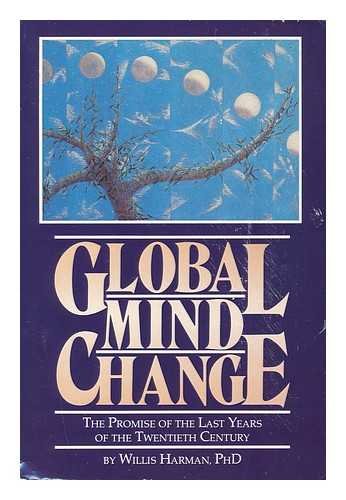
Harman, Willis W. Global Mind Change: The Promise of the Last Years of the Twentieth Century. Indianapolis, IN: Knowledge Systems, Inc., 1988.
Introduction
Global Mind Change: The Promise of the Last Years of the Twentieth Century by Willis W. Harman is a pioneering interdisciplinary work that explores the profound transformations occurring in human consciousness and their implications for society, politics, economics, science, and global governance. Harman, a futurist, social scientist, and former director of the Stanford Research Institute’s Center for the Study of Social Policy, argues that humanity is experiencing not merely political or technological change but a fundamental shift in worldview.
Published during a period of rapid geopolitical, scientific, and cultural transformation, the book challenges the dominance of the mechanistic and materialistic paradigm that has shaped modern civilization since the Scientific Revolution. Harman proposes that many contemporary global crises—including environmental degradation, social inequality, ideological conflict, and institutional dysfunction—reflect the limitations of existing ways of thinking rather than simply failures of policy.
Drawing upon systems theory, psychology, philosophy, spirituality, economics, and futures studies, Harman argues that sustainable solutions require a transformation in collective consciousness. This “global mind change” represents a transition from fragmented, competitive, and reductionist thinking toward more holistic, interconnected, and human-centered approaches to addressing global challenges.
Central Argument
The central thesis of the book is that enduring social and political transformation depends upon a transformation in human consciousness.
Harman argues that the dominant worldview inherited from the industrial era is increasingly inadequate for addressing the complexities of an interconnected world. Rather than relying exclusively on technological progress or institutional reform, societies must reconsider the assumptions, beliefs, and mental models through which reality is interpreted.
According to Harman, genuine global progress requires:
-
A shift from competition toward cooperation.
-
Recognition of global interdependence.
-
Greater appreciation of human potential.
-
Integration of science with ethics and spirituality.
-
Holistic approaches to economic and political development.
The book therefore presents paradigm change as the essential foundation for long-term social transformation.
Major Themes
Paradigm Change
A central theme throughout the book is the concept of paradigm transformation.
Harman argues that civilizations periodically undergo profound shifts in their underlying assumptions about reality. Similar to Thomas Kuhn’s analysis of scientific revolutions, Harman suggests that societies occasionally replace outdated worldviews with new conceptual frameworks better suited to emerging conditions.
The transition from an industrial to an information-based and globally interconnected society requires corresponding changes in human thinking.
Consciousness and Social Change
The book emphasizes that individual and collective consciousness significantly influence political institutions, economic systems, and international relations.
Harman contends that changes in beliefs, values, and perceptions gradually reshape social structures. Consequently, lasting institutional reform cannot occur independently of broader changes in public consciousness.
This perspective places human cognition at the center of historical development.
Systems Thinking
Harman strongly advocates systems thinking as an alternative to reductionist approaches.
Global problems such as climate change, poverty, conflict, migration, and environmental degradation cannot be understood in isolation because they arise from interconnected social, economic, political, and ecological systems.
The book encourages decision-makers to adopt integrated approaches that recognize these complex relationships.
Human Potential
Another recurring theme is the exploration of human potential.
Harman argues that conventional education and organizational structures frequently underestimate creativity, intuition, empathy, and collaborative intelligence.
He suggests that future societies should cultivate not only technical competence but also emotional maturity, ethical responsibility, and personal development.
Theoretical Contributions
Beyond Mechanistic Thinking
One of the book’s greatest contributions is its critique of mechanistic models of society.
Rather than viewing individuals as isolated economic actors, Harman presents human beings as interconnected participants within larger social and ecological systems.
This perspective challenges reductionist approaches that explain political or economic outcomes solely through material variables.
Interdisciplinary Integration
The book successfully integrates insights from multiple disciplines, including:
-
Systems theory.
-
Psychology.
-
Sociology.
-
Economics.
-
Philosophy.
-
Environmental studies.
-
Organizational theory.
-
Futures studies.
This interdisciplinary approach enables Harman to examine global transformation from multiple perspectives simultaneously.
A Vision of Transformational Leadership
Harman proposes that future leaders should possess competencies extending beyond traditional management or political administration.
Leadership should include:
-
Systems thinking.
-
Ethical reasoning.
-
Emotional intelligence.
-
Collaborative decision-making.
-
Long-term strategic vision.
-
Global responsibility.
These qualities remain highly relevant for contemporary governance.
Methodological Strengths
Broad Intellectual Perspective
The book combines conceptual analysis with examples drawn from science, politics, economics, education, and organizational development.
Rather than focusing narrowly on one discipline, Harman develops an integrated framework for understanding global transformation.
Accessible Presentation
Despite addressing complex philosophical and scientific questions, Harman writes with clarity and accessibility.
The book appeals to scholars, policymakers, educators, business leaders, and general readers interested in societal change.
Long-Term Perspective
Unlike analyses limited to immediate political events, Global Mind Change examines long-term historical trends and explores possible future trajectories for human civilization.
This futures-oriented perspective distinguishes the work from many conventional political analyses.
Relevance to International Relations
Although the book is not primarily an international relations text, its implications for global politics are substantial.
Harman suggests that international cooperation increasingly depends upon shared understandings of global interdependence.
His framework encourages policymakers to move beyond purely competitive conceptions of international relations toward models emphasizing:
-
Cooperation.
-
Sustainable development.
-
Shared responsibility.
-
Collective security.
-
Global governance.
These ideas resonate strongly with contemporary discussions of transnational challenges.
Relevance to Cognitive Science
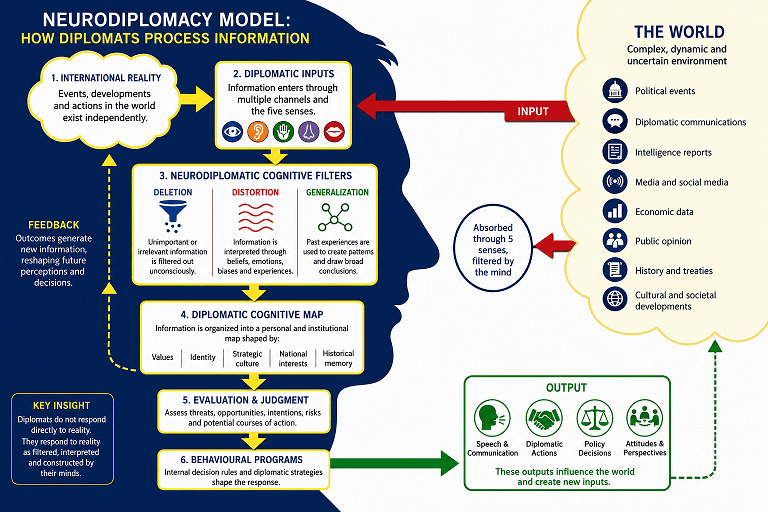
The book holds considerable relevance for cognitive science because it emphasizes how beliefs, mental models, and worldviews shape human behaviour.
Key cognitive themes include:
-
Perception.
-
Belief systems.
-
Learning.
-
Cognitive transformation.
-
Meaning-making.
-
Systems thinking.
-
Human consciousness.
Harman argues that individuals do not merely react to objective reality but interpret events through underlying conceptual frameworks that influence judgment and behaviour.
This perspective aligns with contemporary research on cognitive schemas, mental models, and adaptive learning.
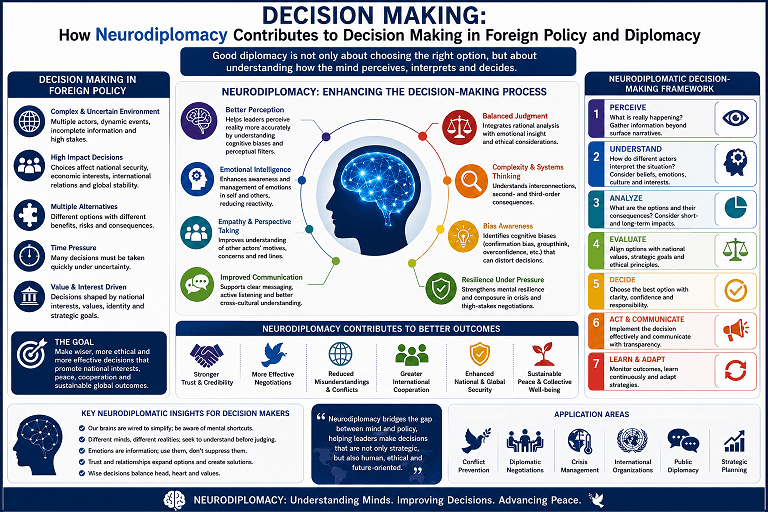
Relevance to Neurodiplomacy
For scholars of Neurodiplomacy, Global Mind Change offers significant conceptual insights.
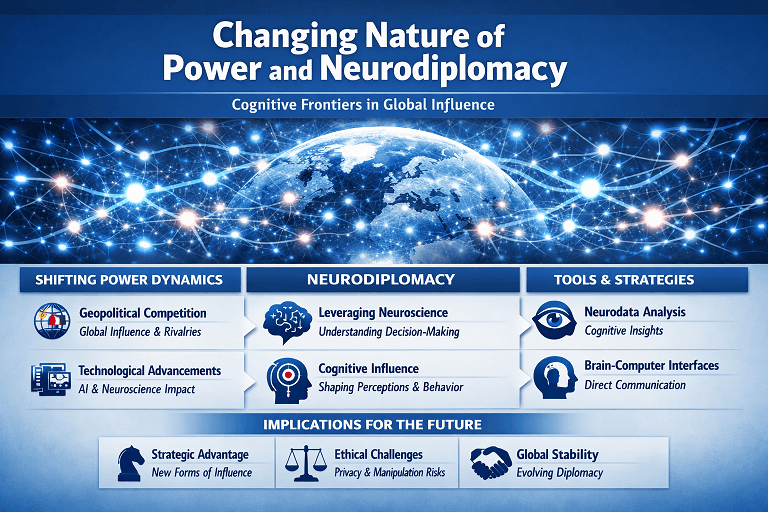
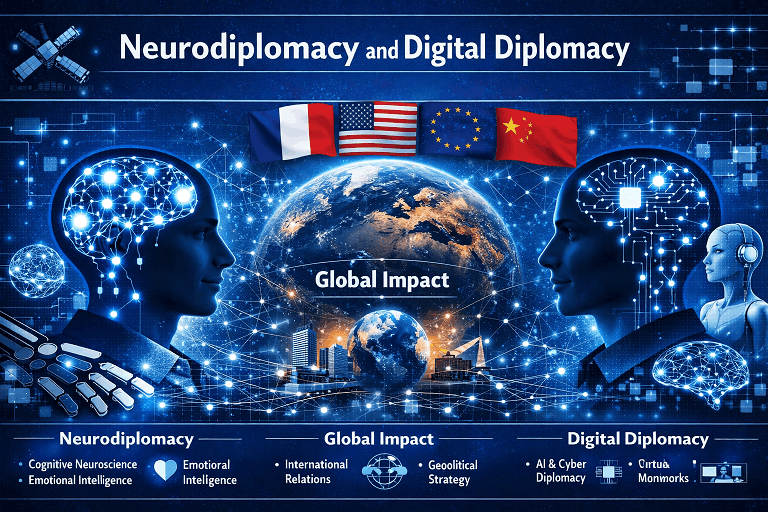
Neurodiplomacy seeks to understand how cognition, emotion, identity, perception, communication, and decision-making influence diplomacy and international relations. Harman’s emphasis on paradigm change and belief transformation complements this perspective by highlighting the cognitive foundations of international behaviour.
Several themes are particularly relevant:
-
Transformation of belief systems.
-
Cognitive framing of international issues.
-
Systems thinking in diplomacy.
-
Global identity.
-
Trust and cooperation.
-
Ethical leadership.
-
Collective learning.
The book suggests that many international conflicts originate not only from competing interests but also from incompatible worldviews and mental models. Consequently, effective diplomacy requires engaging with the cognitive and psychological dimensions of international interaction.
Furthermore, Harman’s vision of evolving global consciousness aligns with Neurodiplomacy’s emphasis on understanding how perception, cognition, and communication shape diplomatic relationships. His work provides an intellectual foundation for exploring how shifts in collective thinking may facilitate international cooperation, conflict prevention, and more adaptive global governance.
Strengths of the Book
Visionary Perspective
The book anticipated many contemporary debates concerning sustainability, globalization, systems thinking, and human-centered leadership.
Several of Harman’s predictions regarding interconnected global challenges remain remarkably relevant.
Interdisciplinary Scholarship
By combining philosophy, psychology, science, economics, and political analysis, Harman provides a comprehensive framework for understanding societal transformation.
Practical Relevance
The book offers valuable insights for leaders confronting complex policy problems that cannot be solved through traditional sector-specific approaches.
Limitations
Conceptual Breadth
The book’s interdisciplinary scope occasionally sacrifices analytical precision. Some concepts remain broad and would benefit from more rigorous empirical operationalization.
Limited Empirical Evidence
Many arguments rely primarily on conceptual reasoning rather than systematic empirical testing.
Future research could strengthen Harman’s framework by incorporating evidence from cognitive science, behavioural economics, neuroscience, and political psychology.
Optimistic Assumptions
Some readers may regard Harman’s confidence in humanity’s capacity for collective transformation as overly optimistic, particularly in light of persistent geopolitical rivalries and institutional constraints.
Nevertheless, these limitations do not diminish the book’s intellectual significance.
Conclusion
Global Mind Change remains one of the most influential explorations of the relationship between human consciousness and societal transformation. Willis W. Harman argues persuasively that the most significant challenges confronting humanity cannot be addressed solely through technological innovation, political reform, or economic growth. Instead, they require a deeper transformation in the beliefs, values, and cognitive frameworks through which individuals and societies understand the world.
The book’s interdisciplinary perspective, emphasis on systems thinking, and vision of global cooperation continue to inspire scholars across multiple disciplines. Its insights are particularly valuable for international relations, leadership studies, cognitive science, political psychology, and emerging fields such as Neurodiplomacy.
For researchers seeking to understand how changes in human perception and collective consciousness influence diplomacy, governance, and international cooperation, Global Mind Change remains an intellectually rich and highly relevant work.
Overall Assessment
A visionary and interdisciplinary exploration of how transformations in human consciousness, belief systems, and collective worldviews shape the future of global society, offering enduring insights for international relations, cognitive science, leadership studies, and Neurodiplomacy.