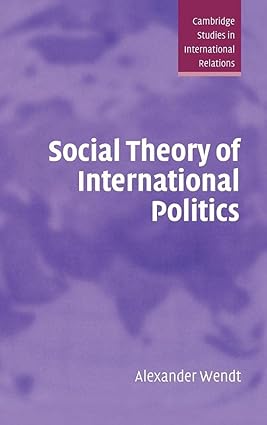
Author: Alexander Wendt
Publisher: Cambridge University Press
Year: 1999
Pages: 429
Introduction
Alexander Wendt’s Social Theory of International Politics is one of the most influential works in contemporary international relations theory and is widely regarded as the foundational text of constructivism. Published in 1999, the book challenged the dominance of realism and neoliberal institutionalism by introducing a social theory of international politics that emphasizes the role of ideas, identities, norms, and shared meanings in shaping state behavior.
Wendt’s central argument is both simple and revolutionary: international politics is not governed solely by material power or objective structures but is socially constructed through interactions among states. By integrating insights from sociology, philosophy, and social theory into international relations, Wendt transformed scholarly debates about power, anarchy, identity, and state behavior.
The book represents a major intellectual turning point in the discipline and remains essential reading for students and scholars of international relations, diplomacy, political psychology, and foreign policy analysis.
Central Argument
The book’s most famous proposition is:
“Anarchy is what states make of it.”
This statement summarizes Wendt’s challenge to realist assumptions about international politics.
Traditional realist theories argue that the absence of a central authority in the international system inevitably produces competition, insecurity, and conflict. Wendt rejects this deterministic view. He argues that anarchy does not possess a fixed meaning; rather, its consequences depend on how states interpret and respond to it.
According to Wendt:
- International structures are social as well as material.
- State interests are not fixed but socially constructed.
- Identities influence behavior.
- Shared ideas shape international outcomes.
- Interaction creates political reality.
Thus, states help create the international environment in which they operate.
Constructivism and Social Reality
The core contribution of the book lies in its development of a constructivist understanding of international politics.
Wendt argues that international reality is not simply given by nature. Instead, it emerges through social interaction.
States develop:
- Shared expectations.
- Common understandings.
- Collective identities.
- International norms.
- Social institutions.
These factors shape political behavior just as significantly as military or economic capabilities.
The book therefore challenges the materialist assumptions of realism and introduces a more comprehensive understanding of world politics.
Identity and State Interests
One of Wendt’s most innovative contributions is his discussion of identity.
Traditional theories typically assume that states possess predetermined interests. Wendt argues that interests derive from identities.
States first answer the question:
“Who are we?”
before answering:
“What do we want?”
National identities influence:
- Foreign policy preferences.
- Alliance formation.
- Threat perceptions.
- Diplomatic behavior.
- International cooperation.
The emphasis on identity has had a profound influence on subsequent scholarship in international relations.
The Social Construction of Anarchy
A major section of the book examines different cultures of anarchy.
Wendt identifies three ideal types:
Hobbesian Culture
States view one another as enemies.
Characteristics include:
- Mutual hostility.
- High insecurity.
- Frequent conflict.
Lockean Culture
States view one another as rivals.
Characteristics include:
- Competition.
- Recognition of sovereignty.
- Limited conflict.
Kantian Culture
States view one another as friends.
Characteristics include:
- Cooperation.
- Collective security.
- Peaceful conflict resolution.
These cultures are not determined by the structure of the international system itself but emerge through historical interaction.
This argument demonstrates how international politics can evolve over time.
Norms and International Institutions
The book emphasizes the importance of norms and institutions.
Wendt argues that institutions are not merely formal organizations; they are shared understandings that guide behavior.
Examples include:
- Sovereignty.
- Diplomacy.
- International law.
- Human rights.
- Collective security.
These institutions persist because states collectively recognize and reproduce them.
The analysis highlights the power of ideas in shaping international relations.
Methodological and Philosophical Contributions
Beyond its substantive arguments, Social Theory of International Politics makes important philosophical contributions.
Wendt seeks to bridge several longstanding debates:
- Materialism versus idealism.
- Structure versus agency.
- Positivism versus interpretivism.
He argues that social reality contains both material and ideational dimensions.
This philosophical synthesis contributed significantly to the development of constructivist methodology and theory.
Relevance to Diplomacy
The book has profound implications for diplomatic studies.
Diplomacy depends heavily upon:
- Shared meanings.
- Norms.
- Identities.
- Communication.
- Trust.
Wendt’s analysis suggests that diplomats do not merely represent national interests; they also participate in constructing international realities through interaction.
Diplomatic dialogue helps create:
- Expectations.
- Relationships.
- Collective understandings.
- International norms.
Thus, diplomacy becomes a mechanism through which international structures are continuously reproduced and transformed.
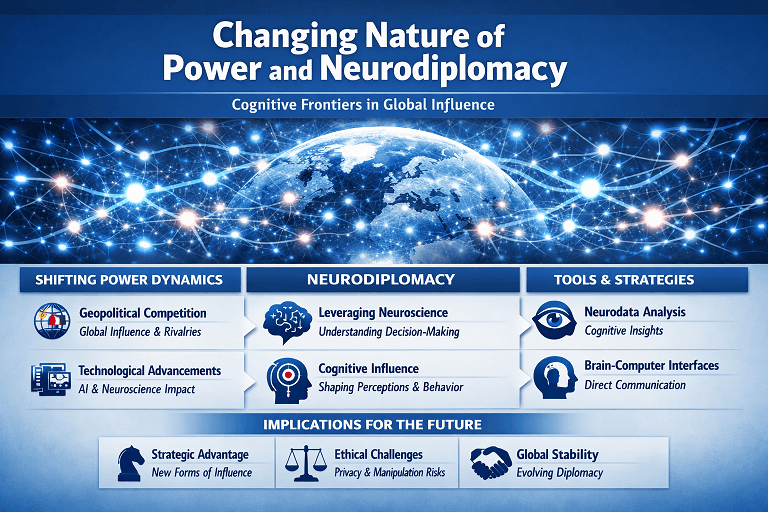
Relevance to Neurodiplomacy
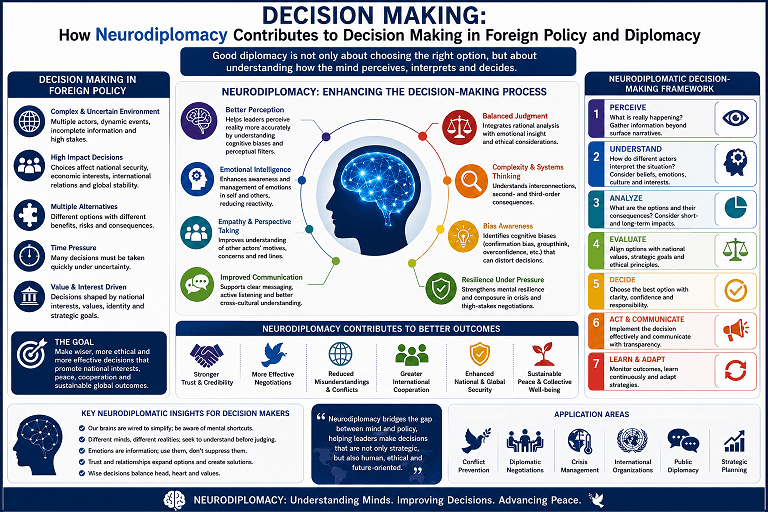
From a Neurodiplomatic perspective, Wendt’s work is particularly important because it highlights the role of perception, identity, and meaning in international politics.
Neurodiplomacy focuses on:
- Cognition.
- Perception.
- Emotion.
- Communication.
- Decision-making.
- Identity construction.
Many of these themes parallel constructivist assumptions.
For example:
- States act according to perceived realities.
- Identities shape interests.
- Communication creates meaning.
- Social interaction transforms behavior.
Neurodiplomacy extends these insights by examining the cognitive and psychological mechanisms through which such constructions occur.
In this sense, constructivism provides an important theoretical foundation for neurodiplomatic analysis.
While Wendt explains how international realities are socially constructed, Neurodiplomacy seeks to explain how those constructions emerge within the minds of leaders, diplomats, and societies.
Strengths
The book possesses numerous strengths.
Theoretical Innovation
It transformed the study of international relations by introducing a social theory of world politics.
Intellectual Influence
Few books have had a comparable impact on contemporary international relations theory.
Interdisciplinary Approach
The integration of sociology, philosophy, and political science enriches the analysis.
Emphasis on Agency
The book demonstrates that international actors can transform political structures.
Relevance to Contemporary Politics
Issues such as identity, norms, and narratives remain central to world politics today.
Limitations
Despite its immense influence, the book has several limitations.
Abstract Language
The theoretical and philosophical discussions can be challenging for readers unfamiliar with social theory.
Limited Attention to Psychology
Although identity and perception are central themes, the book provides little analysis of the cognitive mechanisms underlying these processes.
Underestimation of Material Power
Some critics argue that Wendt places excessive emphasis on ideas at the expense of military and economic factors.
Limited Policy Guidance
The book focuses more on theoretical explanation than practical policy recommendations.
Nevertheless, these limitations do not diminish its significance.
Conclusion
Social Theory of International Politics is one of the most important works in modern international relations theory. By demonstrating that international politics is socially constructed through identities, norms, and shared meanings, Alexander Wendt fundamentally reshaped scholarly understanding of world politics.
The book’s enduring contribution lies in its challenge to deterministic and materialist explanations of international behavior. It reminds scholars and practitioners that international realities are not fixed; they are created and transformed through social interaction.
For students of international relations, diplomacy, political psychology, foreign policy, and Neurodiplomacy, Wendt’s work remains indispensable. Its insights continue to influence debates about identity, norms, cooperation, conflict, and the social foundations of international order.
Overall Evaluation
Overall Assessment: A landmark and transformative work that established constructivism as a major paradigm in international relations and fundamentally altered how scholars understand the relationship between identity, ideas, norms, and international politics.
For a Neurodiplomacy framework, Wendt’s constructivism is especially important because it provides the theoretical basis for the proposition that international reality is not merely material but cognitive and social. Neurodiplomacy extends this argument by examining how perceptions, emotions, identities, and communication processes within human minds contribute to the construction of international political realities.