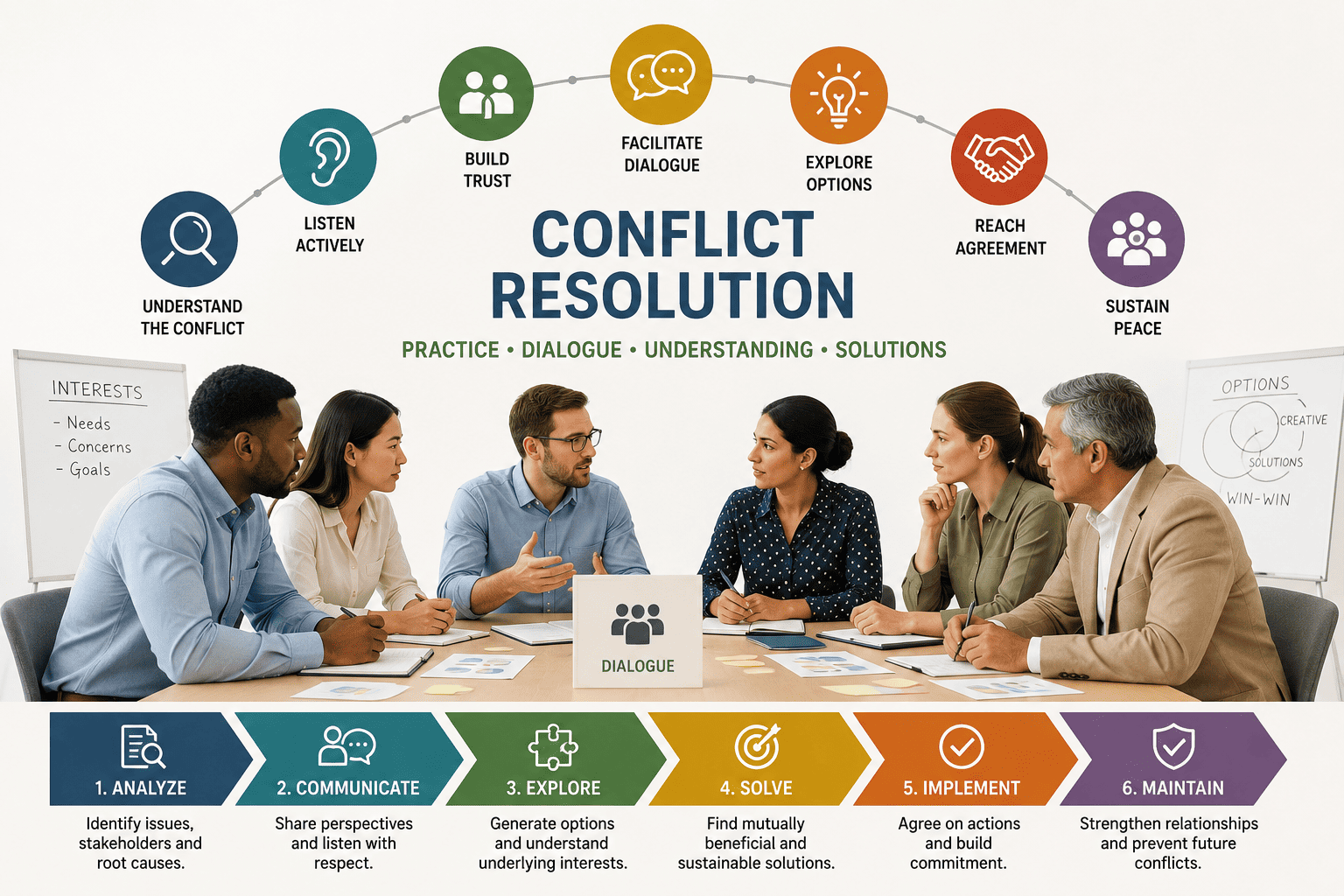
“Conflict Is Not the Problem; How We Manage It Determines the Outcome.”
Tools, Techniques, and Strategies for Managing and Transforming Conflict
4-day (32-hour) practical workshop on Conflict Resolution
Day 1 (8 Hours)
Understanding Conflict and Human Behavior
Session 1
Introduction to Conflict Resolution: Understanding the Nature and Dynamics of Conflict
Practical Exercise: Conflict self-assessment and reflection.
Session 2
Sources and Types of Conflict: Identifying Root Causes
Practical Exercise: Conflict mapping workshop.
Session 3
Perception, Misperception, and Conflict Escalation
Practical Exercise: Multiple-perspective analysis.
Session 4
Communication Barriers and Misunderstandings in Conflict Situations
Practical Exercise: Communication breakdown simulation.
Session 5
Emotions and Conflict: Managing Anger, Fear, and Frustration
Practical Exercise: Emotional regulation techniques.
Session 6
Active Listening and Empathic Communication
Practical Exercise: Listening and feedback drills.
Session 7
Building Trust and Psychological Safety
Practical Exercise: Trust-building activities.
Session 8
Conflict Analysis Laboratory
Practical Exercise: Group analysis of a real conflict case.
Day 2 (8 Hours)
Conflict Management and Resolution Techniques
Session 9
Conflict Styles and Approaches to Resolution
Practical Exercise: Identifying personal conflict styles.
Session 10
Interest-Based Conflict Resolution
Practical Exercise: Separating positions from interests.
Session 11
Questioning and Dialogue Techniques
Practical Exercise: Strategic questioning exercises.
Session 12
Reframing Conflict: Turning Problems into Opportunities
Practical Exercise: Reframing workshop.
Session 13
Managing Difficult Conversations
Practical Exercise: Challenging dialogue role plays.
Session 14
Problem-Solving Strategies for Conflict Resolution
Practical Exercise: Collaborative problem-solving challenge.
Session 15
Negotiation as a Conflict Resolution Tool
Practical Exercise: Negotiation simulation.
Session 16
Conflict Resolution Simulation I
Practical Exercise: Team-based conflict resolution exercise.
Day 3 (8 Hours)
Mediation, Facilitation, and Collaborative Solutions
Session 17
Introduction to Mediation and Third-Party Intervention
Practical Exercise: Mediation process demonstration.
Session 18
The Role of the Mediator: Skills and Responsibilities
Practical Exercise: Mediator role-play practice.
Session 19
Facilitating Dialogue Between Opposing Parties
Practical Exercise: Facilitated dialogue simulation.
Session 20
Managing High-Emotion and High-Stakes Conflicts
Practical Exercise: Crisis communication exercises.
Session 21
Cross-Cultural Conflict Resolution
Practical Exercise: Intercultural conflict scenarios.
Session 22
Consensus Building and Collaborative Decision-Making
Practical Exercise: Consensus-building workshop.
Session 23
Conflict Resolution in Teams and Organizations
Practical Exercise: Workplace conflict case study.
Session 24
Conflict Resolution Simulation II
Practical Exercise: Multi-party mediation exercise.
Day 4 (8 Hours)
Advanced Conflict Resolution and Capstone Simulation
Session 25
Conflict Transformation: Moving Beyond Settlement
Practical Exercise: Designing sustainable solutions.
Session 26
Power, Influence, and Conflict Dynamics
Practical Exercise: Stakeholder and power analysis.
Session 27
Managing Resistance and Difficult Personalities
Practical Exercise: Challenging participant simulations.
Session 28
Restorative Approaches to Conflict Resolution
Practical Exercise: Restorative dialogue circle.
Session 29
Conflict Resolution in Leadership and Diplomacy
Practical Exercise: Leadership conflict scenarios.
Session 30
Lessons from International Conflict Resolution and Peacebuilding
Practical Exercise: Analysis of real-world peace processes.
Session 31
Capstone Preparation: Strategy Development for Complex Conflict
Practical Exercise: Team planning and role allocation.
Session 32
Grand Conflict Resolution Simulation
Practical Exercise: Full-scale conflict resolution and mediation simulation integrating all workshop skills.
Learning Outcomes
By the end of the workshop, participants will be able to:
- Analyze the causes and dynamics of conflict.
- Recognize and manage emotional triggers.
- Apply active listening and empathic communication techniques.
- Reframe conflicts constructively.
- Use negotiation and mediation skills effectively.
- Facilitate dialogue between conflicting parties.
- Build trust and cooperation.
- Resolve workplace, community, organizational, and diplomatic conflicts.
- Manage cross-cultural conflicts.
- Design sustainable conflict-resolution strategies.
This workshop typically dedicates 65–75% of workshop time to practical exercises, simulations, mediation practice, dialogue facilitation, negotiation role plays, and case studies, making it highly suitable for diplomats, mediators, managers, educators, peacebuilding professionals, humanitarian workers, and organizational leaders.